












Age of Hellenism - Ancient World Collection










- Genuine Originals: three silver coins
- Proof: world wonders in gold
- Limited: 2,000 or 5,000 pieces
- Genuine OriginalsHand-struck and once truly circulated among traders
- ProofMirrored fields and matte reliefs in fine gold 999.9
- LimitedFive world wonders with 2,000 pieces each, minted 2026
Total discount in this bundle
410,00 €
- 310,00 € discount on the included products
- 100,00 € promotional discount on the bundle
- 1 x1/200 oz Gold Wonder of the World Colossus of Rhodes 2026 (Mintage: 2,000 | Proof)
- 1 x1/200 oz Gold Aphrodite 2026 (Mintage: 5,000 | Proof)
- 1 x1/200 oz Gold Wonder of the World Temple of Artemis at Ephesus 2026 (Mintage: 2,000 | Proof)
- 1 x1/200 oz Gold Wonder of the World Mausoleum of Halicarnassus 2026 (Mintage: 2,000 | Proof)
- 1 x1/200 oz Gold Wonders of the World Lighthouse of Alexandria 2026 (Mintage: 2,000 | Proof)
- 1 x1/200 oz Gold Wonder of the World Statue of Zeus at Olympia 2026 (Mintage: 2,000 | Proof)
- 1 xSilver Tetradrachm Antiochus I Soter (280-261 BC | Heir of Alexander the Great)
- 1 xSilver Diobol Ionian Griffin of Teos (300-200 BC | Original from Greek Antiquity)
- 1 x1/200 oz Gold Minted Bar Gods of Olympus - Poseidon 2026 (Mintage: 5,000 | Proof)
- 1 xAntique Silver Drachm Alexander the Great (356-323 BC)
 Price alert set
 share
shareCurated collection
The Hellenistic age
Ancient originals and modern strikes, laid out side by side.
A collection usually takes years to grow. This one arrives complete.
10
pieces in this collection
Why as a collection
Put together, not hunted down.
Anyone collecting a subject one piece at a time buys whatever happens to be in stock. Older years, small mintages and strikes from other countries turn up later, or never again.
- One common thread
- The pieces were chosen for a subject, not for what happened to be available.
- A subject closed
- Instead of filling gaps over time, the subject stands whole from the first day.
- No hunting needed
- Gathering what lies together here one piece at a time costs time and attention over years.
What the additions in the name mean.
These terms appear in the article names of the collections. They describe how a coin was made.
- Proof
- The most elaborate way of striking. The die is polished, the field of the coin mirrors, the motif stands matt on top of it.
- Antique finish
- The finished strike is treated afterwards until it looks dark and uneven, like a piece that lay in the ground for a long time.
- High relief
- The motif stands noticeably higher above the field than usual. For that the coin passes through the press several times.
- Partial gilding
- A thin layer of gold is applied to parts of a silver coin so that single areas stand out.
Collecting usually takes years.
Here everything is together on day one.
Different mints, different years, different formats. Gathered one by one, that would be the work of many evenings.
- Pieces
- 10
- Fine weight
- 1.12 g
- Subject
- The Hellenistic age
The Hellenistic Age: Ten Pieces from an Era
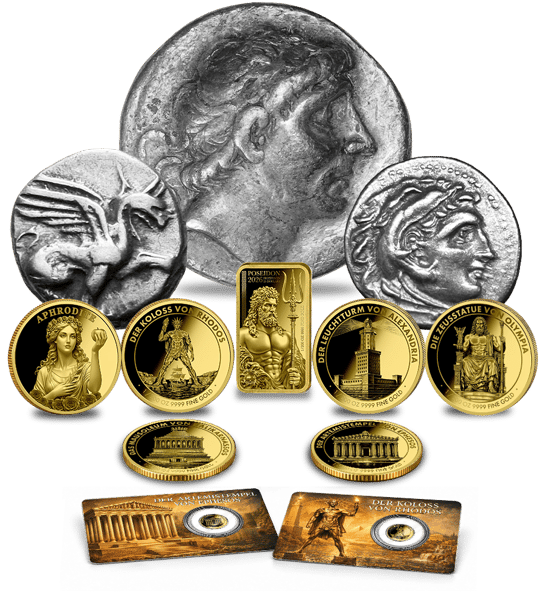
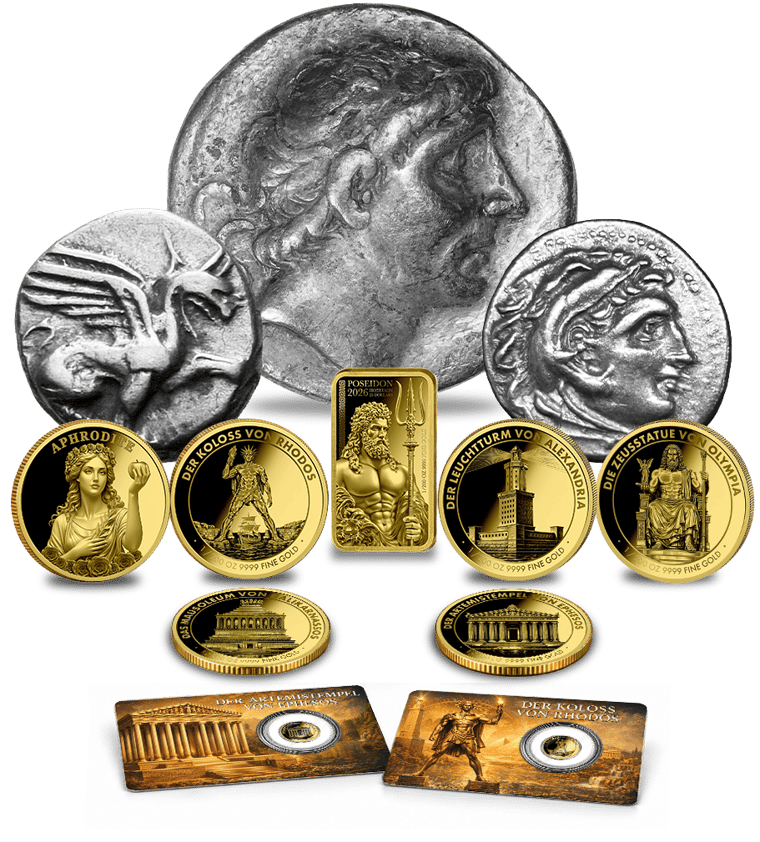
When Alexander the Great died in Babylon in 323 BC, he left behind an empire that stretched from Macedonia to the Indus. He also left behind a culture that would long outlive that empire. The Ancient World Collection "Age of Hellenism" brings this era into your hands. It includes three genuine originals from Greek antiquity in silver, as well as six gold coins and one gold minted bar, depicting the wonders of the world and the gods of that time in the purest fine gold. Hand-struck currency thus sits alongside coins struck in Proof, the highest minting quality.
In total, the collection contains 1.12 g of fine gold (7 × 1/200 ounce) and three historic silver coins. These coins were once genuinely in circulation, passing through the hands of mercenaries, merchants and craftsmen.
What "Hellenism" Actually Means
The term was coined by historian Johann Gustav Droysen in the 19th century. It denotes the roughly three centuries between Alexander's death and the end of Ptolemaic Egypt in 30 BC. During this period, the Greek language, art and Greek currency spread across the entire eastern Mediterranean and far into Asia. The famous list of the Seven Wonders of the World also originated in this era.
Three Ancient Originals in Silver
Collectors seeking ancient silver coins value pieces with provenance and history. This collection contains three of them, each a hand-struck one-of-a-kind:
- Ancient Silver Drachm Alexander the Great (356–323 BC): approx. 4 g in weight, approx. 18 mm in diameter. The obverse shows Herakles wearing the lion's skin, often with Alexander's own facial features. On the reverse, Zeus is enthroned with an eagle and sceptre. In the Greek world, the drachm was the common silver denomination.
- Silver Tetradrachm Antiochus I Soter (280–261 BC): approx. 17 g in weight, approx. 26 mm in diameter, struck according to the Attic standard. Antiochus was the son of Seleucus I, a general of Alexander. The obverse shows him wearing a diadem in a realistic royal portrait, the reverse depicts Apollo seated on the Omphalos of Delphi. The king received his epithet "Soter" ("Saviour") after his victory over the Galatians in the so-called Battle of the Elephants.
- Silver Diobol Ionian Griffin of Teos (300–200 BC): around 1 g in weight and only about 9 mm in diameter. The obverse features the griffin, the heraldic animal of the Ionian port city of Teos. The reverse shows a lyre (chelys). The diobol was small change for the market, making it especially close to people's everyday lives.
With the drachm, tetradrachm and diobol, you own three denominations of the Greek coinage system. The range spans from the large trade coin to the tiny piece used for daily shopping.
A Word on Condition
The historical coins are currency that was once in circulation. Patina, centring, nicks, wear and the legibility of the legends therefore vary from piece to piece, and this is precisely what makes genuine ancient originals so appealing. Detailed information on condition can be found on the respective individual product pages. Mint, year of issue and reverse variant may vary. The image therefore shows only an example, and the delivered specimen will differ in appearance and condition.
Wonders of the World and Gods in Fine Gold
Kettner Edelmetalle had the seven gold pieces produced in Germany. They are issued for the Republic of Liberia with a face value of 25 dollars each. Each piece contains 0.16 g of gold with a fineness of 999.9/1,000 and is struck in Proof with year of issue 2026:
- Colossus of Rhodes, mintage 2,000: The bronze statue of the sun god Helios was created in the Hellenistic period at the harbour entrance of Rhodes.
- Lighthouse of Alexandria, mintage 2,000: The Ptolemies had it built in the city that Alexander himself had founded.
- Mausoleum at Halicarnassus, mintage 2,000: All mausoleums to this day are named after this tomb of Mausolus.
- Temple of Artemis at Ephesus, mintage 2,000: According to tradition, it burned down in 356 BC, on the night Alexander was born.
- Statue of Zeus at Olympia, mintage 2,000: the masterpiece of Phidias, made of gold and ivory.
- Aphrodite, mintage 5,000: the goddess of love with a rose wreath and golden apple.
- Minted bar Gods of Olympus – Poseidon, mintage 5,000: the ruler of the seas with his trident. This piece has a bar shape, but thanks to its face value, it is an official coin.
The five Wonders of the World coins have a diameter of 14 mm. Their reverse depicts all seven Wonders of the Ancient World in medallions surrounding Liberia's coat of arms. The Proof finish creates mirrored fields and frosted reliefs, so that the details stand out sharply even in this small format.
Why a Collection?
Each piece is special in its own right. But as a set, the ten pieces tell a coherent story. It begins with Alexander, followed by his Seleucid heir and an Ionian city during the time of the Wars of the Diadochi. Added to this are the structures that were admired in this world. The World of the Celts Collection follows a similar concept. Here, however, the ancient originals stand alongside modern fine gold.
Anyone seeking as much gold as possible in a single piece is better served by larger denominations. The strengths of this collection lie elsewhere: in its variety, its low mintages, and its combination of numismatics and precious metal.
Gold is humanity's oldest currency and has outlived all others. The silver coins in this collection show just how enduring precious metal is: they were already money when Rome was not yet a world power.
A Tangible Asset with History
Gold and silver have an intrinsic value that does not depend on trust in any institution. For millennia, both metals have served as stores of value and are still valued today for wealth preservation, inflation hedging and crisis protection. The collection fits just as well into a collection of Greek coins as into an existing precious metals portfolio. It also makes a wonderful gift for anyone passionate about history. Shipping is carried out as insured value shipping.
The Collection at a Glance
- Contents: 6 gold coins, 1 gold minted bar, 3 ancient silver coins
- Total fine gold weight: 1.12 g (7 × 1/200 oz, 0.16 g each, fineness 999.9)
- Silver: tetradrachm approx. 17 g, drachm approx. 4 g, diobol approx. 1 g
- Gold: year of issue 2026, Proof, face value 25 dollars each (Liberia)
- Silver condition: ancient circulated coinage, individually varying (details on the individual product pages)
- Condition: new goods
Product depiction may differ from the final product.
