 280,000
  30 years
  Secure






Time Travel Package











 Most Popular Product: Number 1 in category History
- New arrival: Product is new in the shop
- Shipping costs: Free shipping by valuables courier within Germany available
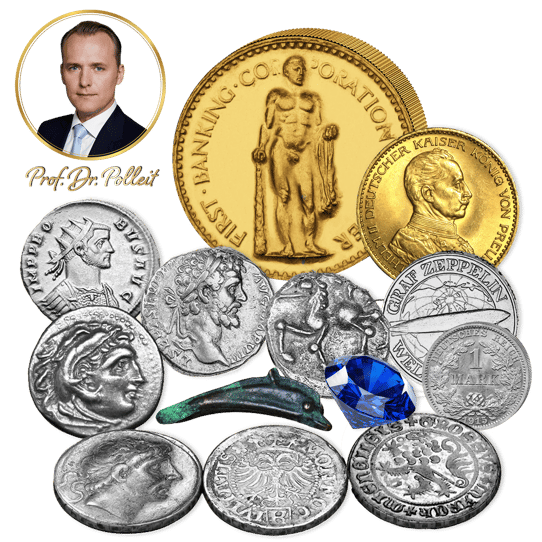
- 1 xBronze Dolphin Money (ca. 5th century BC | Greek Black Sea colony Olbia)
- 1 x3 Reichsmark Graf Zeppelin (1930 | Commemorative Coin for the Round-the-World Flight)
- 1 xSilver Quinarius of the Celtic Vindelici (ca. 1st century BC | Alpine foreland between Lake Constance and the Inn)
- 1 xSilver Fürstengroschen Balthasar of Thuringia (1381-1407 | Knight in the Hundred Years' War)
- 1 xSilver Denarius Emperor Septimius Severus (193-211 AD | Victor over Persia)
- 1 xAntique Silver Drachm Alexander the Great (356-323 BC)
- 1 xSilver Tetradrachm Antiochus I Soter (280-261 BC | Heir of Alexander the Great)
- 1 x1/2 Batzen Silver Free Imperial City of Kempten (1511-1533 | Era of the Peasants' Wars and Reformation)
- 1 x1 Mark Silver Coin Germany German Empire
- 1 x20 Mark Prussia Wilhelm II Gold Coin Uniform
- 1 x1 oz Gold Rothschild Hercules 1954 (n.d.) - 500 Dirhams
- 1 xSilver Antoninianus Emperor Probus (276-282 AD | Age of Germanic Invasions)
- 1 xBlue Sapphire
 Price alert set
 share
shareTime Travel Package: 2,500 Years of Monetary History in One Collection
Imagine holding a drachm bearing the name of Alexander the Great in your hand one evening. Beside it lies a denarius that once changed hands in the Roman Empire, a groschen from the late Middle Ages, and finally a full troy ounce of gold that made monetary history in 1954 in the free port of Tangier. This is exactly what the Time Travel Package offers: twelve historical means of payment and a sparkling blue sapphire. Together they span an arc from Greek antiquity to the middle of the 20th century.
No restrikes, no replicas. Every piece is a historical original.
The Contents in Chronological Order
1 x Bronze Dolphin Money from the Greek Black Sea colony of Olbia (approx. 5th century BC)
1 x 3 Reichsmark Graf Zeppelin (1930, commemorative coin for the round-the-world flight)
1 x Silver Quinarius of the Celtic Vindelici (approx. 1st century BC, foothills of the Alps between Lake Constance and the Inn)
1 x Silver Prince's Groschen Balthasar of Thuringia (late Middle Ages)
1 x Silver Denarius of Emperor Septimius Severus (193–211 AD)
1 x Ancient Silver Drachm of Alexander the Great (356–323 BC)
1 x Silver Tetradrachm of Antiochus I Soter (280–261 BC)
1 x 1/2 Batzen Silver of the Imperial City of Kempten (1511–1533)
1 x 1 Ounce Gold Rothschild "Hercules" 1954 (undated) – 500 Dirhams
1 x Silver Antoninianus of Emperor Probus (276–282 AD)
Blue Sapphire (0.01 g, replica), to be delivered separately in approx. 3–4 weeks
The entire package has a gross weight of 77.45 g. Of this, 58.27 g is the fine weight of precious metal, the majority of which is gold.
Antiquity: Where Coinage Began
Dolphin Money from Olbia: Money in Animal Form
Before the round coin became the standard everywhere, the Greeks also used unusual shapes. In Olbia, a colony of the city of Miletus on the northern coast of the Black Sea, people paid with small bronze dolphins. The dolphin refers to Apollo Delphinios, one of the city's most important gods. The green patina that has formed over roughly two and a half millennia is not a flaw here. Collectors value it as a typical feature of a genuine archaeological find.
Alexander the Great and His Successors
The drachm in the name of Alexander shows the head of Heracles wearing the skin of the Nemean Lion. This coin design spread throughout the entire Hellenistic world and remains famous worldwide to this day. The tetradrachm of Antiochus I Soter leads directly into the era of the successors. Antiochus was the son of Seleucus, one of Alexander's generals, and ruled over an empire stretching from Asia Minor deep into Central Asia. On the reverse, Apollo is typically depicted seated on the omphalos with a bow and arrow. The tetradrachm is the heaviest ancient piece in the set and, with its large flan, a real eye-catcher.
Rome: Emperors, Legions, and Years of Crisis
Septimius Severus led successful campaigns against the Parthians and captured their capital, Ctesiphon. His denarius, with its laureled, bearded portrait, dates from a strong phase of the Roman Empire. The antoninianus of Probus, with its distinctive radiate crown, by contrast leads right into the crisis of the 3rd century. At that time, the emperor pushed the Franks and Alemanni back across the Rhine. Two rulers and two eras show how Roman coinage evolved.
The Celts in the Alpine Foothills
The quinarius comes from the Vindelici, whose center was the large oppidum near Manching. It shows a highly stylized horse on a curved, irregular flan. Celtic coin art seems almost modern: abstract, powerful, and unmistakable. For many collectors from southern Germany, such a piece is also part of their own regional history.
Middle Ages and Early Modern Period: Groschen, Batzen, and the Imperial Eagle
Landgrave Balthasar of Thuringia had his prince's groschen minted from 1393 onwards in Sangerhausen and Freiberg. Typical is the rampant Meissen lion with a small "b" in front of it, the identifying mark of this type of groschen. A good century later, the Imperial City of Kempten minted its half batzen with the double-headed eagle of the Holy Roman Empire. It was a turbulent time, shaped by the Peasants' Wars and the Reformation.
Both coins were hand-struck, and this is visible: individual centering and lively surfaces. Among the silver coins of their era, each specimen is a one-of-a-kind piece.
Empire and Weimar Republic
1 Mark, German Empire: The small silver coin with the imperial eagle in a wreath was the everyday currency of the gold mark era.
20 Mark Prussia, Wilhelm II in Uniform: One of the last imperial gold coins, with 7.17 g of fine gold at a fineness of 900/1000. The inscription reads "WILHELM II DEUTSCHER KAISER KÖNIG V. PREUSSEN." A classic that almost every German collector knows.
3 Reichsmark Graf Zeppelin 1930: The airship floats above the globe, accompanied by the inscription "GRAF ZEPPELIN WELTFLUG 1929." This commemorative coin made of 500 fine silver (15 g, 30 mm) commemorates the round-the-world voyage of the LZ 127. It is one of the most popular designs of the Weimar Republic.
The Centerpiece: The Rothschild Gold Ounce "Hercules"
In 1954, the First Banking Corporation issued a gold coin in the international free port of Tangier that was ahead of its time. It is considered the first gold coin designed for an exact ounce weight, appearing thirteen years before the Krugerrand. The gold was refined by N. M. Rothschild & Sons. On the reverse are the stamp R·M·R of the Royal Mint Refinery and the inscription "ONE FINE OUNCE TROY (GRMS 31.103) OF GOLD ASSAY 916.7."
The obverse shows Hercules leaning on his club. The design alludes to the Pillars of Hercules at the Strait of Gibraltar, on whose southern shore Tangier lies. From around 1960 onwards, a large part of the mintage was melted down again. This is why the Hercules ounce is especially sought after by collectors today.
Why a Set Instead of Individual Coins?
Of course, each of these coins can also be purchased individually. But the appeal of the Time Travel Package lies in the curated selection: you don't have to laboriously search for matching pieces from antiquity, the Middle Ages, and the modern era yourself. Instead, you immediately receive a collection with a clear common thread. A tip for beginners: the set makes an excellent foundation that can later be expanded with individual eras of your choice.
The set is deliberately not a pure investment product like a bar. Here, history, rarity, and the joy of collecting take center stage. Nevertheless, the high gold content ensures solid intrinsic value, making the package interesting for investors with a sense of history as well.
Gold is humanity's oldest currency. It has outlived the drachm, the denarius, the groschen, and the Reichsmark, and remains a benchmark of value to this day.
This collection shows what has distinguished precious metal for millennia. Currencies disappeared, empires crumbled, yet gold and silver remained coveted. As an inflation hedge and crisis protection, people have always trusted physical precious metal. With the Time Travel Package, you literally hold this experience in your hand.
Important Note on Condition and Images
These pieces are circulated means of payment and bear corresponding traces: darker patina, individual centering, nicks, wear, and sometimes weaker areas of the legend. This is precisely what makes them appealing. The year of minting, mint, and reverse variant may vary, so the specimen delivered may differ from the image shown. You will receive an original, not a mass-produced item. Please understand that the image in the shop is only an example. For historical reasons, the delivered item may individually differ from it in appearance and condition.
Please note: The blue sapphire will be delivered separately in approx. 3–4 weeks.
Product depiction may differ from the final product.
