




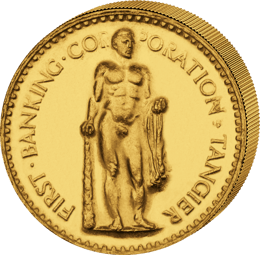

1 oz Gold Rothschild Hercules 1954 (n.d.) - 500 Dirhams







- Monetary History: pioneer of the gold ounce
- London Quality: R·M·R hallmark
- Rarity: most were melted down
- Monetary HistoryRegarded as the first one-ounce gold coin, 13 years before the Krugerrand
- London QualityRefined at the Royal Mint Refinery, recognized worldwide
- RarityOnly a few examples escaped melting around 1960
 Price alert
  Share
ShareThe Rothschild Gold Ounce of 1954: Morocco, 500 Dirhams, a Full Troy Ounce
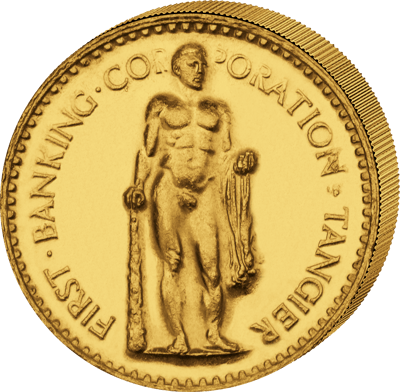
- Design: Hercules depicted in full figure, casually leaning on his club, the lion's skin draped over his left arm – no ruler's portrait, no coat of arms, but pure mythology. The inscription names the issuing institution: FIRST · BANKING · CORPORATION · TANGIER. The reference is deliberately chosen: since antiquity, the Pillars of Hercules have marked the Strait of Gibraltar, on whose southern shore Tangier lies.
- Material / Fineness: Struck in gold with a fineness of 916.67/1,000 – the classic 22 karat. The gross weight is 33.93 g, of which 31.1 g is pure fine gold. The reverse itself attests to this: ONE FINE OUNCE TROY (GRMS 31.103) OF GOLD ASSAY 916.7.
- Manufacturer: Rothschild Bank – refined by N. M. Rothschild & Sons in London. In the inner circle of the die are the three letters R·M·R, for the Royal Mint Refinery.
- Face Value & Year of Issue: 500 Dirhams, minted in 1954, country of origin Morocco.
- Format: 25.50 mm diameter, denomination 1 oz, Brilliant Uncirculated (BU) condition, delivered in a protective coin capsule.
Some coins are collected. Others are weighed. This one is both – and it also happened to make monetary history along the way.
Tangier 1954: The Free Port Where the Troy Ounce Became a Coin
In the 1950s, Tangier was a special case on the map. Administered as an international zone, the Moroccan port city developed into one of the freest trading and gold hubs in the world, while the rest of Morocco remained under Sultan Mohammed V. In 1950, the First Banking Corporation of Tangier began operations there – an institution that openly advocated a return to a gold-backed currency. Four years later, it cast this conviction in metal.
And it did so with radical consistency: the value of this coin is not defined by a monetary unit, but simply by one troy ounce of gold. This is precisely where its historical significance lies. The 1954 500 Dirhams is regarded by many numismatists as the very first gold coin ever designed to the exact ounce weight. It was not until thirteen years later, in 1967, that the South African Krugerrand entered the stage and made the principle world-famous. In international catalogues, this piece is listed today as "Morocco – Tangier, First Banking Corporation" (KM X#12, Lec-297).
Hercules, R·M·R, and the Myth of a Banking House
The reverse dispenses with any ornamentation and resembles a bar stamp: REFINED BY, beneath it the circular hallmark N·M·ROTHSCHILD & SONS. This simplicity is deliberate – here it is not a state that speaks, but a refinery. London dealers therefore promptly nicknamed the issue the "Hercules Ounce".
The three letters R·M·R stand for the Royal Mint Refinery. N M Rothschild & Sons operated this London refinery from 1852 to 1967, processing across generations a considerable share of the gold that flowed to the Thames from all over the world. The RMR mark was internationally recognised and regarded as a hallmark of quality by both central banks and private buyers. Whoever holds this coin therefore holds a piece of London's gold market history – carried by a name that, like almost no other, stands for discretion, foresight, and quality.
Another reason for its rarity today: from around 1960 onward, a large part of the original mintage was withdrawn and melted down. Many of the few surviving examples resurfaced decades later from Swiss bank holdings – known in the trade as the "Swiss Bank Hoard".
Rothschild Ounce and Krugerrand in Direct Comparison
A comparison with the most famous of all bullion coins is only natural, since both share one decisive feature: 22 karat. Yet their roles could hardly be more different.
- Same alloy, same fine weight: Both contain exactly 31.1 g of fine gold at a gross weight of around 33.93 g. The copper content makes the metal more durable and gives it its warm, slightly reddish tone.
- The Krugerrand: minted in the millions, instantly tradable worldwide, with a narrow trading margin. The obvious choice when weight alone is what matters.
- The Rothschild Gold Ounce: a historical original from 1954, surviving in a limited quantity. Here, alongside the metal value, it is above all the numismatic history that counts – a genuine collector's item.
- Our verdict: The Krugerrand is the workhorse, the Tangier Ounce the eyewitness to history. Whoever owns both covers two very different facets of the same metal.
Gold: The Store of Value That Has Outlived Every Currency
For more than 6,000 years, gold has served as a store of value. Even in ancient Egypt it was a benchmark in trade; later, kings and emperors wore it as a sign of their power, and for long stretches of the 19th and 20th centuries, states tied their currencies directly to the metal under the gold standard. No paper currency has ever achieved a comparable lifespan. That is precisely why investors value physical gold coins as an inflation hedge and as tangible crisis protection.
Gold is humanity's oldest currency – and the only one that has never reached a value of zero.
Supply is limited, the metal is imperishable, and its intrinsic value is independent of trust in any government. While fiat money can be printed and controlled by central banks, an ounce of gold cannot be created by decree. One telling detail underscores this: the world's largest gold holders are, of all institutions, the central banks themselves. They hold the metal as a reserve to support their financial systems – a clear signal about the level of trust placed in their own paper currency.
Added to this is its tax treatment: in Germany, investment gold is generally exempt from VAT, and profits from the sale of physical gold are usually tax-free after a holding period of at least one year. Gold also remains liquid worldwide, can be used as a medium of exchange at any time, and protects its owner against the gradual erosion of purchasing power.
Who This Gold Ounce Is Suited For
This coin appeals equally to collectors of historic gold coins and to investors looking to add a piece with genuine history to their holdings. It combines the intrinsic value of a full troy ounce with an origin that is truly one of a kind: an international zone that has long since become history, a bank with a bold vision, and the most famous name in European finance. And because gold retains its lustre across millennia, a piece like this can later be passed on quite naturally to the next generation.
Product depiction may differ from the final product.
