





Silver Denarius Emperor Septimius Severus (193-211 AD | Victor over Persia)
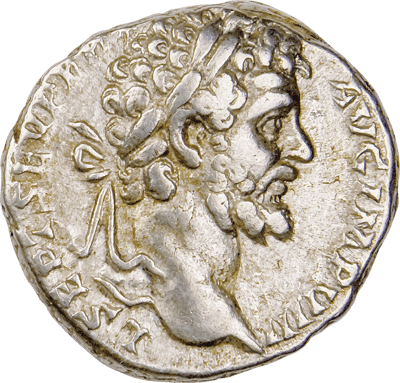











- Genuine Original: around 1,800 years old
- Emperor Portrait: founder of a dynasty
- Gift: with real history
- Genuine OriginalStruck by Roman mint masters with hammer and die
- Emperor PortraitLaureate head of the emperor on the obverse
- GiftA piece of the Roman Empire to give and pass on
 Price alert
  Share
ShareAncient original
The Roman empireDenarius of Septimius Severus
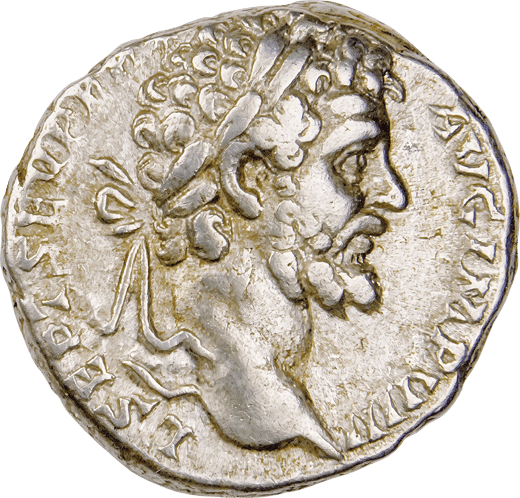

You are looking at the front.
Between the day someone struck this piece with a single hammer blow and the day you hold it, there are roughly
1,800years
- Struck by hand
- Original, not a restrike
- approx. 18 mm across
- 30 days return policy
Where it belongs
Eleven epochs, a thousand years, one shelf.
For more than two hundred years the denarius was the leading currency of the Mediterranean and paid for the army and administration of an empire reaching from Scotland to the Euphrates. Under Augustus a legionary earned 225 denarii a year. On the reverse the emperor advertised himself: his victories, his piety, his wife.
7th to 5th century BC
Archaic Greece
5th to 4th century BC
Classical Greece
6th century to 330 BC
Achaemenid Persia
5th to 2nd century BC
Carthage
336 to 30 BC
The hellenistic age
3rd to 1st century BC
Celtic tribes
27 BC to AD 235
The Roman empire
Your piece
AD 235 to 284
Crisis of the third century
AD 284 to 313
The tetrarchy
AD 306 to 363
The Constantinian dynasty
AD 395 to 1453
The eastern Roman empire
Keeping it
First things first: do not clean it.
The dark layer on bronze and the matte grey on silver are called patina. It has grown over centuries and collectors treat it as a mark of authenticity. Polishing it away does not give you a nicer piece, it gives you a damaged one: auction houses regularly value a brightly cleaned coin below the same coin with its patina intact.
Hold it by the edge
Fingerprints contain acid and salt. Take the piece between thumb and forefinger by the rim, over a soft surface.
Store it dry and dark
Moisture is the only real enemy. A pouch or a capsule in a dry place is enough; PVC sleeves are not, they attack the surface.
No agents, no brush
No vinegar, no silver cloth, no ultrasound. If you want a crust removed, let a conservator do it, not the kitchen sink.
Emperor Septimius Severus (193–211 AD): Hand-Struck Denarius from the Roman Empire
This denarius is genuine silver from the hands of Roman mint masters – struck under an emperor who extended the Empire in the east as far as the Euphrates and Tigris. You are not holding a modern mass-produced item, but an original that circulated some 1,800 years ago as soldiers' pay, market money and tax payment throughout the Roman Empire. An ancient coin, tangible asset and historical document all in one.
The Self-Made Man from Leptis Magna
Lucius Septimius Severus was born in 146 AD in Leptis Magna, in present-day Libya. As governor of Pannonia, he was proclaimed emperor by his Danube army in April 193. By 197 he had prevailed over all rivals and founded the Severan dynasty. His 18-year reign relied on the army – he doubled the soldiers' pay in 197. A decision with far-reaching consequences for coinage, since the enormous sums had to be paid out in silver. At his side stood Julia Domna, with whom he had two sons: Caracalla and Geta. The empress and the princes also appear on their own denarii – collectors can assemble an entire family.
Expansion in the East: Ctesiphon, Parthicus Maximus, Mesopotamia
Hardly had the civil war been decided when Severus marched east. In 197/198 he led his great Parthian campaign, conquered the residence city of Ctesiphon, and in January 198 assumed the victory title Parthicus Maximus – a title that also appears on coin legends. The new province of Mesopotamia secured the eastern frontier. In Rome, the Arch of Septimius Severus on the Forum Romanum still commemorates this triumph today: its relief decoration shows sieges and captured Parthian warriors, while the river deities Euphrates and Tigris frame the side arches. Some reverses even depict this monument itself – architecture in miniature.
Designs and Legends
The obverse regularly shows the laureate head of the emperor facing right, surrounded by legends such as L SEPT SEV PERT AVG IMP, SEVERVS PIVS AVG or SEVERVS AVG PART MAX. The reverses are pleasingly varied: Victoria, Virtus with spear and shield, Mars, war trophies, Providentia, Africa wearing an elephant headdress, or Profectio and Adventus scenes depicting the ruler's departure and return. Coins were minted chiefly in Rome, the principal mint, and additionally, during the war years, at eastern workshops such as Alexandria, Emesa and Laodicea ad Mare. The types are still classified today according to the standard reference work Roman Imperial Coinage (RIC).
Technical Details at a Glance
- Denomination: Denarius – the most common silver denomination of the imperial era
- Country: Roman Empire
- Precious metal: Silver; fineness not specified due to historical circumstances
- Gross weight: approx. 3.2 g
- Diameter: approx. 18 mm
- Year of issue: various, 193–211 AD
- Manufacturer: various (ancient Roman mints)
- Production: hand-struck, using die and hammer
- Condition: circulated coinage, grade varies
A word on the silver content: under Septimius Severus, the fineness of the denarius was significantly reduced – numismatic references cite around 50 percent for his reign, with some later issues falling below that. Because the year of issue and mint vary, we deliberately do not specify a fixed fineness. The metal is silver, the alloy is ancient.
Condition: Traces of 1,800 Years
These pieces are circulated currency and bear corresponding traces: darker patina, individual centering, nicks, wear, and in places weaker areas of the legend. This is precisely what makes them appealing. Since the year of issue, mint and reverse variant may vary, the piece delivered will differ from the image shown – you receive an original, not a mass-produced item. Please understand that the image in the shop serves as an example and may differ individually from the item delivered in terms of appearance and condition due to historical circumstances. Each of these coins was struck by hand.
Our care tip: do not clean, do not polish. The patina that has developed is part of the coin and protects its surface. It is best to handle the coin only by its edge, and to store it in a dry place – this way, its character will be preserved for generations.
Ancient Silver Coins as a Tangible Asset
Ancient silver coins combine the joy of collecting with the concept of tangible assets. Silver has been a monetary metal, a store of value, and a symbol of wealth and prestige for thousands of years – this denarius is the best proof of that. For inflation protection and as crisis protection, investors value the metal's intrinsic worth, its high liquidity, limited availability, and robust industrial demand from electronics, solar and medical technology.
- Physical tangible asset, independent of trust in fiat money
- Small, divisible, and traded worldwide as a commodity
- Profits from the sale of silver are generally tax-free, provided the holding period is at least one year
- Durable: silver retains its physical properties over centuries – this coin proves it
- Suitable for passing on wealth across generations
Comparison: Denarius, Antoninianus and Modern Bullion Coin
A denarius of Marcus Aurelius or Trajan contains more fine silver, but in good condition usually costs significantly more. The antoninianus, introduced by Caracalla in 215, appears larger but is poorer in silver; under emperors such as Gallienus, the silver content dropped drastically. Modern bullion coins, in turn, offer 999 fine silver, exact weights and mint-fresh quality – but no biography. The Severus denarius sits appealingly in between: an affordable entry point into antiquity, a wide range of designs, and each piece a unique item with a name, a face and a date.
Gold and silver are humanity's oldest currencies. This denarius has outlived emperors, wars, empires and countless paper money systems – and today it lies in your hand.
Ideal for those starting out in ancient numismatics, as a gift with genuine history, and as a tangible building block of a broadly diversified precious metals collection. Shipping is carried out as insured value shipping.
Product depiction may differ from the final product.
