
 280,000
  30 years
  Secure


1/2 Batzen Silver Free Imperial City of Kempten (1511-1533 | Era of the Peasants' Wars and Reformation)













 Popular Product: Among the top 5 in category Small Coins
- Collector coin: Especially interesting for collectors
- Secure shipping: 100% insured & anonymous delivery
 Price alert set
 share
share
Personal consultation
Get free advice from one of our precious metals experts - we look forward to your call!
A Half Batzen from Kempten: Silver That Survived the Peasants' War
Some coins are beautiful. This one is something rarer: a witness to its time. The 1/2 Batzen of the Imperial City of Kempten was hammered between 1511 and 1533 – in those very decades when Luther's theses spread through the Empire, the peasants of the Allgäu rose up in revolt, and Kempten finally broke free from the rule of its Prince-Abbot. Whoever holds this small piece of silver in their hand is holding an original from the Holy Roman Empire of the German Nation. No restrike, no copy: genuine money from a Swabian free city.
The Coin at a Glance
- Face value: 1/2 Batzen (Half Batzen), reckoned at 2 Kreuzer
- Material: silver, fineness varies – alloy typical of regional coinage of the period
- Gross weight: approx. 2 g
- Diameter: 21.5 mm
- Years of minting: 1511 to 1533, year of issue varies
- Issuer: Imperial City of Kempten, Holy Roman Empire of the German Nation
- Technique: hammered coinage on a round, slightly irregular planchet
- Condition: circulated coin, condition varies
Double-Headed Eagle, Three Coats of Arms, and the Letter K
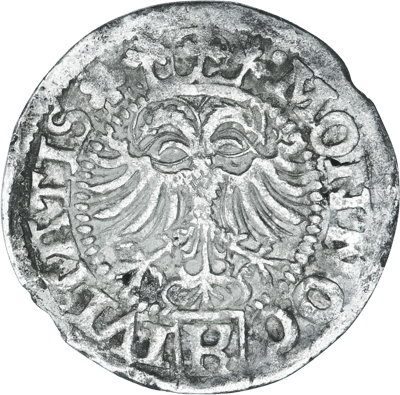
One side shows the crowned, nimbate double-headed eagle of the Empire, beneath it a small shield bearing the letter K – the abbreviation for Campidona, Kempten. The legend names the issuer: MON(eta) NO(va) CIVITATIS, continued on the reverse with CAMPIDONENSIS and the year. There, the three-part coat of arms of Austria, Burgundy, and Tyrol is displayed. This is no coincidence: Kempten depended on Habsburg coinage silver, and Emperor Maximilian I explicitly confirmed the city's minting rights in 1514. Politics, economics, and heraldry, all on 21.5 millimeters.
Minted at a Turning Point in History
In 1525, the conflict in the Allgäu escalated. The Prince-Abbot fled from the rebellious peasants behind the city walls – and the citizens seized the opportunity: for 30,000 guilders, they bought out all his remaining rights in the imperial city in what became known as the "Great Purchase." Kempten was free. Shortly afterward, the Reformation took hold here. It was in precisely these years that half batzen like this one passed from hand to hand: at weekly markets, at customs posts, in weaving rooms, and in taverns.
Gold and silver are humanity's oldest currencies. Empires, princes, and paper money systems have come and gone – this piece of silver is still here.
What Was a Batzen Actually Worth?
The Batzen emerged at the end of the 15th century, first minted in Bern in 1492, and quickly spread throughout the Swiss Confederation and southern Germany. One Batzen was worth four Kreuzer, or one-fifteenth of a guilden; the Half Batzen accordingly corresponded to two Kreuzer. This denomination thus ranked between the Pfennig and the Thaler – everyday money for small and medium transactions; the Kempten Half Batzen is also catalogued as one-sixtieth of a Thaler. After the first half of the 16th century, southern German Batzen coinage came to an end. Surviving pieces are therefore witnesses to a concluded era of coinage, during which numerous cities still minted their own money.
Condition: Circulated Coinage with a Story
These pieces are circulated coinage – and they look the part. Darker patina, individual centering, small nicks, wear, and in places weaker legend impressions: these are not flaws but biography. Every trace comes from hands that, centuries ago, used these coins to settle payments for goods, freight, or debts.
Since the year of minting, mint, and reverse variant can vary, the piece delivered may differ from the image shown. Please understand the photo in the shop explicitly as a representative image: appearance, exact weight, and condition vary from piece to piece for historical reasons. You are acquiring an original.
Silver: A Tangible Asset with a Past and a Present
Historical silver coins combine two motives that rarely align so clearly: numismatic passion for collecting and the sober desire for a tangible asset. Silver possesses an intrinsic value derived from its physical properties and worldwide demand – electronics, solar technology, medical technology, and jewelry consume the metal year after year. Supply is limited, the metal is durable, and unlike fiat money, it does not depend on trust in a government.
- Value preservation across generations: silver does not age and can be passed down within the family.
- Inflation hedge: as a scarce tangible asset, silver has traditionally served to protect purchasing power.
- Crisis protection: small silver denominations have always been sought after as a means of exchange for manageable transactions.
- Tax aspect: profits from the sale of silver are generally tax-free, provided the holding period is at least one year.
- Entry point: compared to gold, silver is often more affordable, making it easily accessible for private collectors as well.
Who This Half Batzen Is Suited For
Compared with modern bullion coins such as the Maple Leaf or the Vienna Philharmonic, the Kempten Half Batzen naturally contains little fine silver – its appeal lies elsewhere. It is a collector's item with substance. Anyone who collects Old German coinage, who has a fondness for Swabian city history, who gathers coinage from free imperial cities, or who simply wishes to own a genuine piece of the 16th century will find this appealing. This coin also makes an excellent gift, for instance for people with a connection to the Allgäu: half a millennium of history in the palm of one's hand carries more weight than any certificate.
In short: an approximately 500-year-old original made of silver, minted during one of the most turbulent phases of German history – and to this day, quite literally, tangible.
Product depiction may differ from the final product.
