





3 Reichsmark Graf Zeppelin (1930 | Commemorative Coin for the Round-the-World Flight)
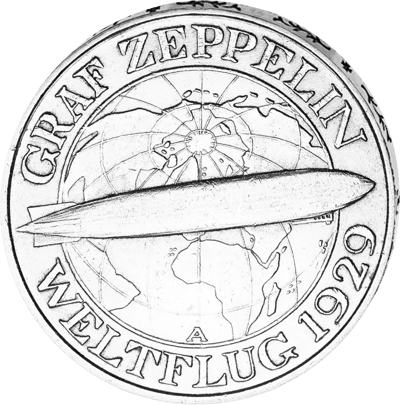
- Bold Design: Airship over the Earth
- Six Mints: complete the series
- True Time Witness: once real money
- Bold DesignDesigned by Franz Paul Krischker, sleek and modern
- Six MintsFrom A for Berlin to J for Hamburg, every mark counts
- True Time WitnessWith its own patina and traces from the Weimar Republic











- Bold Design: Airship over the Earth
- Six Mints: complete the series
- True Time Witness: once real money
 Price alert
  Share
Share
Original from the Weimar Republic · 1930
What a Reichsmark bears
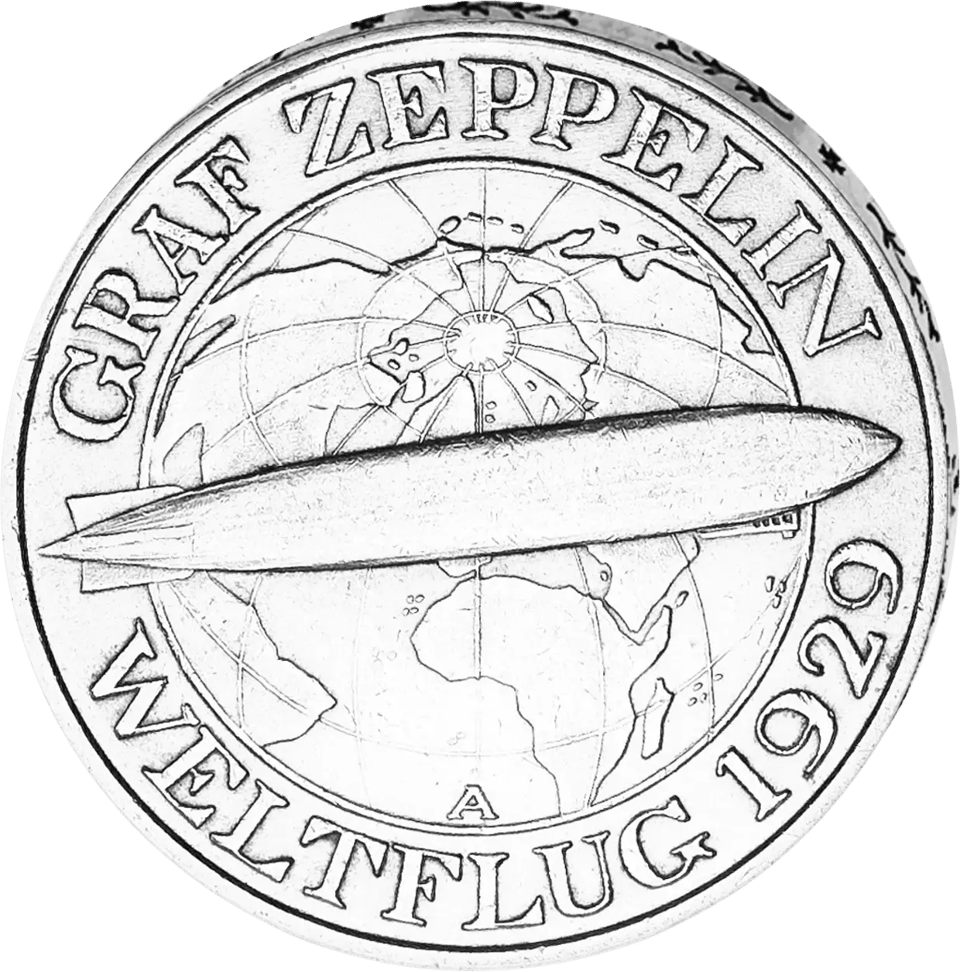
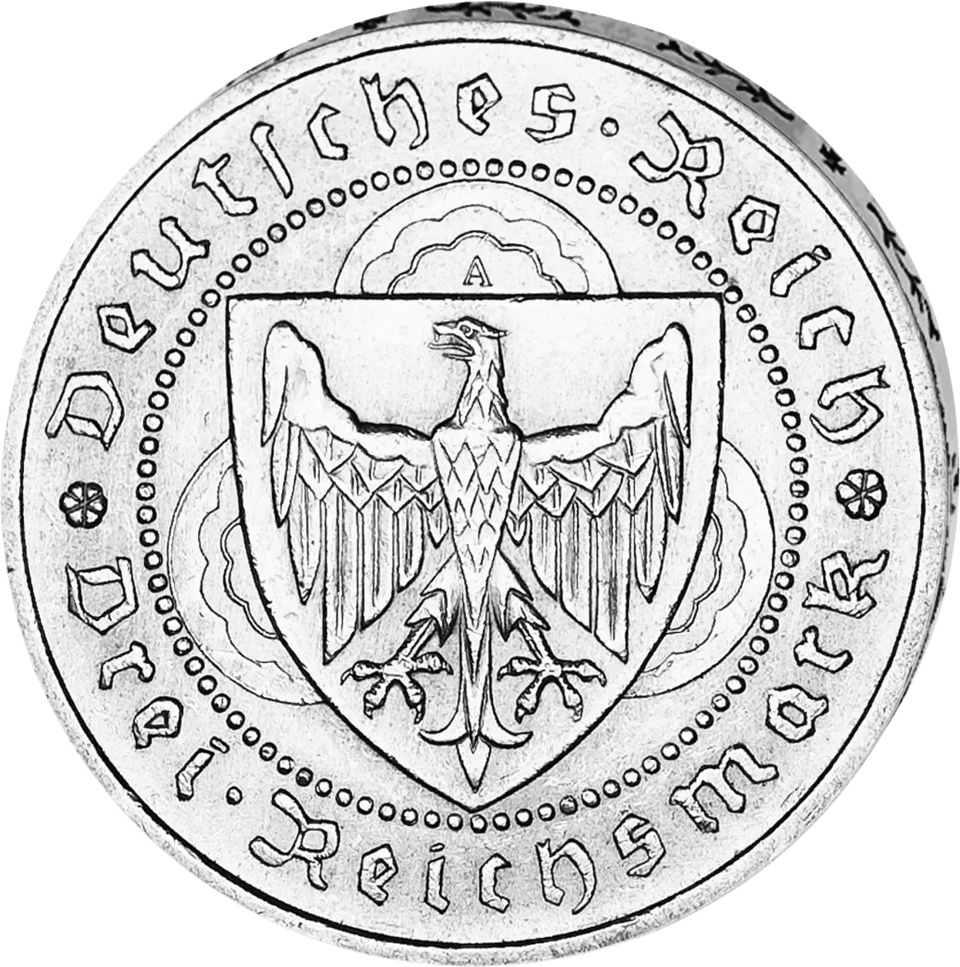
3 Reichsmark Graf Zeppelin 1930, picture side
The Reichsmark existed from October 1924. Its commemorative coins of three Reichsmark bear a picture of their own on one side and the value on the other. This coin commemorates the world flight of the airship Graf Zeppelin in 1929.
On the piece
A value side and a picture of its own
Each of these coins bears Deutsches Reich and the value, 3 Reichsmark. One side bears a picture of its own.
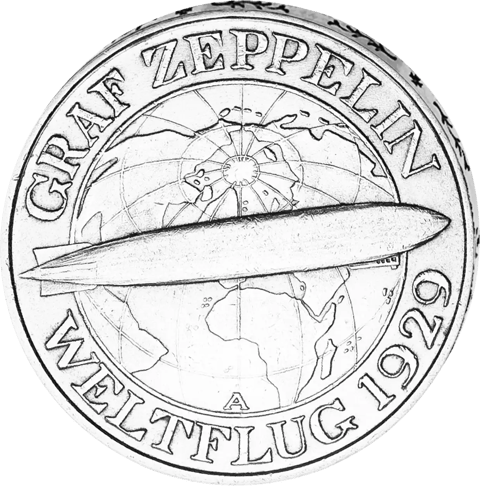
Here the airship flies before a globe, GRAF ZEPPELIN above, WELTFLUG 1929 below.
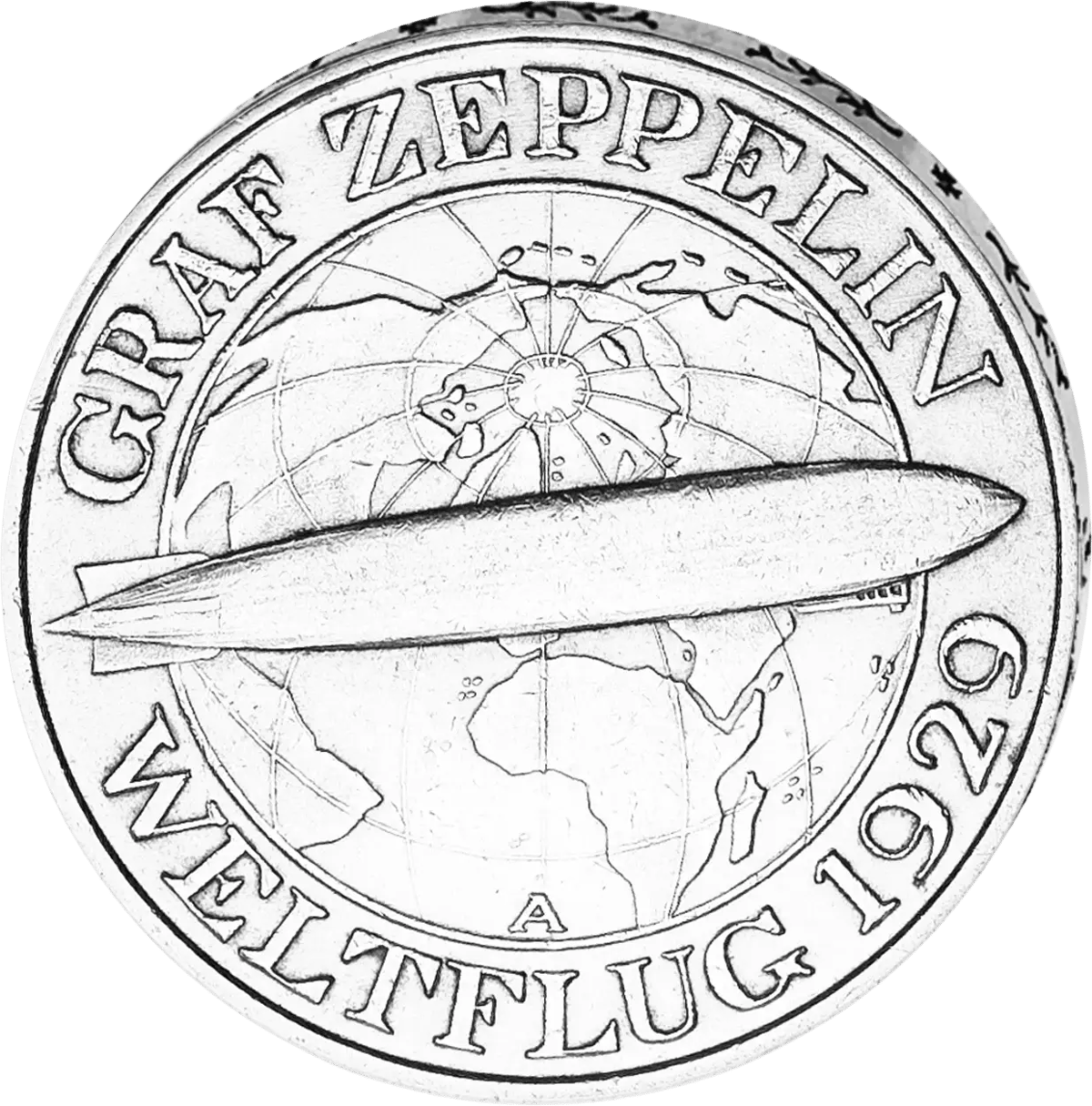
World flight 1929WELTFLUG 1929, below in the arc

Rentenmark and Reichsmark
From the Rentenmark to the Reichsmark
In the autumn of 1923 the Rentenbank was founded. Its Rentenbank notes were issued in a new money:
“The unit of value of these Rentenbank notes is the Rentenmark, which is divided into 100 Rentenpfennig.”
15 October 1923
Decree on the founding of the Rentenbank.
8 November 1923
A decree allows coins of 1, 2, 5, 10 and 50 Rentenpfennig.
30 August 1924
The coinage act introduces the Reichsmark.
October 1924
The Reichsbank issues the Reichsmark alongside the Rentenmark, one to one.
June 1948
The Deutsche Mark replaces the Reichsmark.

Weimar commemorative coins
Three Reichsmark for an occasion
The commemorative coins of 3 Reichsmark are made of silver, 500/1,000, weigh about 15 grams and measure 30 millimetres.
“The commemorative coins for the world flight of the airship ‘Graf Zeppelin’ in 1929 were struck in 1930 at all German mints in 3- and 5-mark size with different edges.”
Design and dies were made by the Berlin medallist Franz Krischker.
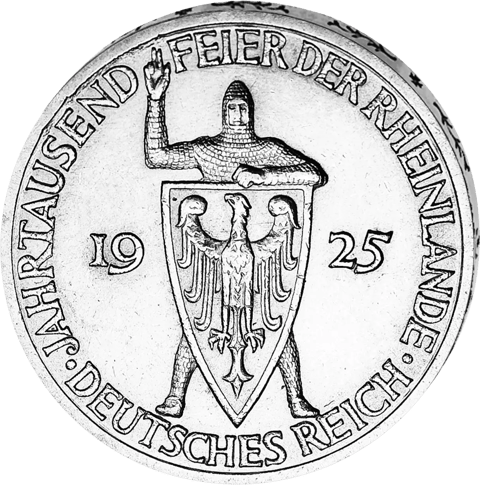
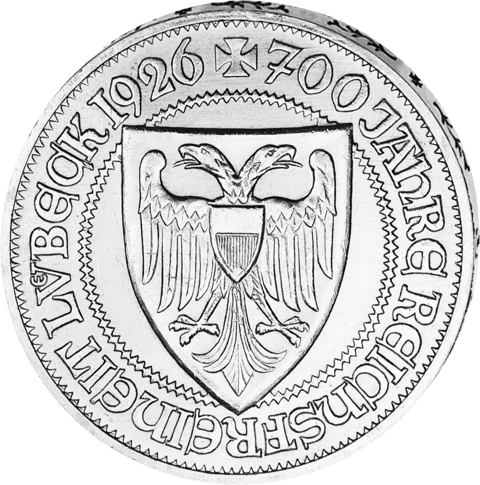
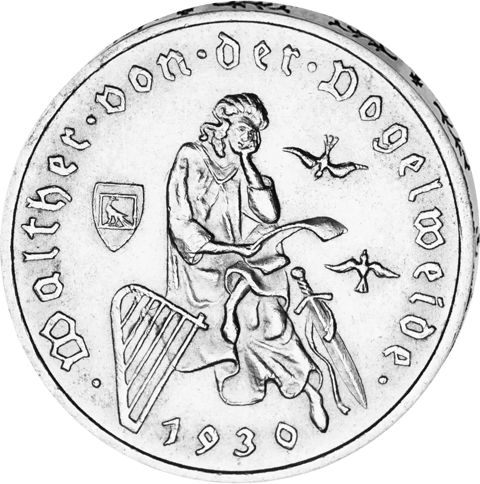
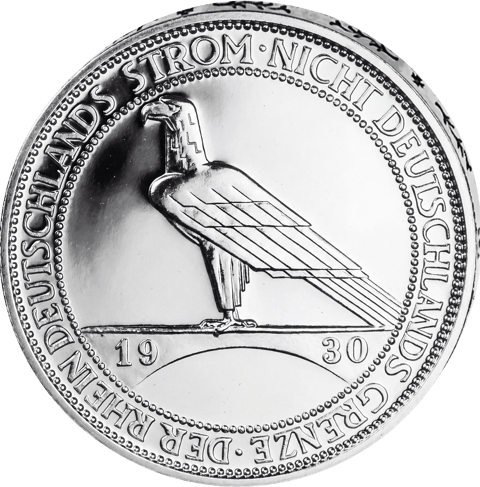
The mint mark
A letter for the mint
On the coins of the Reich a letter names the mint. The photo shows the A for Berlin; this coin was struck at all German mints.
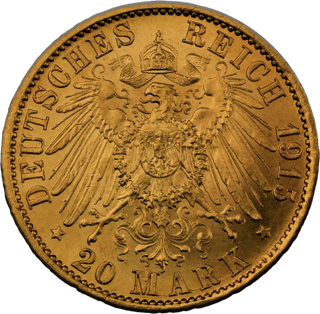
The gold of the mark
The gold of the German Empire
Twenty and ten marks in gold, 900/1,000: a twenty-mark piece weighs 7.96 grams, of which 7.17 grams is fine gold.
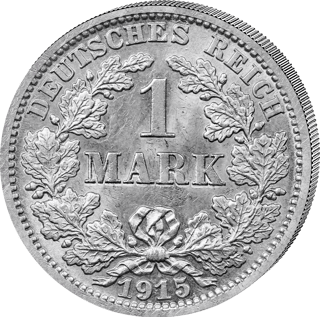
The mark in silver
The silver mark in the hand
A mark holds 5 grams of fine silver, 900/1,000, and measures 24 millimetres. No one had to accept silver coins for amounts over 20 marks.
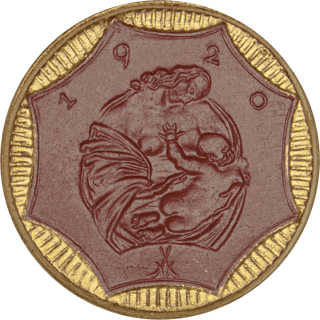
Emergency money
Emergency money in stoneware and from Hamburg
In 1921 Saxony issued emergency money of Meissen Böttger stoneware, and in August 1923 Hamburg issued its own emergency money.
Our strikes
What our strikes take up
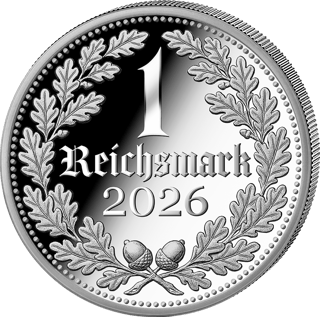
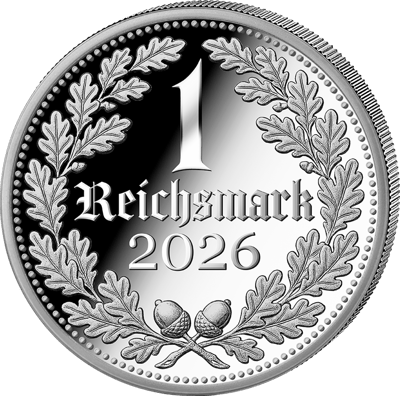
Our strikes bear the lettering 1 Reichsmark or 1 Mark in an oak wreath. They are newly struck, no Reichsmark of the past and no legal tender of the Reich.
At a glance
- Type
- Original
- Era
- Weimar Republic
- Occasion
- World flight of the Graf Zeppelin 1929
- Face value
- 3 Reichsmark
- Metal
- Silver
- Fineness
- 500/1,000
- Gross weight
- 15 g
- Fine weight
- 7.5 g
- Diameter
- 30 mm
- Year of striking
- 1930
Gross weight: the weight of the whole coin. Fine weight: the pure metal in it. Fineness: its share in thousandths.
Details from our product data and the strike.

Original and new strike
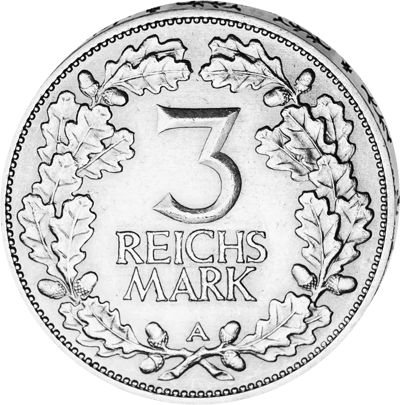
On the left 3 Reichsmark of 1925 with the value in an oak wreath, on the right our ounce, which bears the lettering 1 Reichsmark in an oak wreath.
3 Reichsmark Graf Zeppelin 1930 – When an Airship Circled the Globe
- Historical occasion: Circulation commemorative coin of the Weimar Republic marking the legendary world flight of the airship LZ 127 "Graf Zeppelin" in 1929
- Precious metal: 15 g gross weight in 500/1,000 silver – equivalent to 7.5 g of pure fine silver per piece
- Dimensions & face value: 30.00 mm diameter, round planchet, face value 3 Mark ("DREI REICHSMARK")
- Minting quality: circulated currency in bank-standard condition – deliberately not a modern Proof, but lived monetary history
- Edge design: plain edge with incuse inscription "EINIGKEIT UND RECHT UND FREIHEIT"
- Cataloguing: Jaeger 342, KM# 67 – a single year of issue, namely 1930
- Collector character: each specimen an original with its own patina, its own mint, and its own history
Some coins are pretty. This one is a witness to history. When the German Reich had the 3 Reichsmark struck in silver in 1930 to commemorate the world flight of the "Graf Zeppelin," the memory of this event was still fresh: under the command of Hugo Eckener, the airship LZ 127 had circumnavigated the northern hemisphere in August 1929 – with stops in Friedrichshafen, Kasumigaura near Tokyo, Los Angeles, and Lakehurst. Around 33,700 kilometers, a good 287 hours of actual flight time, an event that filled newspapers around the world. Whoever holds these silver coins today holds a piece of technological history in their hands.
Design: Zeppelin over the Globe, Imperial Eagle on the Value Side
The commemorative side shows the slender airship flying across a globe – encircled by the legend "GRAF ZEPPELIN WELTFLUG 1929". To the left of the southern tip of Africa sits the mint mark, a small detail that collectors look for first. The value side bears the German heraldic eagle within a shield, surrounded by the inscription "DEUTSCHES REICH", the year 1930, and the face value "DREI REICHSMARK". The dies were engraved by Franz Paul Krischker. His design remains to this day one of the most expressive images of the Weimar era – clean, modern, almost graphic in style.
Six Mints, One Year of Issue
Minting took place exclusively in 1930, distributed across six German mints. The total mintage adds up to around one million pieces – of which large portions were later withdrawn, melted down, or lost during the war and post-war periods.
- A – Berlin: 541,900 pieces
- D – Munich: 140,600 pieces
- E – Muldenhütten: 74,500 pieces
- F – Stuttgart: 100,300 pieces
- G – Karlsruhe: 61,000 pieces
- J – Hamburg: 81,700 pieces
Circulated Goods with Character – What You Receive
These pieces were genuine legal tender and bear the traces of their life: darker patina, individual centering, nicks, wear, and here and there a weaker section of the legend. That is precisely what makes them appealing. Since the year of issue, mint, and reverse variant can vary, the specimen delivered may differ from the image shown – you receive an original, not a mass-produced item. Please understand that the image in the shop is merely an example, and the item delivered may differ individually in appearance and condition due to historical circumstances. Anyone looking for the mirrored fields of a Proof version will find that in modern commemorative coins; here, authenticity is what counts. Coin capsules or collector's albums are suitable for storage – preserving the naturally developed toning.
Silver: Collector's Joy Meets Substance
Silver was the everyday money of the world for millennia – from ancient trading posts to the Reichsmark coins of the 1920s and 1930s. This white precious metal holds an intrinsic value that no fiat currency possesses: it is industrially sought after, for instance in electronics, solar, and medical technology; it is tradable worldwide, durable, and limited in supply. As an inflation hedge and as crisis protection, physical precious metal traditionally shows its strengths when paper assets begin to falter. Gold is considered humanity's oldest currency and has outlived all others – silver has accompanied it from the very beginning as the metal of small amounts and tangible exchange.
Historic circulation coins connect two worlds: the material value of the precious metal and the narrative value of an era. Rarely do you get both in a single piece.
A tax note that many buyers appreciate: profits from the sale of silver are generally tax-free in Germany, provided the minimum holding period of one year is observed. Your tax advisor can provide specific information.
Context: 3 Reichsmark, 5 Reichsmark, and Other Weimar Commemorative Coins
A 5-Reichsmark piece with the same Zeppelin design was also issued for the same occasion. It weighs more, is larger, and has a higher fineness – but the smaller 3-Mark issue is significantly more accessible and can be nicely completed in a collection by mint mark. Anyone who already owns historical issues such as Rhineland, Weimar Constitution, or Lessing will find in this Zeppelin coin the iconic link between numismatics and aviation history. Compared to modern bullion coins made of fine silver, it does not score on fineness, but on provenance, design, and rarity in fine condition.
For collectors, this piece is a must-have; for beginners, a charming entry point into the world of historic silver coins – and for anyone who values substance, a tangible piece of German history that can be passed on: from generation to generation.
Product depiction may differ from the final product.
