





3 Reichsmark Rhineland Evacuation (1930 | Weimar Republic)
- Historic document: end of occupation
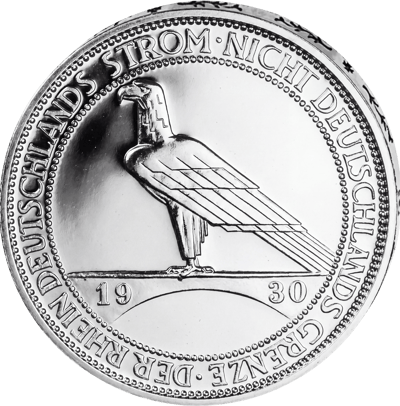
- Eagle on bridge: design with a message
- Rarely preserved: out of circulation since 1934
- Historic documentMinted when the occupation ended five years early
- Eagle on bridgeArndt quote around it: Rhine as river, not border
- Rarely preservedMany pieces were melted down, originals in demand
Unfortunately, this item is currently out of stock. We will be happy to send you an email as soon as this product becomes available again.
- Historic document: end of occupation
- Eagle on bridge: design with a message
- Rarely preserved: out of circulation since 1934
 Price alert
  Share
Share
Original from the Weimar Republic · 1930
What a Reichsmark bears


3 Reichsmark Rhineland evacuation 1930, picture side
The Reichsmark existed from October 1924. Its commemorative coins of three Reichsmark bear a picture of their own on one side and the value on the other. The value side bears DEUTSCHES REICH and DREI REICHSMARK, with the eagle in a shield.
On the piece
A value side and a picture of its own
Each of these coins bears Deutsches Reich and the value, 3 Reichsmark. One side bears a picture of its own.
The value side bears DEUTSCHES REICH · DREI REICHSMARK and the eagle in a shield, the picture side the year 1930.

Rentenmark and Reichsmark
From the Rentenmark to the Reichsmark
In the autumn of 1923 the Rentenbank was founded. Its Rentenbank notes were issued in a new money:
“The unit of value of these Rentenbank notes is the Rentenmark, which is divided into 100 Rentenpfennig.”
15 October 1923
Decree on the founding of the Rentenbank.
8 November 1923
A decree allows coins of 1, 2, 5, 10 and 50 Rentenpfennig.
30 August 1924
The coinage act introduces the Reichsmark.
October 1924
The Reichsbank issues the Reichsmark alongside the Rentenmark, one to one.
June 1948
The Deutsche Mark replaces the Reichsmark.

Weimar commemorative coins
Three Reichsmark for an occasion
The commemorative coins of 3 Reichsmark are made of silver, 500/1,000, weigh about 15 grams and measure 30 millimetres.
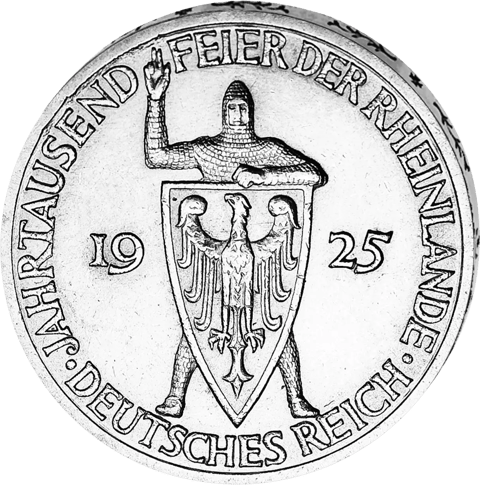 1925, Rhineland
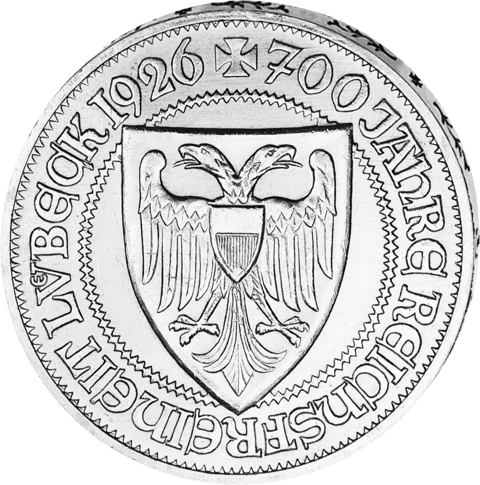 1926, Lübeck
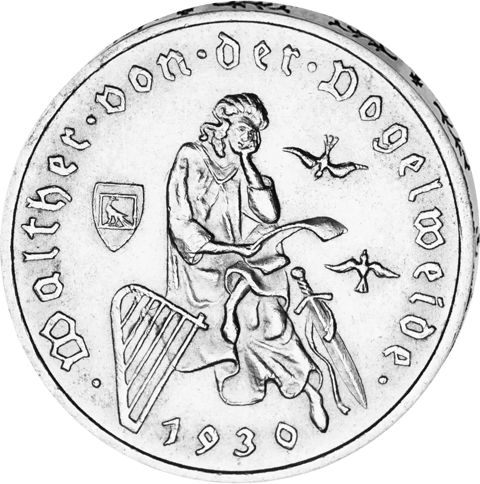 1930, Walther von der Vogelweide
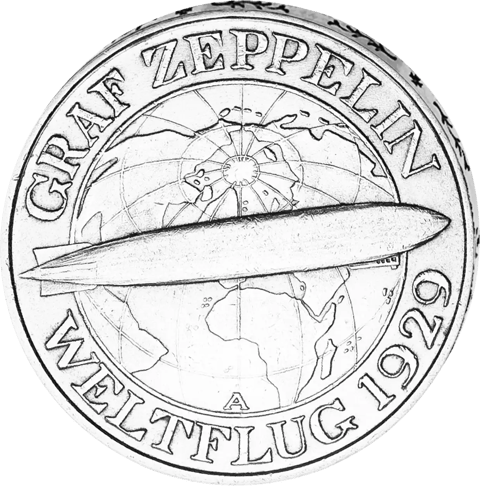 1930, Graf Zeppelin
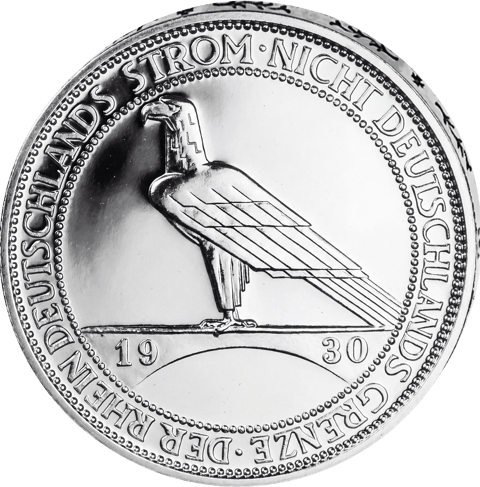 1930, Rhineland evacuation
The mint mark
A letter for the mint
On the coins of the Reich a letter names the mint, A for example Berlin, J Hamburg, F Stuttgart. The photo of this piece shows a E.

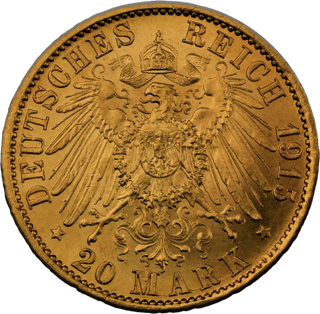
The gold of the mark
The gold of the German Empire
Twenty and ten marks in gold, 900/1,000: a twenty-mark piece weighs 7.96 grams, of which 7.17 grams is fine gold.
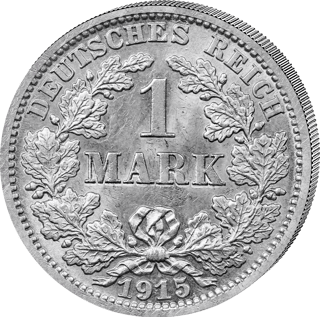
The mark in silver
The silver mark in the hand
A mark holds 5 grams of fine silver, 900/1,000, and measures 24 millimetres. No one had to accept silver coins for amounts over 20 marks.
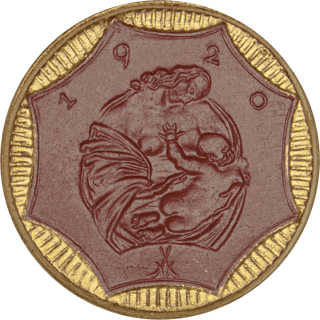
Emergency money
Emergency money in stoneware and from Hamburg
In 1921 Saxony issued emergency money of Meissen Böttger stoneware, and in August 1923 Hamburg issued its own emergency money.
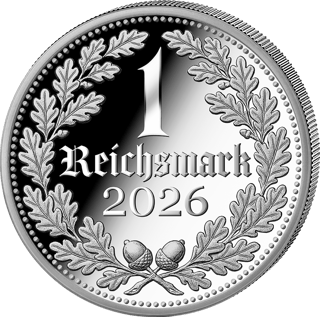
Our strikes
What our strikes take up
Our strikes bear the lettering 1 Reichsmark or 1 Mark in an oak wreath. They are newly struck, no Reichsmark of the past and no legal tender of the Reich.
At a glance
- Type
- Original
- Era
- Weimar Republic
- Face value
- 3 Reichsmark
- Metal
- Silver
- Fineness
- 500/1,000
- Gross weight
- 15 g
- Fine weight
- 7.5 g
- Diameter
- 30 mm
- Year of striking
- 1930
Gross weight: the weight of the whole coin. Fine weight: the pure metal in it. Fineness: its share in thousandths.
Details from our product data and the strike.

Original and new strike
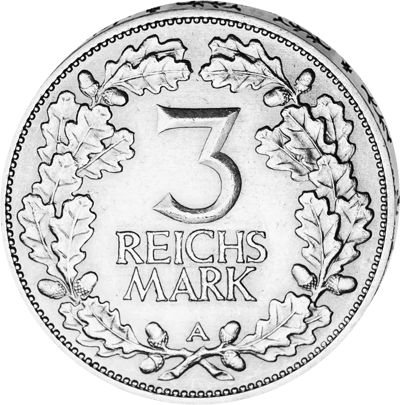
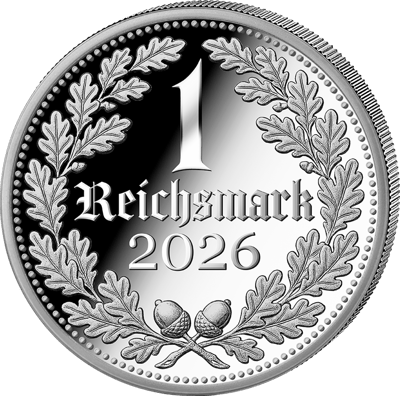
On the left 3 Reichsmark of 1925 with the value in an oak wreath, on the right our ounce, which bears the lettering 1 Reichsmark in an oak wreath.
3 Reichsmark Rhineland Evacuation 1930 – When the Rhineland Became Free
On 30 June 1930, the last French troops left the so-called Mainz Zone. This marked the end of the Allied occupation of the Rhineland – five years earlier than stipulated by the Treaty of Versailles. The German Reich reacted promptly and, that very same year, issued this silver commemorative coin with a face value of three Reichsmark. Anyone holding this piece today holds a document of its time from the Weimar Republic: minted in a moment of national relief, preserved to this day in genuine silver.
Eagle on the Bridge – A Design with a Message
The obverse depicts a strictly stylised eagle perched on a bridge arch over the Rhine, dividing the year 1930. Around the edge runs the legend "DER RHEIN DEUTSCHLANDS STROM · NICHT DEUTSCHLANDS GRENZE ·" ("The Rhine, Germany's river – not Germany's border"), a quote attributed to Ernst Moritz Arndt. The reverse bears the Reich eagle within a coat of arms, framed by two oak branches, with the inscriptions DEUTSCHES REICH and DREI REICHSMARK. The plain edge carries the inscription EINIGKEIT UND RECHT UND FREIHEIT ("Unity and Justice and Freedom").
The Rhine, Germany's river, not Germany's border – hardly any German circulation coin conveys its historical message so unmistakably.
Technical Specifications at a Glance
- Face value: 3 Reichsmark (circulating commemorative coin)
- Year of issue: 1930
- Material: Silver, fineness 500/1,000
- Gross weight: 15 g, of which 7.5 g fine silver
- Diameter: 30.00 mm
- Catalogue reference: Jaeger 345 (KM 70)
- Country: Germany – Weimar Republic
- Condition: Circulated, bank-standard quality
Six Mints, One Occasion
The issue commemorating the liberation of the Rhineland was produced at no fewer than six German mints: Berlin (A), Munich (D), Muldenhütten (E), Stuttgart (F), Karlsruhe (G), and Hamburg (J). In total, around 3.05 million pieces left the coining presses – Berlin contributed by far the largest share, while Muldenhütten, with approximately 38,400 pieces, produced the clearly smallest mintage. As early as 1934, the denomination was withdrawn from circulation and melted down, and much of it has since been lost. This is precisely why surviving originals are highly sought after.
Circulated Coinage with Character – Not a Mass-Produced Item
These pieces were genuine legal tender. They bear the traces of their history: a darker patina, individual centring, nicks, wear, and in some cases weaker areas of the legend. For many collectors, this is exactly the appeal. As the year of issue, mint, and reverse variant may vary, the item supplied may differ from the picture shown. Please understand that the shop image serves as an example, and that the delivered item may individually differ in appearance and condition due to its historical background. You will receive an original – not a polished mass-produced item.
Comparison: What Makes This 3 Mark Coin Special
- Compared to the 5 Reichsmark Rhineland Evacuation coin (J. 346): the same design, but in a more manageable format and at a significantly lower entry price – ideal for starting a collection.
- Compared to circulation coins from the German Empire and the Weimar Republic: this coin commemorates a specific historical event, rather than serving merely as everyday currency.
- Compared to modern bullion coins: lower fine silver content, but a numismatic collector's value that no modern minting programme can replicate.
Silver: A Tangible Asset with a Long Tradition
Silver has accompanied humanity for millennia as both money and coinage metal. It is scarce, durable, tradable worldwide as a commodity, and in strong demand industrially – in electronics as well as in solar and medical technology. Anyone who collects silver coins combines the intrinsic value of the metal with tangible history. As a tangible asset in your own hands, physical precious metal is a proven building block for inflation hedging and crisis protection. And: profits from the sale of silver are generally tax-free after a holding period of at least one year.
Who This Piece Is Suited For
For collectors of German coins, the 3 Reichsmark silver coin commemorating the Rhineland Evacuation is a must-have piece within the Weimar Republic series. For everyone else, it is a wonderful entry point: an original from 1930 that has passed through countless hands, affordable to start with, and able to be passed down through generations. History that you can keep.
Product depiction may differ from the final product.