
 280,000
  30 years
  Secure


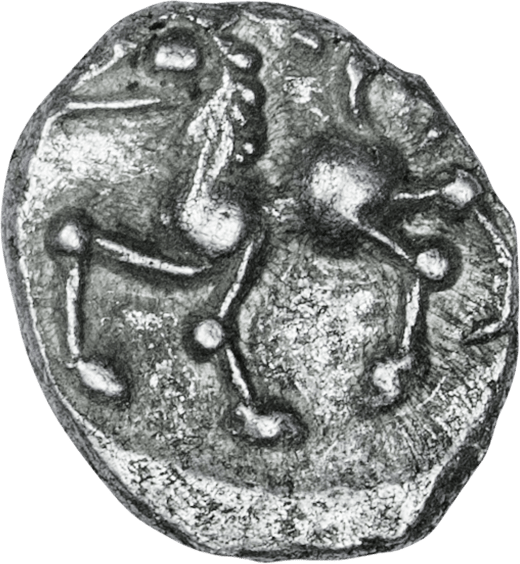


Silver Quinarius of the Celtic Vindelici (ca. 1st century BC | Alpine foreland between Lake Constance and the Inn)













 Popular Product: Among the top 10 in category Other Antiques
- Special offer: Product is currently on sale
- Shipping costs: Free shipping within Germany available
 Price alert set
 share
share
Personal consultation
Get free advice from one of our precious metals experts - we look forward to your call!
Silver Quinarius of the Celtic Vindelici – Hand-Struck Money from the 1st Century BC
What arrives here is no mass-produced item, but a piece of monetary history. This quinarius is genuine circulating currency from antiquity: a small, compact planchet made of silver, around 12 mm in diameter and about 2 g in weight – placed by hand between two dies and struck with a hammer over two thousand years ago. Whoever holds this coin holds the payment medium of a people whom the Romans forced into the light of written history only in 15 BC.
Design: Horse and Tuft – Celtic Formal Language in Pure Form
The quinarii of southern Germany follow a Roman model. The denarius was widely imitated in Gaul, though at half its size – as a quinarius. The Celts adopted the pictorial idea of head and horse and radically reshaped it. On the reverse, a horse trots or gallops, usually to the left, accompanied by pellets, torque-shaped arcs, or small secondary symbols. The obverse shows a head that became increasingly abstract over the various minting periods: hair turns into tufts, the face into a \"pincer\" shape, until in the end only a swirl with central points remains. Hence the collector's name tuft quinarius (\"Büschelquinar\"). These coinages are usually dated to the period from roughly 150 to 50 BC.
For the Celts, the horse was no arbitrary decoration. It stood for status, mobility, and military power – a pictorial symbol that appears repeatedly on gold, silver, and small silver coins of the Danubian Celts and Vindelici.
Key Facts at a Glance
- Precious metal: Silver (ancient alloy, no standardized fineness specified)
- Face value: Quinarius
- Diameter: approx. 12 mm
- Gross weight: approx. 2 g
- Minting period: approx. 1st century BC, various years of issue
- Origin: Celtic settlement areas, Alpine foreland between Lake Constance and the Inn River
- Condition: circulated currency (used), various grades of preservation
- Category: collector's item from the \"History\" series
Who Were the Vindelici?
The Vindelici – Latin Vindelici – were a group of Celtic tribes in the Alpine foreland between Lake Constance and the Inn River. Among them were the Brigantii around Bregenz and the Estiones around Kempten; their settlement region was called Vindelicia. The most significant known oppidum lies near Manching on the Danube, south of Ingolstadt. There, gold and silver coins were minted in the late 2nd and early 1st centuries BC – die finds prove that coin production took place on site. In the summer of 15 BC, Tiberius and Drusus, the stepsons of Augustus, subjugated the Vindelici. Their territory was later united with that of the Raeti to form the province of Raetia. From the tribal name, Augusta Vindelicum remained – today's Augsburg.
Circulating Currency with Character – What You Receive
These pieces were money, and they look like it. Expect the traces of two thousand years:
- darker patina, sometimes blotchy surfaces
- individual centering, not perfectly round planchets
- nicks, wear, and sometimes weaker areas of the legend
- differing reverse variants, mints, and years of issue
This is precisely what makes them appealing. Each of these coins was struck by hand, no die pair is identical to another, and no planchet is perfectly round. Because the year of issue, mint, and variant may vary, the piece delivered may differ from the image shown: the pictures in the shop are example photos, and the appearance and condition of the item actually delivered may vary individually due to historical circumstances. You receive an original – not a mass-produced item. Those seeking precision to the tenth of a millimeter should turn to modern bullion coins. Those seeking character will find it here.
Ancient Silver, Modern Wealth Protection
Silver has been a coinage metal, medium of exchange, and symbol of wealth and prestige for thousands of years – this quinarius is living proof. To this day, silver is traded worldwide as a commodity, is highly liquid, and is in strong industrial demand in electronics, solar, and medical technology. Supply is naturally limited, and its intrinsic value derives from the metal itself rather than from trust in a government or central bank. Unlike fiat money, silver retains its physical properties for centuries. This is why investors and collectors value silver coins as an inflation hedge, as crisis protection, and as a tangible asset that can be passed down from generation to generation.
This piece of silver has endured for two thousand years. The currencies it once knew are long since history – the metal remains.
From a tax perspective: profits from the sale of silver are generally tax-free, provided a minimum holding period of one year is observed. In the case of ancient coins, there is the added factor that their value depends not solely on metal content, but also on rarity, type, and condition.
Comparison: Ancient Quinarius or Modern Silver Coin?
Modern bullion coins offer clearly defined fine weights, standardized fineness, and day-to-day tradability – ideal for the systematic build-up of a silver holding. The quinarius plays in a different league. It brings history, rarity, and individuality, but is neither standardized in fineness nor freely available on demand. Conversely, a freshly stamped new coin tells no story. Many collectors therefore combine both – investment silver as the foundation, ancient Celtic coins from southern Germany as the centerpiece of the collection.
Shipping is carried out as insured value shipping. For newcomers to ancient numismatics, for enthusiasts of Bavarian and Swabian regional history, and for anyone wanting to hold a genuine piece of the Celtic era, this small silver quinarius is an excellent starting point.
Product depiction may differ from the final product.
