





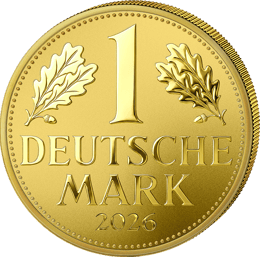

0.5g Gold Deutsche Mark 2026 (Mintage: 1,000 | Reverse Proof)
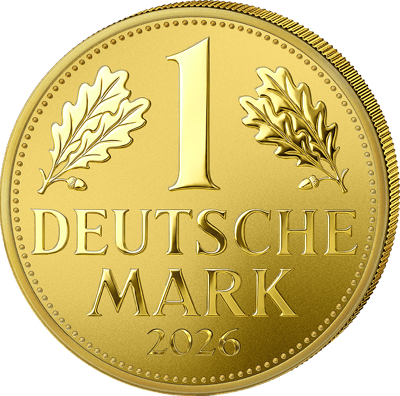
Unfortunately, this item is currently out of stock. We will be happy to send you an e-mail as soon as this product becomes available again.
- Genuine investment gold: 999.9/1,000 fine gold
- In-house minting: German Eagle series
- Give gold as a gift: genuine gold investment
- Genuine investment goldVAT-free and value aligned with the gold price
- In-house mintingExclusive to Kettner Edelmetalle, issued for Liberia
- Give gold as a giftGive lasting fine gold for christenings or Christmas
 Price alert
 Share
Deutsche Mark · 2026 Edition
The coin that passed through our hands for half a century.When memory turns to gold.
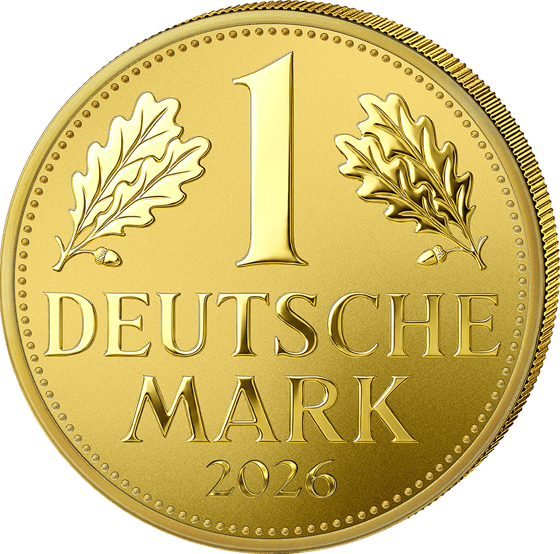
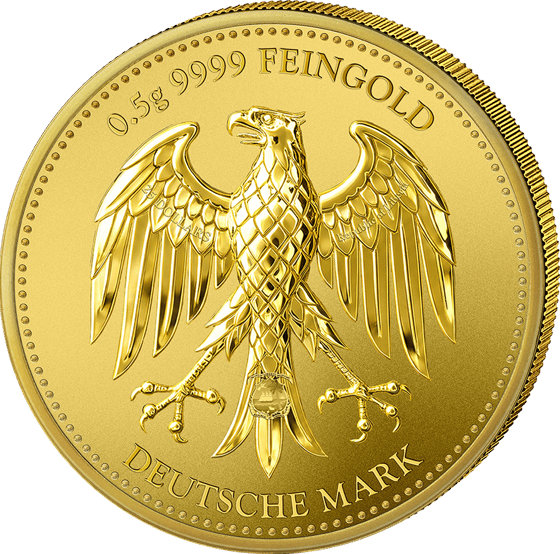
You are looking at the value side.
It jingled in coat pockets, lay on shop counters and in piggy banks. The One between the oak twigs went through millions of hands until the farewell of the D-Mark. Now its image returns as a homage, struck in fine gold.
- Mintage 1,000 pieces
- Reverse Proof
- 0.5 g
It was never just money. It was a promise.
On 20 June 1948, every resident of the three western zones exchanged 40 Reichsmarks for 40 D-Marks, the “Kopfgeld” or per-head quota. The very next day, shop windows were full to bursting. The new currency set off the economic miracle.
In the Bundesbank’s words, the D-Mark enjoyed trust from its first day and kept it to the very end. Over five decades it also became an international symbol of stable money.
12 billion
Some never fully let go of it: according to the Bundesbank, around twelve billion D-Marks have still not been exchanged, more than half of them in coins.
From the Kopfgeld to the farewell
Half a century of the Mark
1948
A new beginning
On 20 June the currency reform takes effect. From the next day, the Deutsche Mark is the only legal tender in the three western zones.
1950
The One with the oak leaves
At the end of 1950 the one-mark coin enters circulation, designed by Josef Bernhart of Munich. Its motif remains unchanged until the farewell of the D-Mark.
1951
The Heiermann
Albert Holl’s silver five-mark coin is struck for the first time and circulates from May 1952. It remains the only circulation coin of the Federal Republic made of silver.
1957
The Bundesbank
On 1 August the Deutsche Bundesbank takes over from the Bank deutscher Länder, which had issued the first D-Marks in 1948.
1990
One Mark for everyone
“If the D-Mark comes, we stay. If it doesn’t, we’ll go to it” was a slogan at the Monday demonstrations. On 1 July 1990 it came to the GDR, even before German reunification.
2001
The farewell
In farewell, the Deutsche Bundesbank issues the One as a gold coin, one million pieces in fine gold. Since 1 January 2002 Germans have paid in euros.
The motif
An image everyone knows
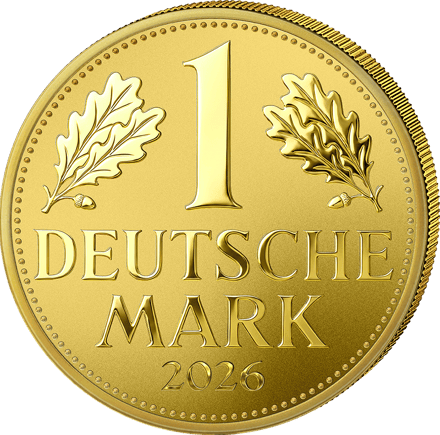
The value side follows the one-mark coin of the past. Anyone who once held the Mark recognises it at once.
- The large One
- Clear and unadorned, it stands in the centre, just as on the one-mark coin designed by the Munich artist Josef Bernhart.
- Two oak twigs
- To the left and right, two oak twigs with acorns frame the numeral. Oak leaves already graced the pfennig coins, and the German 1, 2 and 5 cent coins still show them today.
- The eagle
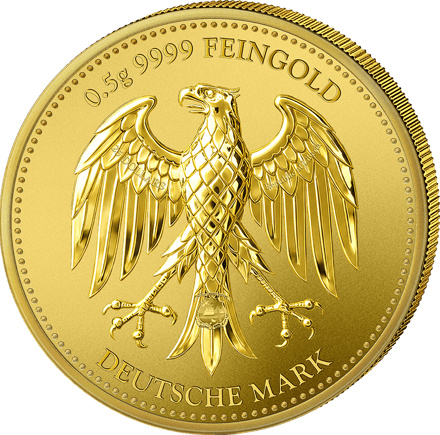
- On the other side the eagle spreads its wings, worked down to the last feather. The wings carry the face value and Republic of Liberia in small letters.
The finish
Two ways to catch the light
Proof
The field shines deep like a mirror, the motif lies on it in matte relief. With this finish, dies and blanks are specially polished and the blanks are fed into the press one by one.
Reverse Proof
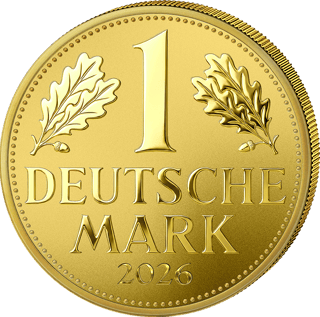
Here it is the other way round: the field is frosted, the motif gleams like a mirror. Every leaf vein and every feather catches the light.
Some things pass.
The memory remains.
The D-Mark is history. Its image in precious metal remains, for you and for those you will one day pass it on to.
1,000
pieces in the edition
0.5 g fine gold · 999,9/1.000 · 14 mm · Reverse Proof · Coincard
An own edition by Kettner Edelmetalle, not an issue of the Federal Republic of Germany or the Deutsche Bundesbank. The issuing country is the Republic of Liberia, hence the face value in dollars.
0.5 g Gold German Mark 2026 – Reverse Proof with a mintage of only 1,000 pieces
- Strictly limited: Worldwide mintage of only 1,000 pieces – a true rarity among the small gold mintages of the 2026 vintage.
- Genuine investment gold: 0.5 grams of fine gold, whose value is based on the precious metal and tracks the gold price – tradable worldwide and resalable at any time.
- Growth potential: High appreciation potential due to the strict limitation and the persistently high demand for small gold units.
- Minting quality: Reverse Proof – the fields are frosted, the relief is mirror-polished, i.e. exactly the reverse of the classic Proof finish.
- Design: The legendary "1 Deutsche Mark" with two finely drawn oak branches complete with acorns, the mint year 2026, and the majestic eagle with widely spread wings on the second side.
- Material and fineness: Gold with a fineness of 999.9/1,000, 14.00 mm diameter, reeded edge, delivered in an eye-catching coin card.
- Manufacturer: Exclusive in-house mintage by Kettner Edelmetalle from the "German Eagle" series.
- Country of origin: Germany – issued for the Republic of Liberia with a face value of 25 dollars.
Some gold coins need no introduction. The "1 Deutsche Mark" is one of them: for decades, this image lay in millions of wallets, and it stands for a hard currency and economic stability. For 2026, it returns in gold – in an edition that exists only 1,000 times worldwide. Anyone looking for an extremely limited collector's coin whose substance also consists of pure fine gold will find both in a single piece measuring just 14 millimeters.
The design: oak leaves, eagle, and a piece of currency history
At the center of one side is the large digit "1", flanked by two oak branches – leaf veins, notches, and one acorn each are clearly recognizable. Below it is the inscription "DEUTSCHE MARK" and the year 2026. The other side belongs to the eagle: spread wings, finely graduated plumage, an open beak, plus the indication of the fine gold weight. A delicate beaded border frames both sides, and the reeded edge completes the appearance. In doing so, this mintage continues the great German tradition – from the Gold Mark of the German Empire, through the D-Mark, to the official 1-DM gold coin.
Reverse Proof: the inverted shine
Reverse Proof means: what is mirrored on a Proof coin is frosted here – and vice versa. The relief emerges gleaming from a silky matte background, creating a bolder, more modern contrast. This special form is elaborate to produce and therefore appears almost exclusively in small series. Here there are only 1,000 pieces – a very low mintage that clearly sets this piece apart from typical small gold issues.
Why this small gold investment is convincing
Despite all the charm of the design, the core remains sober and solid: you are buying physical investment gold. Gold is the oldest currency in the world, a proven store of value for over 6,000 years, and it has never had a value of zero. Central banks hold it as a reserve, and it is recognized worldwide as a means of payment and exchange. Supply is scarce, and its physical properties never change – gold has shone for millennia and will never lose its shine. As a tangible asset, it also serves as an inflation hedge and crisis protection against currency risks.
- Preservation of value: Physical fine gold as a durable tangible asset – independent of printed fiat money.
- Building wealth in small steps: Small amounts of gold add up over the years to a considerable fortune.
- High liquidity: You can sell gold worldwide and easily exchange it for cash.
- Tax-attractive: The purchase is VAT-free; profits from the sale of gold are generally tax-exempt after a holding period of at least one year.
- Double scarcity: The supply of gold is limited – and this mintage is additionally restricted by a strictly limited quantity of 1,000 pieces.
Gold is humanity's oldest currency – it has outlived all others.
In comparison: 0.5 g of fine gold versus the full ounce
A full ounce of gold ties up a lot of capital at once. This 0.5-gram mintage reverses the ratio: the outlay remains manageable, while the metal is the same. Compared to a 0.5 g gold bar, the coin offers a face value, a reeded edge, and a strictly limited number of pieces; anyone who focuses exclusively on maximum weight per euro, however, should opt for larger units or bars. So this is no mere souvenir, but recognized investment gold featuring a design that everyone in Germany knows.
That is precisely why this edition is also the right choice if you want to give real gold as a gift for a personal occasion – for a birth, a christening, a birthday, or Christmas. What you are giving is not a perishable item, but an asset whose value tracks the gold price. And since this mintage of only 1,000 pieces will not be expanded, the rule is: secure your copy of this rarity while the limited edition lasts.
Product depiction may differ from the final product.