





1 Ruble Silver Tsar Alexander I (1810-1826 | Rival of Napoleon)








- Genuine Original: no restrikes
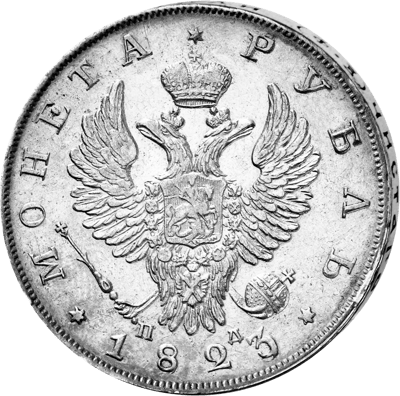
- Double Eagle: with imperial crown
- St. Petersburg: mint mark С.П.Б.
- Genuine OriginalEvery piece comes from the original production of those years
- Double EagleBears sceptre, orb and the Moscow coat of arms
- St. PetersburgMint masters' initials are a collecting field of their own
 Price alert
 Share
A Ruble from the Era When Europe Was Redrawn
Weighing around 20.7 grams, 35.5 millimeters wide, minted in Tsarist Russia: the 1 Ruble of Tsar Alexander I is more than a historic circulation coin. It is a witness to its time. Whoever holds it in their hand holds money from the years when Napoleon upended Europe and a Russian emperor stood against him as his most tenacious adversary. For collectors of historic coinage and for all who seek precious metal with a story to tell, this piece ranks among the most exciting silver coins of the 19th century.
Alexander I – The Tsar Who Resisted Napoleon
In 1801, Alexander I ascended the throne. At first, France dictated the terms: the defeat at Austerlitz in 1805, the Peace of Tilsit in 1807. Then came 1812. The Grande Armée marched into Russia, Moscow burned, and the retreat through the Russian winter became the turning point of the era. Two years later, Alexander rode into Paris. At the Congress of Vienna, he was regarded as Metternich's most important rival, and in 1815 he founded the Holy Alliance. It was in precisely these years that rubles like this one passed through the hands of merchants, officers, and peasants – financing freight, wages, and taxes.
Double-Headed Eagle, Oak Wreath, Edge Lettering: The Design in Detail
Obverse: the crowned Russian double-headed eagle holding scepter and orb, with the Moscow coat of arms on its chest encircled by the chain of the Order of St. Andrew. Around the edge runs the Cyrillic legend "МОНЕТА РУБЛЬ" together with the year.
Reverse: the fine silver designation "ЧИСТАГО СЕРЕБРА 4 ЗОЛОТН. 21 ДОЛЯ" within a wreath of laurel and oak, topped by the imperial crown, with the mint mark С.П.Б. for St. Petersburg below.
Edge: lettered edge bearing the contemporary fineness indication of 83 ⅓ Solotnik – the Russian equivalent of our modern fineness specification.
Mint master: depending on the year of issue, initials such as ФГ, МФ, ПС, ПД, or НГ abbreviate the responsible die engravers – a popular collecting field in its own right.
The Technical Specifications
Material: silver, fineness 875/1,000 (classic Russian coinage standard)
Gross weight: 20.7 g – nominally around 18 g of pure coinage metal
Diameter: 35.5 mm, face value: 1 ruble
Country of origin: Russia, minted in St. Petersburg
Years of issue: various, from the period 1810 to 1826
Series: History – collector's product, shipped as insured value shipment
Condition: Not Flaws, but a Biography
These pieces are circulated coinage – and they look it. Darker patina, individual centering, small nicks, wear, and in places weaker-struck areas of the legend: these are not defects, but biography. Every trace comes from hands that, centuries ago, used them to settle goods, freight, or debts. Since the year of issue, mint, and reverse variant can vary, the piece delivered may differ from the image shown. Please understand the photo in the shop explicitly as a sample image: appearance, exact weight, and condition vary from piece to piece for historical reasons. You are acquiring an original.
In Comparison: Tsarist Rubles, Thalers, and Modern Circulation Coins
Compared to the Maria Theresa Thaler, which continues to be restruck to this day, the Alexander Ruble has a clear advantage: every specimen stems from the original production of the Tsarist Empire. Compared to later rubles under Nicholas II, which are frequently found in good condition, early circulated examples of Alexander I are noticeably rarer on the German market and generally more heavily worn – but in return, this represents genuine money from the age of war and congress. Compared to modern bullion coins, the ruble has a lower fineness; yet it was precisely this harder alloy that made it durable enough for everyday circulation.
Precious metal forgets nothing: governments, paper currencies, and armies have come and gone – the metal of this coin has remained unchanged for over two hundred years.
Value Preservation, Inflation Hedge, and Crisis Protection
For centuries, silver has served simultaneously as a means of payment, a store of value, and a symbol of wealth. To this day it is traded worldwide as a commodity, used in electronics, solar technology, and medical devices, and gladly held in small units as a means of exchange. Availability is limited, while the material is practically indestructible. Historic pieces like this ruble combine this intrinsic material value with numismatic collector appeal – an approach that links inflation hedging and crisis protection with genuine history. A note for investors: profits from the sale of silver are generally tax-free provided a holding period of at least one year is observed. Please consult your tax advisor regarding your personal situation.
Whether as an entry point into the numismatics of the Tsarist Empire, as a gift with substance, or as a tangible piece of family wealth passed down through generations: this silver ruble brings together metal, power, and history in a single coin.
Product depiction may differ from the final product.
