





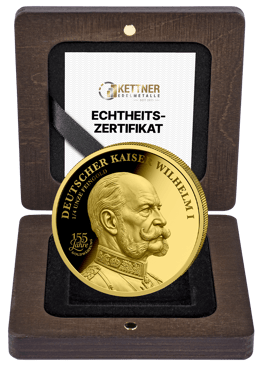

1/4 oz Gold Kaiser Wilhelm I 155 Years of the Gold Standard 2026 (Mintage: 99 | Proof)
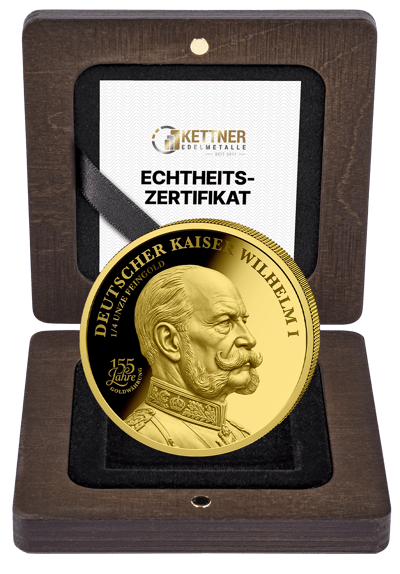








- 1871 Model: based on the Reich law
- Purest Gold: fineness 999.9/1,000
- Elegant Case: ideal as a gift
- 1871 ModelPortrait and imperial eagle follow the 1871 law
- Purest GoldFiner than the historic 20-mark coins in 900 gold
- Elegant CaseSafely stored for display or as a gift
 Price alert
 Share
German Emperor Wilhelm I – 155 Years of Imperial Gold Currency as a Rarity in Proof Quality
Strictly limited: A mintage of only 99 pieces worldwide – for a deliberately small circle of collectors
Growth opportunities: Very high appreciation potential thanks to the limited mintage and the sought-after Imperial-era theme
Rarity: An exceptionally rare collector's coin marking the anniversary of the German gold currency
Investment goal: A tightly limited anniversary piece that, thanks to its strict limitation, remains permanently desirable among connoisseurs
Minting quality: The highest possible minting quality, Proof (PP), with a mirrored background and finely matted reliefs
Design: An expressive profile portrait of the first German Emperor in uniform, with the crowned imperial eagle on the reverse between the years 1871 and 2026
Material / Fineness: A quarter ounce (7.78 g) of the purest gold with a fineness of 999.9/1,000
Manufacturer: An exclusive issue by Kettner Edelmetalle
Country of origin: Germany – issued as official legal tender of the Republic of Liberia with a face value of 100 Dollars
On December 4, 1871, Wilhelm I signed the "Law concerning the Minting of Imperial Gold Coins." The title sounds sober. But behind it lay nothing less than the birth of a common German currency: until then, the federal states of the young Empire had seven different coinage systems with 119 different coin types, including Thalers, Guilders, Kreuzers, and Groschen. With the Mark and its golden circulation coins of 10 and 20 Mark, order was brought to this chaos. 155 years later, Kettner Edelmetalle honors this milestone with a quarter ounce coin issued in a very low mintage.
A Design Based on the Law of 1871
Anyone holding the coin quickly notices: the design is not freely invented but deliberately draws on the historical model. The Imperial Law itself already prescribed how the new gold pieces had to look:
"The imperial gold coins shall bear on one side the imperial eagle with the inscription 'German Empire' and the indication of value […] as well as the year of minting, and on the other side the image of the sovereign […]." – § 5 of the Law of December 4, 1871
The anniversary issue follows exactly this principle. The obverse shows Wilhelm I in right profile, with a distinctive beard and moustache and features marked by age. The high uniform collar bears fine oak leaf embroidery and a small crown. In Proof quality, these details stand out almost three-dimensionally. Around the edge reads "DEUTSCHER KAISER WILHELM I," below it "1/4 UNZE FEINGOLD." On the left, within the mirrored field, sits the "155 Jahre Goldwährung" emblem.
On the reverse, the crowned imperial eagle with breast shield is enthroned, surrounded by the inscription "DEUTSCHES REICH" and the years 1871 and 2026. Two laurel branches frame the face value of 100 Dollars. Those who look closely will also discover the subtle inscription "Republic of Liberia" within the plumage.
Wilhelm I – The Emperor of German Unification
Wilhelm I was born in 1797 and became King of Prussia in 1861. On January 18, 1871, he was proclaimed German Emperor in the Hall of Mirrors at Versailles. He thus stood at the head of the new Empire as its currency was placed on a golden foundation. He reigned until his death in 1888. His portrait on the Prussian 10 and 20 Mark pieces shaped the image of the gold mark for decades – and now returns in fine gold.
What Makes the Proof Quality So Special
For Proof quality, especially carefully prepared blanks (planchets) are struck with high-polish minting dies. The result is a contrast unmatched by any ordinary bullion coin: a background that acts like a mirror, paired with a matte, sharply defined relief. To preserve this shine, the coin should only be handled with gloves.
Original 20 Mark or Anniversary Quarter Ounce? An Honest Comparison
A historical 20 Mark imperial gold coin contains about 7.17 g of fine gold and consists of 900/1,000 gold, with the remainder being copper. The new issue contains 7.78 g of fine gold at 999.9 purity, placing it slightly above – and in flawless condition. Both have their appeal:
Historical original: a genuine artifact of the Imperial era, though usually showing signs of circulation and preserved in large numbers
Bullion quarter ounce: priced close to the gold value, but minted without any quantity limit and without a mirror finish
This anniversary coin: fine gold at its finest, 30.00 mm diameter, Proof quality, and a limitation that ensures true rarity
For collectors of German coin history, it is thus an ideal complement to the originals. A modern rarity that spans an arc from 1871 to today.
Gold – A Reliable Store of Value for Over 6,000 Years
Even in ancient Egypt, the yellow metal served as a standard of trade. Kings and emperors used it to display their power. In the 19th century, it became the basis of the gold standard, which the young Mark also joined. Gold is the oldest currency in the world and, thanks to its intrinsic value, has never been worth zero. Many therefore value gold coins as an inflation hedge or as crisis protection. With this piece, however, it is above all about something else: the passion for history and the joy of collecting.
The precious metal also offers tax advantages. Investment gold is exempt from VAT in Germany. Profits from its sale are generally tax-free after a holding period of at least one year. And because gold never loses its properties, such a family heirloom can easily be passed on to the next generation.
Safely Stored in an Elegant Case
Each coin comes in a case, providing excellent protection – ideal for your own display case or as a gift for history enthusiasts. Anyone wishing to own one of only 99 pieces should not wait too long. After all, a collector's coin like this does not appear every day.
Product depiction may differ from the final product.
