
 280,000
  30 years
  Secure


1 Schilling Free and Hanseatic City of Hamburg (1725-1868 | with City Coat of Arms)













 Popular Product: Among the top 10 in category Small Coins
- Collector coin: Especially interesting for collectors
- Secure shipping: 100% insured & anonymous delivery
 Price alert set
 share
share
Personal consultation
Get free advice from one of our precious metals experts - we look forward to your call!
1 Schilling of the Free and Hanseatic City of Hamburg – Hanseatic Silver with City Coat of Arms
- Historical witness: genuine legal tender of the Free Hanseatic City of Hamburg from the minting period 1725 to 1868
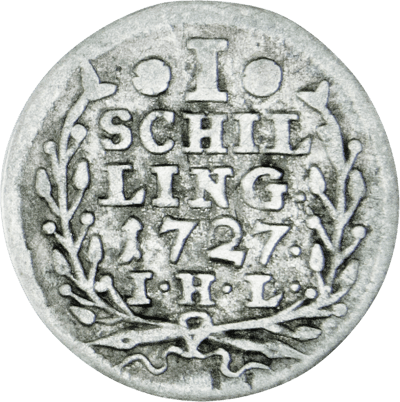
- Design with recognition value: the Hamburg city coat of arms – the three-towered castle – meets the denomination "I SCHILLING" between laurel branches
- Minting quality: typical bank circulation stock with honest signs of use – deliberately not modern collector quality "Proof" (PP)
- Material and fineness: silver, 835/1,000 according to item data
- Compact format: 17.00 mm diameter with a mere raw weight of around 1.1 g
- Face value with history: one Hamburg Schilling was equivalent to twelve Pfennig, and thus one forty-eighth of a Thaler
- Year of issue and mint master vary: each specimen is an individual original, not a series product
- Safely on its way: delivery via insured value shipping
Reach into the display case, and you hold a piece of the port city in your hand. This 1 Schilling belongs to those small silver coins that actually passed over shop counters, market stalls, and counting-house desks in the 18th and 19th centuries. Not a commemorative piece, not a jubilee design – circulating money. That is precisely why such a piece is so appealing to collectors today: it has worked for a living.
The castle with three towers: Hamburg's coat of arms in silver
One side shows the city's coat of arms, a castle with three towers, with the stars of Mary above the corner towers – an emblem Hamburg has borne since the 13th century. The city name appears around the rim, depending on the type either as "HAMBURGER" or, on the later years of issue, as "HAMB. COUR." for Hamburger Courant. The reverse side simply states value and year: the numeral I, below it SCHILLING, below that the year, framed by two laurel branches. On the older pieces, the initials of the mint master also appear at the bottom – such as I·H·L for Johann Heinrich Löwe, who was responsible for the Hamburg mint from 1725, or O·H·K for his successor Otto Heinrich Knorre.
The fact that Hamburg was allowed to mint its own money at all has a solid historical background: in 1325 the city purchased the mint along with the associated rights from the Counts of Holstein. The Schilling accompanied it for centuries thereafter – alongside the Sechsling and Dreiling as small change in everyday life, while the Thaler and Portugaloeser served large-scale trade. It was the money of shopkeepers, craftsmen, and day laborers, the change of the merchant "pepper sacks" whose ships sailed from the Elbe all the way to Lisbon and into the Baltic Sea.
Patina, nicks, character – every piece is unique
These coins wear their biography openly. Darker patina, individual centering, small nicks, wear, sometimes weaker areas of the legend: this is not a flaw but proof that this coin was used to pay for goods for decades. Anyone seeking the smooth perfection of a PP (Proof) strike will not find it here – anyone wanting history you can touch has come to the right place. Since the minting year, mint, and reverse variant may vary, your specimen will differ from the picture shown. Please understand: the photo in the shop is an example; the appearance and condition of the delivered item vary individually for historical reasons.
Gold and silver are humanity's oldest currencies – they have outlived princes, empires, and paper money systems. A Hamburg Schilling tells this story in miniature.
Collector's joy meets tangible asset
Silver has been a coinage metal, a store of value, and a symbol of prosperity since antiquity. Unlike fiat money, whose purchasing power depends on trust in governments, it possesses intrinsic value: it is traded worldwide as a commodity, is in high demand in electronics, solar, and medical technology, is only available in limited quantities, and remains physically stable over centuries – this piece proves it itself. As a tangible asset, silver is therefore often used for inflation hedging and crisis protection, and in small denominations even as a means of exchange. Profits from the sale of silver are generally tax-free in Germany, provided the holding period of at least one year is observed.
Compared to the larger Hanseatic denominations – 2, 4, 8, or 32 Schilling – the advantage of this piece lies in its low entry price and its abundance: years such as 1727 or 1855 were minted in the millions, making it easier to start a collection. The downside is equally openly stated: at around 1.1 g raw weight, the focus here is not on the amount of precious metal but on the numismatic appeal. It is ideal for building a collection of old German small coins – for example, in combination with issues from Lübeck or Bremen.
Who this Hamburg Schilling is worth it for
- Collectors of old German states who organize Hanseatic city coinage by year of issue and mint master
- Hamburg enthusiasts seeking an authentic original bearing the city's coat of arms
- Beginners who want to get to know historical silver coins without jumping straight to the Thaler
- Gift-givers: a historical witness from the "History" series – worth telling about and easy to handle
A small, thin piece of silver, minted in an era when Hamburg's wealth came through its harbor. Secure an original for yourself – and with it, a chapter of Hanseatic monetary history.
Product depiction may differ from the final product.
