





2 Kreuzer Silver Electorate of Bavaria (1623-1636 | Currency in the Thirty Years' War)
- Genuine Original: no restrike
- Maximilian I: Wittelsbach coat of arms
- Gift Idea: history you can touch
- Genuine OriginalRoughly four centuries old and truly once in circulation
- Maximilian IWith Bavarian lozenge shield and his titles in Latin
- Gift IdeaAs a gift, almost always stronger than any greeting card











- Genuine Original: no restrike
- Maximilian I: Wittelsbach coat of arms
- Gift Idea: history you can touch
 Price alert
  Share
Share2 Kreuzer Electorate of Bavaria (1623–1636): Silver from the Heart of the Thirty Years' War
Some coins are beautiful. This one is something rarer: it was genuinely in circulation – in the full sense of the word. The 2 Kreuzer, known among numismatists as the Halbbatzen, was everyday money of an era in which Europe was ablaze. Whoever holds this piece today holds roughly four centuries of history, trade, and the will to survive in their hands.
This small silver coin was minted in the Electorate of Bavaria, a territory of the Holy Roman Empire of the German Nation. Its diameter is 18 mm, its raw weight around 1 g. A tiny thing compared to a Thaler – and yet a coin with which one could actually accomplish something in the marketplace.
Maximilian I: Duke, Elector, Man of Power
Maximilian I (1573–1651) took over the government of Bavaria in 1597 and restored the heavily indebted duchy through iron administrative discipline. In 1609 he stood at the head of the Catholic League. As a reward for his role in the war against the "Winter King," Emperor Ferdinand II transferred the Palatine electoral dignity to him in February 1623 – the duchy became the Electorate of Bavaria, and the duke became one of the most powerful electors of the Empire. It is precisely at this moment that the minting series of these 2-Kreuzer pieces begins. Maximilian died in 1651 in Ingolstadt; the Kingdom of Bavaria still lay a century and a half in the future.
Coat of Arms, Orb, and a Latin Confession of Faith
- Obverse: the ancestral coat of arms of the Wittelsbachs, the Bavarian lozenge shield, in the inner circle. Surrounding it, the abbreviation M·C·P·R·V·B·D·S·R·I·A·E·E· – spelled out: Maximilianus, Comes Palatinus Rheni, Utriusque Bavariae Dux, Sacri Romani Imperii Archidapifer et Elector. That is: Count Palatine of the Rhine, Duke of both parts of Bavaria, Arch-Steward and Elector of the Holy Roman Empire.
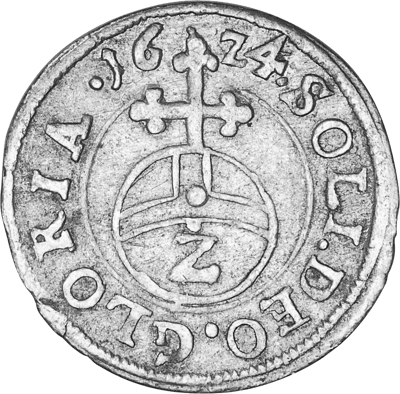
- Reverse: the imperial orb with cross, the denomination shown within the sphere – often rendered as a "Z" for the two. The year is placed above, divided by the cross, along with the motto SOLI DEO GLORIA – "Glory to God alone."
- Cataloguing: listed under KM# 128 as well as Hahn 93; Munich is primarily documented as the mint.
Four Kreuzer made up one Batzen. This piece is the half – the coin denomination in which, in the 17th century, bread, beer, cartage fees, and mercenary pay were settled.
On Condition: Circulated Coinage with a Biography
These pieces are circulated coinage – and they look the part. Darker patina, individual centering, small nicks, wear, and areas where the legend is more weakly struck: these are not flaws but biography. Every trace stems from hands that, centuries ago, used it to settle payments for goods, freight, or debts.
Since the year of minting, mint location, and reverse variant can vary, the piece delivered may differ from the image shown. Please understand the photo in our shop explicitly as a representative image: appearance, exact weight, and condition vary from piece to piece for historical reasons. Likewise, the fineness does not follow a modern standard but rather the coinage standard of its time. You are acquiring an original – not a restrike, not a copy.
Why Silver – and Why This Particular Piece?
Silver has accompanied humankind as a monetary metal for millennia. It served as a medium of trade, a status symbol, and a means of payment for everyday small amounts. The Halbbatzen fulfills this role in miniature form and illustrates what today's silver coins essentially provide as well: tangible value instead of a printed promise.
- Substance instead of trust: Unlike fiat money, whose value rests solely on trust in governments, silver has an intrinsic value derived from its physical properties.
- Industrial demand: Electronics, solar technology, and medical technology consume the metal to a growing extent, while supply remains limited.
- Small and divisible: This was precisely the historical strength of the Kreuzer – and it is precisely why investors today value small silver units as a building block for inflation hedge and as a quiet reserve.
- Durability: Silver does not age. It develops a patina – as this piece impressively demonstrates – yet retains its properties over centuries.
- Tax framework: Profits from the sale of silver are, in principle, tax-free in Germany, provided the holding period is at least one year.
For Collectors, for Keepers, for Gift-Givers
Compared with common bullion coins made of fine silver, the appeal here is different: the Halbbatzen does not live off its fine weight but off its provenance. Anyone focused on pure metal weight should turn to modern strikes. Anyone wanting to hold history in their hands should turn here. Both complement each other perfectly – one side provides mass, the other meaning.
As an entry point into Old German numismatics, this piece is a charming door-opener: significant, manageable, affordable. Experienced collectors use it to complete Wittelsbach series or thematic collections on the Thirty Years' War. And as a gift, a 400-year-old silver coin almost always makes a stronger impression than any greeting card.
Precious metals have outlasted wars, currency reforms, and state bankruptcies. Gold is humanity's oldest currency and has outlived all others; silver stands right alongside it as a monetary metal. This Kreuzer is physical proof of that: the electorate that issued it has long since ceased to exist – yet the metal in your hand still does. This is precisely why historic coinage and investment silver belong in every well-considered crisis protection plan that thinks beyond a single generation.
Product depiction may differ from the final product.
