
 280,000
  30 years
  Secure


1/2 Silver Gulden Free City of Danzig "Kogge" (1923 | with Coat of Arms)












 Popular Product: Among the top 10 in category German Empire until 1945
- Collector coin: Especially interesting for collectors
- Secure shipping: 100% insured & anonymous delivery
 Price alert set
 share
share
Personal consultation
Get free advice from one of our precious metals experts - we look forward to your call!
1/2 Gulden „Kogge“ of the Free City of Danzig – Hanseatic History in Genuine Silver
- Historical original: genuine circulating currency of the Free City of Danzig, catalogued as Jaeger D 6 and KM# 144
- Precious metal: 750/1,000 silver – 1.87 g fine silver at 2.5 g gross weight
- Minting quality: circulated coinage with naturally developed patina – deliberately not a modern collector's product in Proof (PP)
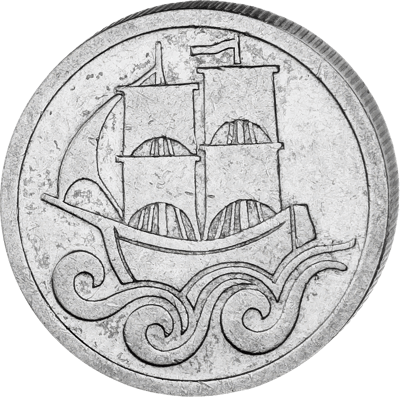
- Classic design: stylised cog (Kogge) over a wave ornament, value side with the Danzig coat of arms and year
- Handy format: just 19.50 mm in diameter – small, divisible, space-saving to store
- Tax advantage: gains are generally tax-free after a holding period of at least one year
- Investment purpose: a collector's item and contemporary witness to the hyperinflation of 1923 at the same time
- Shipping: insured value shipping
There are coins you buy. And there are coins you read. This half gulden clearly belongs to the second category: a small piece of silver, minted in the very year the German paper mark literally vanished into nothing.
1923: When Danzig Gave Itself a Hard Currency of Its Own
With the Treaty of Versailles taking effect, Danzig was separated from the German Reich on 10 January 1920 and placed under the protection of the League of Nations as a Free City. Initially, the paper mark remained in circulation – until hyperinflation tore it apart. On 26 October 1923, the Free City of Danzig introduced the Danzig gulden, divided into 100 pfennig; on 18 December 1923 it became the sole legal tender. Crucially, it was pegged not to the mark but to the British pound. 25 Danzig gulden equalled one pound sterling.
The face value gulden thus stood for stability after the collapse of a paper currency. Whoever holds this piece today holds a city's answer to devalued money – rendered in precious metal, not in printer's ink.
Cog and Coat of Arms: A Design Like a Seal
One side shows the stylised cog, the bulging trading ship of the Hanseatic League, carried by an elegantly curved wave band. The value side bears, in Fraktur script, „Freie Stadt Danzig“, the denomination „1/2 Gulden“, the year, and between them the Danzig coat of arms with the two crosses beneath the crown. Both dies were created by engraver Otto Fischer. The cog was no isolated case: it also appeared on the larger denominations of the first Danzig series, becoming the graphic hallmark of this short-lived currency.
Technical Data at a Glance
- Face value: 1/2 gulden
- Country of origin: Free City of Danzig (Free City of Danzig)
- Material: silver, fineness 750/1,000
- Gross weight: 2.5 g | Fine weight: 1.87 g
- Diameter: 19.50 mm
- Edge: reeded
- Catalogue numbers: Jaeger D 6, KM# 144
- Condition: bank-standard, circulated coin
- Series: History
What You Actually Receive
These pieces once served as money, and they bear the traces of it: darker patina, individual centring, nicks, wear, and in some cases weaker legend areas. That is precisely what makes them appealing. Since the year of minting, mint mark, and reverse variant can vary, the coin you receive will differ from the picture shown – you receive an original, not a mass-produced item. The 1923 vintage was minted in Utrecht with a mintage of around one million pieces; the later 1927 vintage was struck in Berlin and, at roughly 400,000 pieces, was considerably scarcer. On 1 April 1932 this type was withdrawn from circulation – since then it has been purely a collector's item.
Please understand that the image shown in the shop is an example and may differ individually from the item delivered in terms of appearance and condition due to historical circumstances.
Silver: Substance Instead of Promises
Silver has been a coinage metal, a store of value, and a symbol of wealth and prestige for thousands of years. Unlike fiat money, which relies on trust in governments, it possesses an intrinsic value derived from its physical properties. Add to that the strong industrial demand from electronics, solar, and medical technology, while available supply remains limited. The metal is durable, traded worldwide as a commodity, and highly liquid. Small denominations like this half gulden are also suitable as a means of exchange in times of currency instability and therefore belong in many portfolios for inflation hedging and crisis protection. And a point investors like to hear: profits from the sale of physical silver coins are generally tax-free, provided the holding period was at least one year.
Comparison with Other Historical Small Silver Coins
Compared to a 1/2 mark of the German Empire, which was made of 900 silver, the fineness here is somewhat lower. On the other hand, the Danzig collecting field is tightly defined, the number of vintages is manageable, and the historical significance is greater. The half gulden of 1932 was already struck in nickel – so the 1923 issue has the decisive advantage of genuine silver at its core. And compared to shiny new mintings, this piece offers something no modern issue can provide: a biography.
Who This Piece Is Worth It For
For newcomers to historical silver coins, for collectors of German minor territories, for lovers of maritime designs – and for anyone wishing to pass tangible assets down through generations. Gold and silver are humanity's oldest currencies and have outlived every paper currency. This little cog has been sailing through history for over a hundred years. It deserves a place in your collection.
Product depiction may differ from the final product.
