





Silver Denarius Empress Faustina the Younger (145-175 AD | Wife of Emperor Marcus Aurelius)
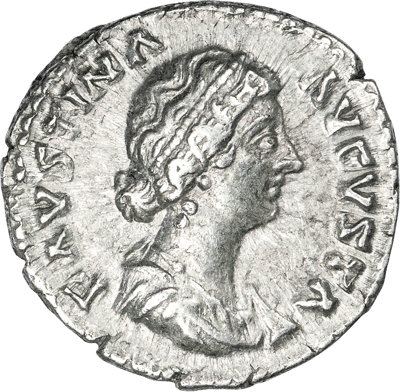











- Genuine Original: hand-struck
- Fine Portrait: elaborate hairstyle
- Augusta and Diva: worshipped as goddess
- Genuine OriginalGenuine Roman currency, each piece one of a kind
- Fine PortraitBraided hairstyle and inscription FAVSTINA AVGVSTA
- Augusta and DivaAfter her death in AD 175 she was elevated to goddess
 Price alert
  Share
ShareSilver Denarius of Empress Faustina Junior – an Original from the Roman Imperial Era
Some coins are an investment, some are history. This Silver Denarius of Empress Faustina Junior is both: a genuine, hand-struck means of payment from the Roman Empire, minted between 145 and 175 AD, bearing the portrait of the wife of the philosopher emperor Marcus Aurelius. Whoever holds it in their hand holds nearly two millennia of monetary history between their fingers – and a piece of silver that has outlasted the fall of the empire, countless currencies and entire ages.
The denarius was the leading coin of Rome for centuries. From around 211 BC into the 3rd century AD, it formed the silver backbone of the Roman economy: it paid legionaries, grain, taxes, wages. This piece therefore belongs to a series of historic silver coins that prove just how old the trust in precious metal as money really is.
The Empress Behind the Portrait
Annia Galeria Faustina, known in numismatics as Faustina Minor or Faustina the Younger, was the daughter of Emperor Antoninus Pius and Faustina Maior. Born around 130 AD, she married the future Emperor Marcus Aurelius at about the age of 15 in the year 145. A few years later she was elevated to Augusta – a title that, in terms of protocol, even placed her above her husband.
The marriage was unusually rich in children; ancient sources speak of around a dozen offspring, among them the future Emperor Commodus. Faustina accompanied Marcus Aurelius on his travels and campaigns and died in 175 AD in Asia Minor. Her husband had her deified as Diva, remained a widower until his own death, and renamed her place of death Faustinopolis. Her image remained present on the empire's coinage, as coins were the mass media of antiquity.
Gold and silver are the oldest currencies of mankind – and they have outlived every paper promise that came after them.
Obverse, Reverse, Coin Design
- Obverse: draped bust of the empress facing right, elaborately braided hairstyle, surrounded by the legend FAVSTINA AVGVSTA.
- Reverse: depending on the variant, a standing or enthroned deity or personification – frequently Venus, alongside others such as Concordia, Fecunditas, Laetitia or Fortuna, usually holding a sceptre, cornucopia or other attributes.
- Face value: Denarius (numismatically: AR Denarius, Roman Empire, Faustina II), minted predominantly in Rome.
- Gross weight: 3.2 g with a diameter of 18 mm.
- Material: silver in ancient coin alloy; an exact fineness is not stated, as the fineness and weight of Roman denarii varied from batch to batch.
Unlike modern bullion coins, denarii were produced purely by hand: a cast blank, two dies, a firm hammer blow. This makes every specimen unique – with its own centring, its own die image, its own patina. In collectors' catalogues, the respective reverse is identified via the RIC number; which variant you receive is determined by the chance of survival through history.
Condition: Circulated Money with Character
These denarii were genuine means of payment and bear the traces of their circulation: darker patina, individual centring, nicks, wear and sometimes weaker legend areas. This is precisely what makes them appealing. Since the year of minting, mint and reverse variant can vary, the specimen delivered will differ from the image shown – you receive an original, not a mass-produced product. Please understand that the image in the shop serves as an example and may individually differ from the delivered item in terms of appearance and condition due to historical circumstances. Shipping is carried out as insured value shipping.
Why Silver, Why Ancient?
Silver has been a store of value, a medium of exchange and a coinage metal for thousands of years – a symbol of wealth and prestige in many cultures. It has intrinsic value, is traded worldwide as a commodity and is in strong demand in industry: electronics, solar and medical technology drive demand, while supply remains limited. Especially in small units, silver serves as a medium of exchange in times of currency instability. Many investors therefore hold it as an inflation hedge and as a solid building block for their crisis protection.
- Collector's value plus metal value: historical originality that no re-minting programme can replicate.
- Entry into ancient numismatics: empresses' denarii are a popular collecting area and considerably more affordable than golden aurei.
- Tax framework: in Germany, profits from the sale of silver are generally tax-free provided the holding period is at least one year.
- Preservation of value across generations: silver is durable and retains its physical properties – ideal for passing on wealth.
- High liquidity: silver is traded worldwide and can be readily sold at any time.
Comparison: Faustina Junior and Other Ancient Denarii
Compared to a denarius of Marcus Aurelius or Trajan, Faustina Junior scores with a finer, often strikingly aesthetic female portrait – the elaborate hairstyles of the empresses provided a stage for the die engravers. Denarii of Faustina Maior, Lucilla or Julia Domna complement the theme "Empresses of Rome" excellently; those collecting chronologically can combine this piece with coins of Antoninus Pius. The disadvantage compared to modern bullion silver coins is obvious: no guaranteed fineness, no exact fine weight, no uniform series quality. The advantage is exactly the same point – individuality, rarity and a historical context that makes a denarius a talking point. Incidentally, the silver content of the denarius continued to decline over the course of the imperial era due to the addition of copper alloy; by around 200 AD it stood at only around 40 to 50 percent. Pieces from the Antonine period therefore belong to a still notably silver-richer phase of Roman monetary history.
For collectors of ancient coins, for lovers of Roman history and for all those who wish to give their physical precious metal holdings a narrative dimension, this denarius is an item with character. A small piece of silver, minted for an empress, passed through Roman hands – and today in your collection.
Product depiction may differ from the final product.
