





Silver Denarius Emperor Trajan (106-117 AD | Rome's Most Successful Ruler)
Unfortunately, this item is currently out of stock. We will be happy to send you an e-mail as soon as this product becomes available again.
- Genuine Original: from ancient Rome
- Emperor's Portrait: with laurel wreath
- Rome's Golden Age: valuable coin silver
- Genuine OriginalHand-struck and in circulation 1,900 years ago
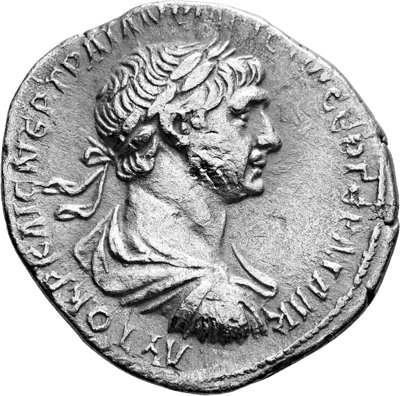
- Emperor's PortraitHailed by the Senate as the best ruler ever
- Rome's Golden AgeMinted before Rome sharply cut the silver content
 Price alert
  Share
ShareDenarius of Emperor Trajan – 1,900 years of world history in your hand
Hand-struck, circulated, genuine: this denarius made of silver was once ordinary currency in the Roman Empire. It changed hands in markets, paid soldiers, wine, grain and road tolls. It was struck under Marcus Ulpius Traianus – the emperor the Senate hailed as optimus princeps, the best ruler of all. Whoever holds this coin holds an original from the golden age of the Roman Imperial era.
Optimus Princeps: Why Trajan is considered Rome's most successful emperor
Trajan ruled from January 98 until his death in August 117 AD. He came from Italica in Hispania, making him the first Roman emperor to originate from a province. Under him, the Roman Empire reached its greatest territorial extent – a record no successor ever surpassed.
- Dacian Wars 101/102 and 105/106 AD: The victory over Decebalus brought the resource-rich province of Dacia and vast quantities of precious metal to Rome.
- Province of Arabia, 106 AD: The annexation of the Nabataean kingdom was explicitly proclaimed and celebrated on the emperor's coins.
- Parthian War 113–117 AD: Armenia and Mesopotamia came under Roman control, pushing the empire's border far to the east.
- Trajan's Column and Forum Traiani: Built between 107 and 113 by Apollodorus of Damascus, the forum significantly exceeded all previous imperial forums in size.
- Adoptive emperorship: With Nerva and Trajan began the era of the Nerva–Antonine dynasty, regarded as the most glorious phase of the Empire.
On August 8, 117, Trajan died in Selinus in Cilicia; he was succeeded by his adoptive son Hadrian. His reputation outlived him for centuries: later rulers were wished to be luckier than Augustus and better than Trajan.
Design: imperial portrait and varying reverses
The obverse always shows Trajan's laureate portrait in profile, surrounded by the imperial titulature. The reverses, however, are delightfully varied: victory goddesses, personifications such as Pax, Fortuna, or Arabia, military standards – or, as in the example pictured from the eastern half of the empire, a striding dromedary symbolizing the province of Arabia Petraea, established in 106 AD. Which variant you receive is left to the chance of history.
The denarius: 500 years as Rome's leading silver currency
The denarius was Rome's most important silver coin for roughly five centuries. Introduced towards the end of the 3rd century BC, it initially weighed about 4.55 g with very high fineness. Weight and silver content were reduced several times during the Imperial era; by around 200 AD the silver content had dropped to only around 40 to 50 percent, and later the denomination collapsed entirely. A denarius of Trajan therefore still dates from the period when this coin was high-quality legal tender – a point collectors of ancient silver coins know very well.
Compared to other imperial denarii
Compared to a denarius of Emperor Hadrian (117–138), the Trajan denarius scores with the aura of the conqueror and the empire's greatest territorial extent; Hadrian, by contrast, stands for consolidation and architecture. Coins struck considerably later, such as those from the era of Septimius Severus, are often cheaper to obtain but noticeably contain less coin silver in the blank. Anyone wishing to combine historical significance with material quality turns to the adoptive emperors – Trajan being the most prominent name among them.
Key facts at a glance
- Country: Roman Empire
- Face value: Denarius
- Minting period: 106–117 AD, year of issue, mint and reverse vary
- Precious metal: Silver, ancient coin alloy without modern fineness specification
- Gross weight: approx. 3.2 g
- Diameter: approx. 18 mm
- Production: hand-struck hammer minting
- Condition: circulated coin, grade of preservation varies
- Investment purpose: collector's item, "History" series, shipped as insured value shipment
Condition: circulated currency with character
These pieces are circulated currency and bear corresponding traces: darker patina, individual centering, nicks, wear, and in places weaker areas of the legend. This is precisely what makes them appealing. Since the year of issue, mint, and reverse variant may vary, the piece delivered will differ from the picture shown – you are receiving an original, not a mass-produced item. We therefore ask for your understanding that the image in the shop serves as an example and the delivered item may individually differ in appearance and condition due to historical circumstances. Each of these coins was struck by hand.
Ancient silver as a tangible asset
Silver has been a monetary and coinage metal for millennia, a symbol of wealth and prestige – and a store of value with intrinsic worth. Unlike fiat money, whose purchasing power depends solely on trust in governments, silver carries its value within the material itself. Added to this is real demand from electronics, solar and medical technology, combined with limited availability and limited supply. Physical precious metal thus remains a classic building block for inflation hedging and crisis protection.
A denarius of Trajan survived the fall of the Western Roman Empire, countless currency reforms, and every paper money crisis. The coin is still here today – trust in the currencies that came after it, mostly, is not.
A note for collectors: profits from the sale of silver are generally tax-free, provided the minimum holding period of one year is observed. Silver is also durable, easily divisible, and liquid – qualities that make it attractive for smaller transactions as well as for passing on wealth across generations.
Who this denarius is suited for
For newcomers to ancient numismatics, the Trajan denarius is an ideal starting point: a well-known emperor, a clear portrait, a manageable format, and an accessible entry point. Collectors of the Roman Imperial era can use it to bridge the gap between Nerva, Hadrian, and Marcus Aurelius. And for those wishing to pass tangible assets on to children or grandchildren, this is a keepsake that tells a story – each piece a unique item, struck by a hand that turned to dust nearly two millennia ago.
Product depiction may differ from the final product.