





Silver Denarius Emperor Domitian (81-96 AD | Completion of the Colosseum)
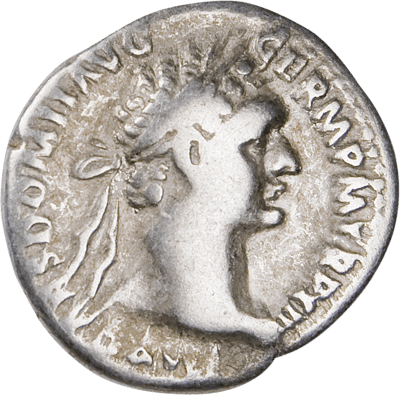











- Genuine Original: hand-struck
- A Survivor: despite being melted down
- Striking Designs: Emperor and Minerva
- Genuine OriginalMinted almost two thousand years ago in the Roman Empire
- A SurvivorThe Senate had its coins withdrawn and melted down
- Striking DesignsLaureate emperor portrait, often Minerva on the reverse
 Price alert
  Share
ShareSilver Denarius of Emperor Domitian – Hand-Struck Money from the Era When the Colosseum Was Completed
Some coins have to be talked about. This denarius speaks for itself. It is made of silver, weighs around 3.2 grams with a diameter of about 18 millimetres, and was hand-struck almost two thousand years ago in the Roman Empire – die on blank, hammer blow, done. No machine, no series production. The original you hold in your hand was genuine legal tender in a metropolis where the largest amphitheatre of antiquity was just taking on its final shape.
Domitian – the Emperor Who Completed the Colosseum
Titus Flavius Domitianus ruled from 14 September 81 until his assassination on 18 September 96 AD. As the successor to his brother Titus and son of Vespasian, he was the third and last ruler of the Flavian dynasty, which had come to power after the chaotic Year of the Four Emperors in 69 AD. Hardly any other emperor left such a mark on Rome's architecture: the rebuilding of the Capitol, the Forum Transitorium, the Arch of Titus, the monumental imperial palace on the Palatine Hill – and, of course, the completion of the Colosseum, which received, among other things, its underground passages under his reign.
After the assassination, the Senate imposed the damnatio memoriae: his memory was to be erased. Images were destroyed, coinage was withdrawn and melted down. This is precisely why every surviving piece is a small triumph over the will of the chroniclers. Modern scholarship now views Domitian considerably more favourably: as a capable administrator with sound fiscal policy and military successes in Germania and along the Danube.
Minerva – the Hallmark of His Coinage
Minerva, goddess of wisdom and war, appears strikingly often on the reverses. Domitian commissioned four representational types of the goddess, which became the dominant motif of his silver coinage – ready for battle with a spear, bearing the aegis, sometimes with the small owl at her feet. The obverse shows the laureate portrait of the emperor, surrounded by the abbreviated titulature. For collectors, these titles are a gift: consular, imperial and censorial numbers often allow a denarius to be dated to the exact year.
Key Facts at a Glance
- Face value: Denarius
- Emperor: Domitian (81–96 AD)
- Precious metal: Silver – no fineness specified, as ancient coinage naturally varies
- Gross weight: approx. 3.2 g
- Diameter: approx. 18 mm
- Origin: Roman Empire
- Year of issue, mint, reverse variant: varies
- Series: History · Collector's product · Shipped as insured value shipment
Condition: Circulated Coinage with Two Thousand Years of History
These pieces are circulated legal tender and bear corresponding traces: darker patina, individual centring, nicks, wear, and in some cases weaker legend sections. This is exactly what makes them appealing. Since the year of issue, mint, and reverse variant may vary, the specimen delivered will differ from the image shown – you receive an original, not a mass-produced item. Please understand that the image in the shop is a representative example and may differ individually from the delivered item in terms of appearance and condition due to historical circumstances. Each of these coins was hand-struck.
Context: Why a Flavian Denarius in Particular?
The denarius was Rome's predominant silver coin for around 500 years. In the 1st century, its fineness was still high, and its diameter typically ranged from 17 to 18 millimetres – placing the Domitian denarius firmly within the finest phase of this denomination. Later, matters deteriorated: under Trajan, the silver content declined, further still under Septimius Severus, and under Caracalla the denarius lost its leading role to the Antoninianus.
- Compared to later denarii (such as those under Commodus or Caracalla): higher silver content, bolder relief, more classical portraiture.
- Compared to large bronzes such as the sestertius: smaller and less conspicuous, but made of precious metal and considerably easier to store.
- Compared to modern bullion coins: no precisely defined fine weight, but a collector's value that does not derive from the metal alone.
Silver: A Tangible Asset with a Very Long Memory
Anyone collecting ancient silver coins is buying two things at once: history and precious metal. Silver served as money and a trading metal in almost every advanced civilisation; it is durable, traded worldwide, and retains its physical properties over millennia – this denarius is the best proof of that. On top of this comes industrial demand from electronics, solar, and medical technology, meeting a naturally limited supply.
Fiat money depends on trust in its issuer. A piece of silver carries its value within itself – from the Roman marketplace to today.
As a tangible asset, silver is traditionally held for inflation protection and as a crisis hedge; small units are also suitable as a means of exchange in times of currency instability. Physical silver is liquid, divisible, and can be passed down through generations. For tax purposes in Germany: profits from the sale of silver are generally tax-free, provided the minimum holding period of one year is observed.
Who This Denarius Is Made For
For newcomers to ancient numismatics who wish to begin with a well-known emperor's name and a strong historical hook. For collectors of the Flavian era. For anyone seeking a gift with more substance than any greeting card. And for enthusiasts who take pleasure in holding a piece of Rome in their hands that had already passed through many hands when the arena was still in use.
Product depiction may differ from the final product.
