





1 Sechsling Free Hanseatic City of Hamburg (1823-1855 | with City Coat of Arms)
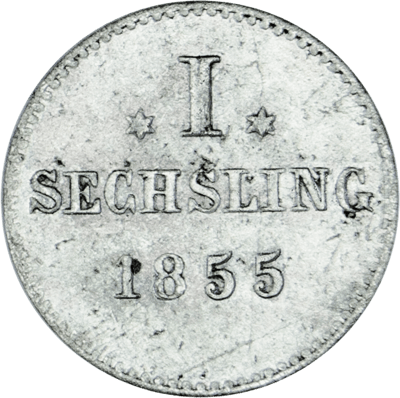











- Genuine Currency: living history
- Final Minting: tradition since 1388
- The Hammaburg: Hamburg's emblem
- Genuine CurrencyOnce carried in the pockets of dockworkers and merchants
- Final MintingThe denomination in its last form before the Reich currency
- The HammaburgThree-towered castle as a symbol of freedom and civic pride
 Price alert
  Share
Share1 Sechsling of the Free Hanseatic City of Hamburg (1823–1855) – Small Change from the Gateway to the World
- Historical Original: genuine legal tender of the Free Hanseatic City of Hamburg from the 19th century, minted between 1823 and 1855.
- Precious Metal: silver with a fineness of 500/1,000 – the typical billon character of northern German small coins.
- Format: a mere 14.00 mm in diameter with a raw weight of around 0.78 g – a hand-friendly gem of numismatics.
- Design: the Hamburg city coat of arms with a three-towered castle, a cross on the central tower, and two six-pointed stars.
- Minting Quality: deliberately not "Proof" (PP), but circulated goods in bank-standard condition with a naturally developed patina.
- Tax Aspect: profits from the sale of silver are generally tax-free, provided the holding period is at least one year.
- Collecting Area: part of our "History" series – a collector's item with Hanseatic origins and a clear provenance story.
Some coins are large, heavy, and loud. This Sechsling is the opposite: tiny, light, unassuming – and yet a witness to history of the first order. It lay in the pockets of dock workers, shopkeepers, and merchants as Hamburg rose to become the most important trading city of northern Germany. Whoever holds it in their hand holds the everyday history of the Hanseatic city between their fingers.
The Sechsling: A Half Shilling with Hanseatic Tradition
The Sechsling – regionally also called Sößling or Sechser – was worth six pfennigs, and thus half a shilling. It was first minted by Lübeck in 1388; through the Wendish Coinage Union of the Hanseatic League, the denomination quickly spread to Hamburg, Lüneburg, and Wismar. East of the Elbe, the Reichstaler had been reckoned at 48 shillings since 1622, meaning 96 Sechslinge made up one taler. In Hamburg itself, the rule was: 16 shillings equaled one mark. And in 1855, the Hanseatic city set the final point – the very last Sechslinge ever produced were made from a billon alloy. So you are acquiring this denomination in its very last form, shortly before the German Empire and the imperial currency replaced the old city denominations.
The City Coat of Arms: The Hammaburg as a Trademark
One side shows the value plainly: "I SECHSLING," flanked by two six-pointed stars, with the year below. The other side belongs to the famous Hamburg city coat of arms – that three-towered castle with a closed gate, whose central tower is crowned by a cross. This coat of arms still stands today for resilience, freedom, and civic pride. Hardly any design condenses Hamburg's identity so clearly onto 14 millimeters.
A Sechsling was no fortune – but it bought bread, beer, and ferry fare. That is exactly where its appeal lies: it tells of real life, not of representation.
Circulated Goods with Character – What You Receive
These pieces were circulated legal tender and bear corresponding traces: darker patina, individual centering, nicks, wear, and in some cases weaker lettering. That is exactly what makes them appealing. Since the minting year, mint, and reverse variant can vary, the piece delivered will differ from the image shown – you receive an original, not a mass-produced item. Please understand that the image in the shop serves as an example and may individually differ from the delivered item in terms of appearance and condition due to historical circumstances. For 1855, incidentally, both pieces without a mint mark and specimens with the letter "A" are known – an additional incentive for variety collectors.
Anyone looking for mirrored surfaces and matte reliefs, as modern collector's coins offer in Proof, has deliberately taken a wrong turn here. Historical circulated goods live from signs of use. They are proof that this small coin truly did its job.
Silver: A Store of Value with a Long Tradition
Silver has been a coinage metal and store of value for thousands of years, a symbol of wealth and prestige in many cultures. Unlike fiat money, whose purchasing power depends on trust in governments, silver possesses intrinsic value – not least because of its strong industrial demand in electronics, solar, and medical technology. Supply is limited, the metal is durable, traded worldwide as a commodity, and highly liquid. As a building block for wealth preservation, inflation hedging, and crisis protection, physical precious metal belongs in every well-thought-out asset structure. Gold is humanity's oldest currency and has outlived all others; silver has always accompanied it as the money of everyday life – divisible, familiar, recognized everywhere in the world.
Comparison: Sechsling, Dreiling, and Larger Denominations
- Sechsling vs. Dreiling: The Dreiling was worth only three pfennigs and is even smaller. The Sechsling feels more substantial in hand and shows the coat of arms more clearly.
- Sechsling vs. Shilling and 8 Shilling: Larger Hamburg denominations contain more fine silver but cost correspondingly more. The Sechsling remains the affordable entry point into the Old German collecting area.
- Sechsling vs. Taler and Speciestaler: Taler coins are representative, while small coins tell the story of daily trade in the harbor. Both complement each other perfectly in a collection.
- Sechsling vs. Modern Silver Coins: Investment classics score with high fine silver content, while historical small coins appeal through rarity, age, and history.
For Collectors and Investors
For collectors, the Sechsling is a must-have piece in the field of Old Germany and northern German city coinage. For investors who value tangible assets, it is a charming addition alongside the major classics: the smallest denominations are divisible, inconspicuous, and historically proven as a means of exchange in times of currency instability. And as a keepsake passed down through generations, this Hamburg original quietly bridges the gap from one generation to the next.
Product depiction may differ from the final product.
