





Bronze Follis Emperor Constantine II (337-340 AD | Constantinian Dynasty)
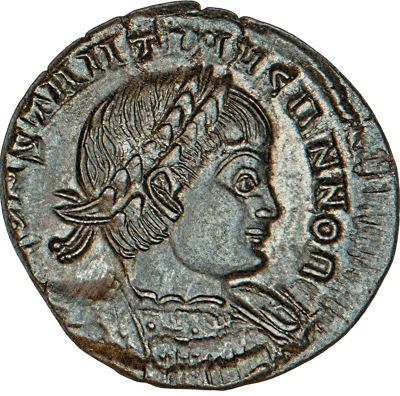











- Genuine Original: around 1,700 years old
- Imperial History: Emperor of the West
- Emperor Portrait: with laurel wreath
- Genuine OriginalNo restrike, but real Roman currency
- Imperial HistoryMinted under the eldest son of Constantine the Great
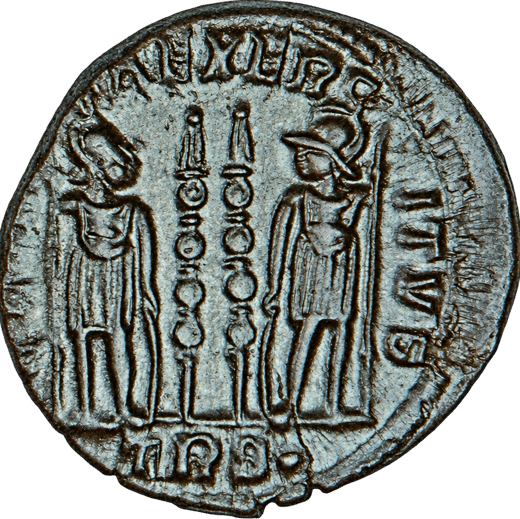
- Emperor PortraitBust in profile, often soldiers on the reverse
 Price alert
  Share
ShareAncient original
The Constantinian dynastyFollis of Constantine II
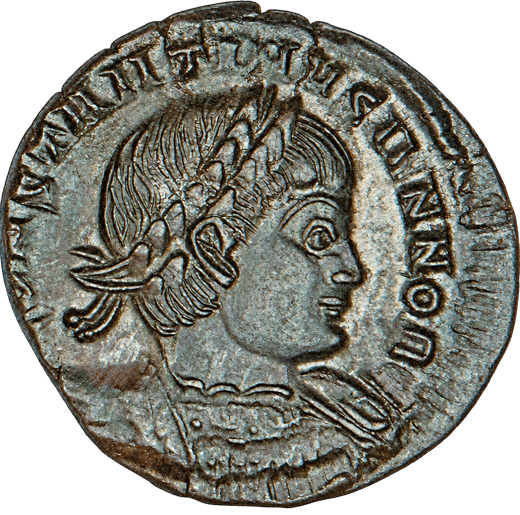
You are looking at the front.
Between the day someone struck this piece with a single hammer blow and the day you hold it, there are roughly
1,700years
- Struck by hand
- Original, not a restrike
- 20mm across
- 30 days return policy
Where it belongs
Eleven epochs, a thousand years, one shelf.
Under Constantine Christianity became permitted and soon preferred, the capital moved to the Bosphorus, and the coinage moved with it: fewer gods, more standards, camps and victory signs. His sons divided the empire between them and went to war with each other.
7th to 5th century BC
Archaic Greece
5th to 4th century BC
Classical Greece
6th century to 330 BC
Achaemenid Persia
5th to 2nd century BC
Carthage
336 to 30 BC
The hellenistic age
3rd to 1st century BC
Celtic tribes
27 BC to AD 235
The Roman empire
AD 235 to 284
Crisis of the third century
AD 284 to 313
The tetrarchy
AD 306 to 363
The Constantinian dynasty
Your piece
AD 395 to 1453
The eastern Roman empire
Keeping it
First things first: do not clean it.
The dark layer on bronze and the matte grey on silver are called patina. It has grown over centuries and collectors treat it as a mark of authenticity. Polishing it away does not give you a nicer piece, it gives you a damaged one: auction houses regularly value a brightly cleaned coin below the same coin with its patina intact.
Hold it by the edge
Fingerprints contain acid and salt. Take the piece between thumb and forefinger by the rim, over a soft surface.
Store it dry and dark
Moisture is the only real enemy. A pouch or a capsule in a dry place is enough; PVC sleeves are not, they attack the surface.
No agents, no brush
No vinegar, no silver cloth, no ultrasound. If you want a crust removed, let a conservator do it, not the kitchen sink.
Bronze Follis of Emperor Constantine II – World History That Fits in the Palm of Your Hand
Around 1,700 years old, 2.2 grams in weight, 20 millimeters in diameter. This bronze follis was once an entirely ordinary means of payment in the Roman Empire: it changed hands in marketplaces, was paid out to legionaries, and jingled in the pouches of merchants between Trier and Antioch. Minted under Constantine II, the eldest son of Constantine the Great. Whoever holds it is holding an original Roman coin – no restrike, no modern copy, but a genuine testament to Late Antiquity.
Constantine II: The Son Who Reached for Power Too Soon
Flavius Claudius Constantinus was born in February 316 in Arelate, present-day Arles. As early as 317 – when he was still a small child – his father raised him to the rank of Caesar, or sub-emperor. Growing up in the shadow of the most powerful man of the ancient world, he governed Gaul, Britain, and Hispania from Trier. When Constantine the Great died in 337, his three sons assumed the title of Augustus and divided the empire among themselves. Constantine II received the West. But his hunger for power exceeded his patience: in 340, he fell in a fratricidal war against Constans near Aquileia. Three years of sole rule, an entire chapter of world history – and coins like this one that tell its story.
What Exactly Is a Follis?
The term derives from the Latin word for "pouch"; the ancient name for this denomination was simply Nummus. Originally, a follis weighed about ten grams and carried an extremely thin coating of silver over the bronze. Under Constantine the Great, the denomination was reduced in size and revalued several times – the late folles of the Constantinian dynasty are therefore compact, easy-to-handle bronze pieces. The specimens offered here originate precisely from this period.
The Facts at a Glance
Face value: Follis
Country / Origin: Roman Empire
Issuing ruler: Constantinus II (Emperor 337–340 AD)
Gross weight: 2.2 g
Diameter: 20 mm
Material: Bronze, fineness and fine weight vary
Year of issue, mint, and denomination: vary
Condition: These pieces are circulated currency and bear corresponding traces: darker patina, individual centering, nicks, wear, and in some cases weaker legend areas. This is precisely what constitutes their appeal. Since the year of issue, mint, and reverse variant may vary, the item delivered will differ from the picture shown – you receive an original, not a mass-produced item. We therefore ask for your understanding that the image in the shop serves as an example and may individually differ from the delivered item in terms of appearance and condition due to historical circumstances.
Series: History · Investment purpose: Collector's item
Design: GLORIA EXERCITVS – The Glory of the Army
The obverse shows the laureate bust of the ruler in profile facing right, surrounded by the imperial legend. Many specimens of this era carry the inscription GLORIA EXERCITVS on the reverse – two helmeted soldiers with spear and shield, with the military standards between them. One of the most successful iconographic formulas of Late Antiquity, struck throughout the empire because it perfectly captured the alliance between the imperial house and the army. As this is circulated currency, the mint, legend details, and patina differ from piece to piece. Chips at the edge, off-center strikes, and a naturally developed green-brown patina are entirely normal for ancient coins – they are not flaws, but evidence of authenticity and use.
Who This Follis Is Suited For
For beginners seeking an affordable entry into ancient numismatics
For collectors of Roman coins who wish to complete the Constantinian dynasty
As a gift with real substance – hands-on history lessons
As a historical complement to modern silver coins and bars in one's own holdings
Coins are witnesses to history, not merely objects. This follis has outlasted emperors, wars, and the fall of a world empire.
Ancient Bronze Compared to Modern Bullion Coins
A modern silver or gold bar derives its value from the metal itself, from precisely defined fineness and current daily valuation. With ancient coins, it's different: here, history, condition, design, and rarity matter. The bronze follis is therefore explicitly a collector's item, not a classic investment product – but in return, it offers something no newly minted year of issue can provide: an unbroken connection to the Romans of the fourth century. Those who combine both gain collector's enjoyment and tangible-asset thinking under one roof.
For coin history shows one thing unmistakably: paper currencies have come and gone, empires have crumbled, yet precious metal has endured. Gold is humanity's oldest currency and has outlived all others – a thought that holds true both for inflation hedging and for crisis protection. This small lump of bronze from the era of Constantine II is a reminder of this in its own quiet way. It is offered as a fixed-price item and is, of course, delivered to you via insured shipping.
Product depiction may differ from the final product.
