





Bronze Follis Emperor Constantine I the Great (306-337 AD | Rise of Christianity)











- Genuine Original: around 1,700 years old
- Imperial Design: glory of the army
- Gift Idea: for history enthusiasts
- Genuine OriginalAncient circulating coin from the Roman Empire, not a replica
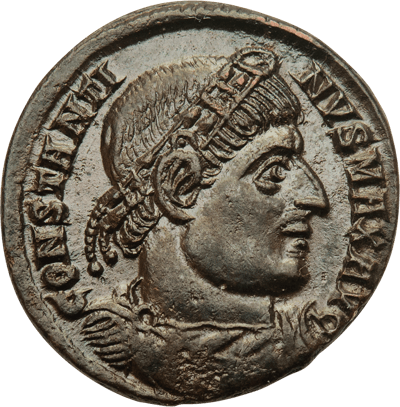
- Imperial DesignEmperor's portrait with diadem, two soldiers with standards
- Gift IdeaIdeal for godchildren and confirmands with a sense of history
 Price alert
  Share
ShareAncient original
The Constantinian dynastyFollis of Constantine I


You are looking at the front.
Between the day someone struck this piece with a single hammer blow and the day you hold it, there are roughly
1,700years
- Struck by hand
- Original, not a restrike
- 20mm across
- 30 days return policy
Where it belongs
Eleven epochs, a thousand years, one shelf.
Under Constantine Christianity became permitted and soon preferred, the capital moved to the Bosphorus, and the coinage moved with it: fewer gods, more standards, camps and victory signs. His sons divided the empire between them and went to war with each other.
7th to 5th century BC
Archaic Greece
5th to 4th century BC
Classical Greece
6th century to 330 BC
Achaemenid Persia
5th to 2nd century BC
Carthage
336 to 30 BC
The hellenistic age
3rd to 1st century BC
Celtic tribes
27 BC to AD 235
The Roman empire
AD 235 to 284
Crisis of the third century
AD 284 to 313
The tetrarchy
AD 306 to 363
The Constantinian dynasty
Your piece
AD 395 to 1453
The eastern Roman empire
Keeping it
First things first: do not clean it.
The dark layer on bronze and the matte grey on silver are called patina. It has grown over centuries and collectors treat it as a mark of authenticity. Polishing it away does not give you a nicer piece, it gives you a damaged one: auction houses regularly value a brightly cleaned coin below the same coin with its patina intact.
Hold it by the edge
Fingerprints contain acid and salt. Take the piece between thumb and forefinger by the rim, over a soft surface.
Store it dry and dark
Moisture is the only real enemy. A pouch or a capsule in a dry place is enough; PVC sleeves are not, they attack the surface.
No agents, no brush
No vinegar, no silver cloth, no ultrasound. If you want a crust removed, let a conservator do it, not the kitchen sink.
Bronze Follis of Emperor Constantine the Great – an Original from Europe's Turning Point
Some coins are simply beautiful. This one is a witness to history. The bronze follis of Emperor Constantine I the Great (306–337 AD) passed through the hands of Roman soldiers, merchants and craftsmen some 1,700 years ago – in precisely that era when Christianity rose from a persecuted faith to the defining force of the Empire. Whoever holds this piece is not holding a replica or a reprint, but genuine ancient circulating coinage from the Roman Empire.
The Coin Design: Imperial Portrait and GLORIA EXERCITVS
The obverse shows Constantinus I in profile facing right, diademed, draped and cuirassed, surrounded by the legend CONSTANTINVS MAX AVG – "Constantinus Maximus Augustus", Constantine the Great. The reverse is military propaganda in its purest form: two helmeted soldiers with spear and shield stand facing one another, between them two standards, above them the inscription GLORIA EXERCITVS, "Glory of the Army". In the exergue is the mint mark of the respective mint. On the piece depicted, it points to Arelate – present-day Arles, which was renamed Constantina in honour of the emperor. Such types were struck mainly in the 330s and circulated throughout the empire, from Britain to the Bosporus.
Technical Data at a Glance
Face value: Follis (in antiquity presumably referred to as Nummus)
Issuing authority: Emperor Constantine I the Great, 306–337 AD
Country: Roman Empire
Weight: 4.5 g
Diameter: 20 mm
Material, fineness and year of issue: varied – each piece is a unique ancient item
Condition: circulated coinage, bank-standard quality
Series: History · Shipped as insured mail
Constantine and the Rise of Christianity
Hardly any ruler has shaped Europe more lastingly. After his victory at the Milvian Bridge in 312, Constantine turned to the Christian god. A year later, the Edict of Milan of 313 between Constantine and Licinius guaranteed religious freedom to Christians throughout the empire. In 325, the emperor convened the First Council of Nicaea, whose formulations still resonate in the Creed today. And in 330 he dedicated his new residence on the Bosporus: Constantinople, the nucleus of the Eastern Roman Empire, which we today call Byzantium. This coin dates from the very heart of this upheaval.
A piece of metal that places the transition from pagan antiquity to the Christian West tangibly in the palm of your hand.
The Follis – Small Change of a World Empire
The follis was introduced around 294 as part of Diocletian's currency reform, explicitly to combat debasement and inflation. It rose to become the empire's most important copper coin, initially weighing around 10 grams with a diameter of 27 to 30 mm, and bore a wafer-thin coating of silver. Under Constantine I, the folles were revalued and reduced in size again around 330. The Latin name, incidentally, means "purse" or "money bag", recalling the sealed bags in which larger sums circulated. For those already familiar with denarii, sestertii and solidi, Constantine's follis is the most affordable genuine ancient original carrying great historical weight – gold coins of the imperial era play in an entirely different league.
Equally Appealing for Collectors and Investors
A genuine historical document rather than a modern reproduction – over 1,600 years old
Historical icon: the emperor under whom Christianity was set on the path to becoming the state religion
An ideal introduction to ancient numismatics and to the History series
A tangible asset you can hold in your hand, independent of digital booking systems
A popular gift for history enthusiasts and godchildren or confirmation candidates
Condition: Patina Tells a Story
These pieces were once circulating currency and bear the corresponding traces: dark bronze patina, individual centring, nicks, wear, and in places weaker areas of the legend. This is precisely what gives them their appeal. Since the year of minting, mint and reverse variant vary, the piece delivered will differ from the illustration – you receive an original, not a mass-produced item. We therefore ask for your understanding that the image shown in the shop is an example and may differ individually from the delivered item in terms of appearance and condition.
Preserving Value Across the Centuries
Gold is humanity's oldest currency and has outlived every paper currency. The follis of Emperor Constantine impressively illustrates how empires rise and fall while metal money endures. This very idea still holds true today: tangible assets as inflation hedge and as crisis protection. Combine this historical original as you wish with modern bullion coins from the silver coins category – history and the present blend together beautifully within the same collection.
Product depiction may differ from the final product.
