





Antoninianus Emperor Gallienus (260-268 AD | Age of the Imperial Crisis)











- Ancient Original: around 1,760 years old
- Radiate Crown: and cuirassed bust
- Hand-struck: every piece unique
- Ancient OriginalPassed through the hands of legionaries and traders
- Radiate CrownImperial portrait with pointed rays and fluttering ties
- Hand-struckIrregular shape and patina as signs of genuine age
 Price alert
  Share
ShareAncient original
Crisis of the third centuryAntoninianus of Gallienus


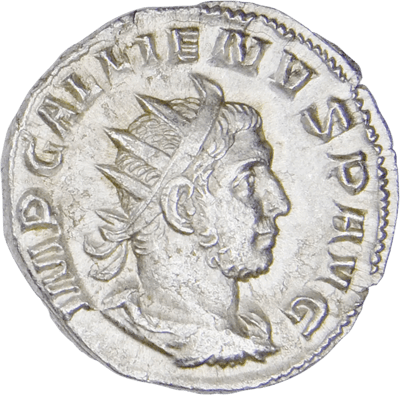
You are looking at the front.
Between the day someone struck this piece with a single hammer blow and the day you hold it, there are roughly
1,750years
- Struck by hand
- Original, not a restrike
- 20 mm across
- 30 days return policy
Where it belongs
Eleven epochs, a thousand years, one shelf.
In fifty years more than twenty men held the imperial title and most of them died violently. At the same time the money collapsed: the antoninianus began as a double denarius with decent silver and ended as a bronze piece with a thin silver wash. Hold a coin from these decades and you are holding an inflation.
7th to 5th century BC
Archaic Greece
5th to 4th century BC
Classical Greece
6th century to 330 BC
Achaemenid Persia
5th to 2nd century BC
Carthage
336 to 30 BC
The hellenistic age
3rd to 1st century BC
Celtic tribes
27 BC to AD 235
The Roman empire
AD 235 to 284
Crisis of the third century
Your piece
AD 284 to 313
The tetrarchy
AD 306 to 363
The Constantinian dynasty
AD 395 to 1453
The eastern Roman empire
Keeping it
First things first: do not clean it.
The dark layer on bronze and the matte grey on silver are called patina. It has grown over centuries and collectors treat it as a mark of authenticity. Polishing it away does not give you a nicer piece, it gives you a damaged one: auction houses regularly value a brightly cleaned coin below the same coin with its patina intact.
Hold it by the edge
Fingerprints contain acid and salt. Take the piece between thumb and forefinger by the rim, over a soft surface.
Store it dry and dark
Moisture is the only real enemy. A pouch or a capsule in a dry place is enough; PVC sleeves are not, they attack the surface.
No agents, no brush
No vinegar, no silver cloth, no ultrasound. If you want a crust removed, let a conservator do it, not the kitchen sink.
Antoninianus of Emperor Gallienus – a minted testimony to the Roman Imperial Crisis
There are coins that are beautiful. And there are coins that tell a story. The silver Antoninianus of Emperor Gallienus belongs to the latter category. This original from the Roman Imperial era stems from an epoch in which the Empire was burning at every border, usurpers seemed to spring up from the ground, and money itself became a mirror of the crisis. Whoever holds such a piece in their hand holds ancient silver that passed through the hands of legionaries, merchants, and citizens of the Roman Empire roughly 1,760 years ago.
Radiate crown, cuirassed bust, beaded border – the design in detail
The obverse shows the emperor's bust facing right: draped and cuirassed, hair in short curls, with a strong nose bridge and a light stubble of beard. The most striking feature is the radiate crown, whose pointed rays extend backward; the ribbons of the crown flutter at the neck. Running around the edge in ancient capital letters is the legend IMP GALLIENVS P F AVG – Imperator Gallienus Pius Felix Augustus. A beaded border frames the portrait, in places cut off by the slightly off-center strike. The reverse designs vary depending on the mint and issue, typically depicting deities or personifications of the Roman Empire.
The coin blank is irregular, not perfectly round, with uneven edges and small chips – exactly as it should be with hand-struck ancient coins. Light matte gray to silvery white meets dark patina residue in the recesses. Not a flaw, but proof: this coin has lived.
Technical data at a glance
Face value: Antoninianus (double denarius)
Precious metal: silver or silver-containing alloy (billon), fineness varies
Gross weight: approx. 3.5 g
Fine weight: approx. 1.5–2.1 g
Diameter: approx. 20 mm
Year of issue / mint: various, Roman Imperial era
Country of origin: Roman Empire
Condition: circulated, bank-standard quality
Packaging: various
Gallienus: emperor in the age of the soldier-emperors
Publius Licinius Egnatius Gallienus reigned from 253 AD together with his father Valerian. When Valerian was captured by the Sassanids in 260 – a shock previously unimaginable for Rome – Gallienus assumed sole rule until his assassination in 268. These eight years are considered the peak of the Crisis of the Third Century: the usurper Postumus proclaimed the Gallic Empire, Germanic tribes pressed against the borders, and in the East, Palmyra grew into its own power. Gallienus, one of the most educated men ever to sit on the Roman throne, reformed the army and administration – and continued minting, year after year, in enormous quantities.
When the state runs out of silver, it dilutes the money. The Antoninianus of Gallienus is the receipt for that – and at the same time the lesson as to why people have held real precious metal for millennia.
For this is exactly what makes this coin so instructive: the Antoninianus was introduced around 214 AD under Caracalla, nominally valued at two denarii, but from the outset its silver content corresponded to only about one and a half. Weight and silver content declined further and further over the decades – an ancient instructional film on currency debasement that can be traced through copper, billon, and silver.
Why ancient silver coins belong in a portfolio
Ancient silver coins combine two worlds: the collector's appeal of a historical original and the tangible asset character of a precious metal that has served as money for millennia. Silver is durable, retaining its physical properties over centuries – this piece proves it impressively – and, due to its industrial demand in electronics, solar, and medical technology, possesses an intrinsic value that no central bank can create or erase by decree.
Tax advantage: Profits from the sale of silver are generally tax-free, provided the minimum holding period of one year is observed.
Tangible asset instead of promises: Unlike fiat money, which relies on trust in governments, silver carries its value within itself.
Easy entry point: Silver is generally more affordable compared to gold – ideal for building a collection in small steps.
Limited supply: Ancient coinage cannot be reproduced; every specimen that is lost is permanently missing from the market.
Value preservation and inflation hedge: Precious metals have always been a proven means of preserving value across generations.
Comparison: Antoninianus, modern bullion coin, commemorative issue
A modern bullion coin scores with an exact fine weight, high fineness, and daily tradability – the Antoninianus naturally cannot offer this, as its fineness fluctuates and its blank is irregular. In return, it plays in a league that no new minting can reach: age, a sense of rarity, and historical aura. Compared to modern commemorative silver coins, it has the advantage of not being a collector's product from a catalog, but genuine circulating money of a world empire. Those who combine both – standardized bullion products for crisis protection and historical pieces for enjoyment and fascination – build a precious metals collection with character.
For collectors of ancient numismatics, for those interested in history, and for anyone wishing to pass on wealth tangibly across generations, this Antoninianus of Gallienus (253–268 AD, sole reign 260–268) is a particularly eloquent piece. Please note: this is circulated merchandise in bank-standard condition – design, year of issue, and appearance vary from specimen to specimen. And that is precisely where its charm lies.
Product depiction may differ from the final product.
