





Complete Set 14 x 20 Mark Gold Wilhelm I (1874-1888)









- First emperor: Wilhelm I in profile
- Plenty of fine gold: 100.38 g in total
- Fine case: with certificate
- First emperorStruck in the German Empire founded in 1871
- Plenty of fine goldFourteen gold coins with a fineness of 900/1000
- Fine caseYear by year united, a piece of the imperial era
 Price alert
 Share

Originals from the German Empire · Wilhelm I
What a mark had to bear
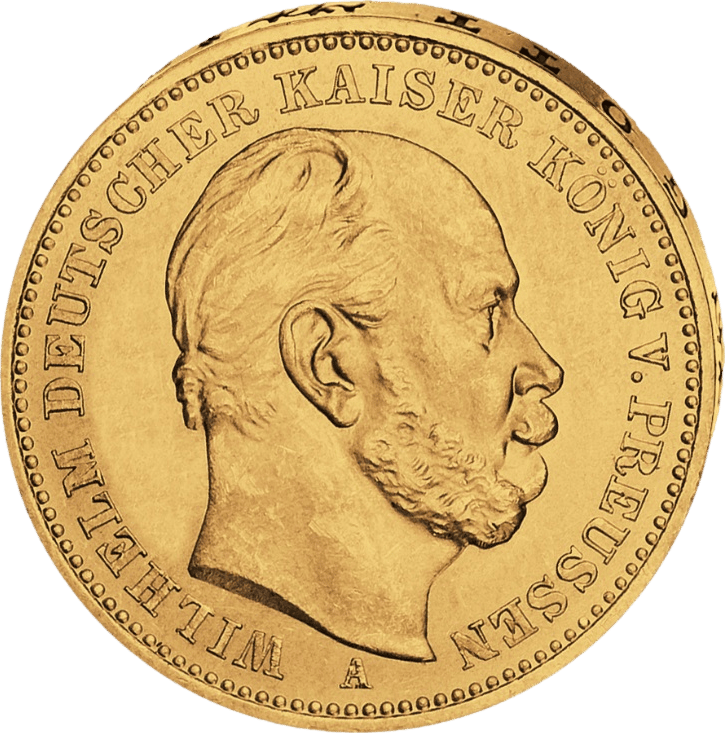
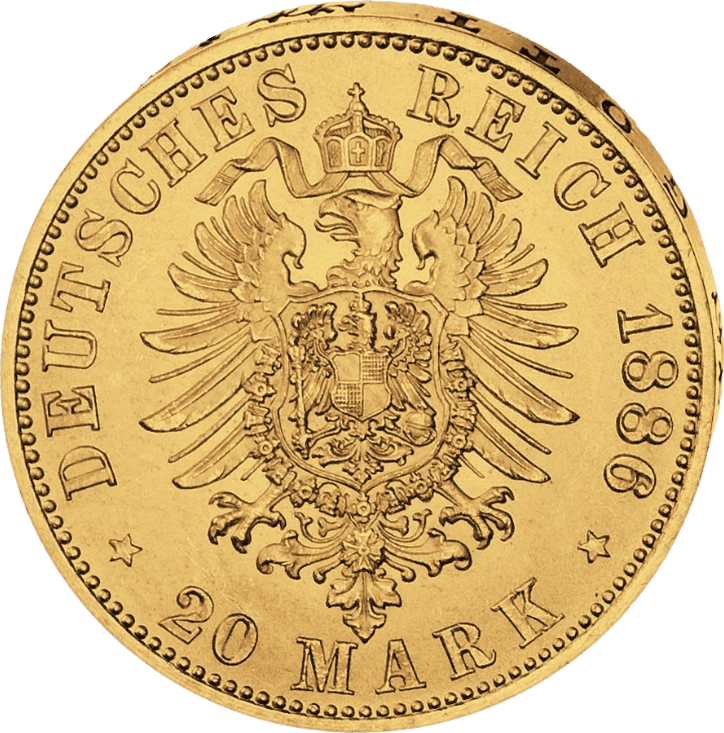
14 × 20 marks Prussia, Wilhelm I, a piece of the set
Value, year, imperial eagle and a letter for the mint: all of this was laid down by law. Each of the 14 twenty-mark pieces weighs 7.96 g, of which 7.17 g is fine gold.
What the law prescribes
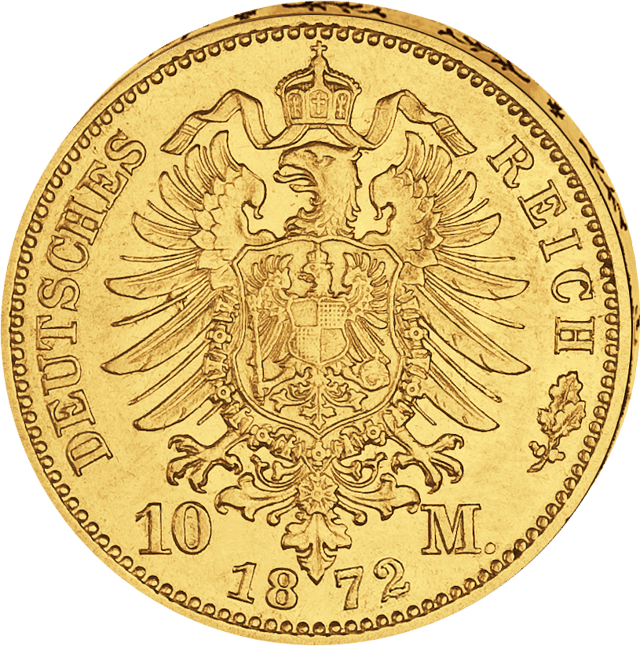
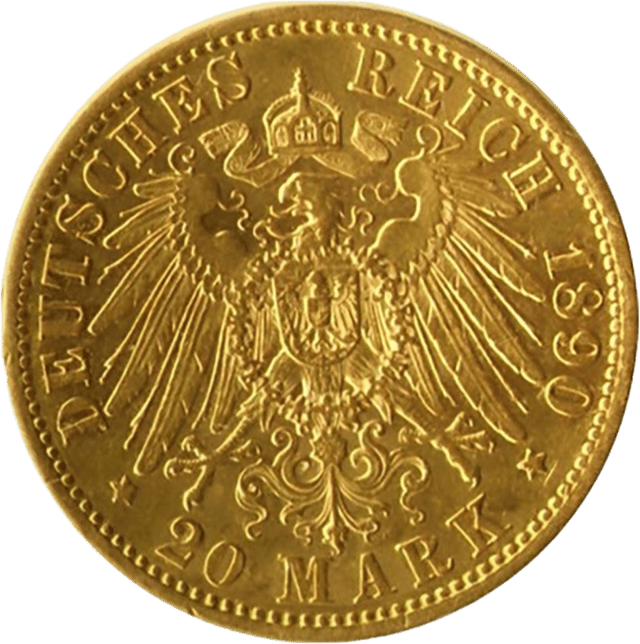
Eagle, value, year and a portrait
For every gold coin of the Reich, the law of 1871 laid down what it bears:
“The imperial gold coins bear on one side the imperial eagle with the inscription ‘Deutsches Reich’ and the statement of the value in marks, as well as the year of striking, on the other side the portrait of the sovereign, or the emblem of the free cities, with a corresponding legend and the mint mark.”
The Münzkabinett Berlin calls the side with the sovereign the obverse and the side with the eagle the reverse. The mint mark is the letter of the mint.
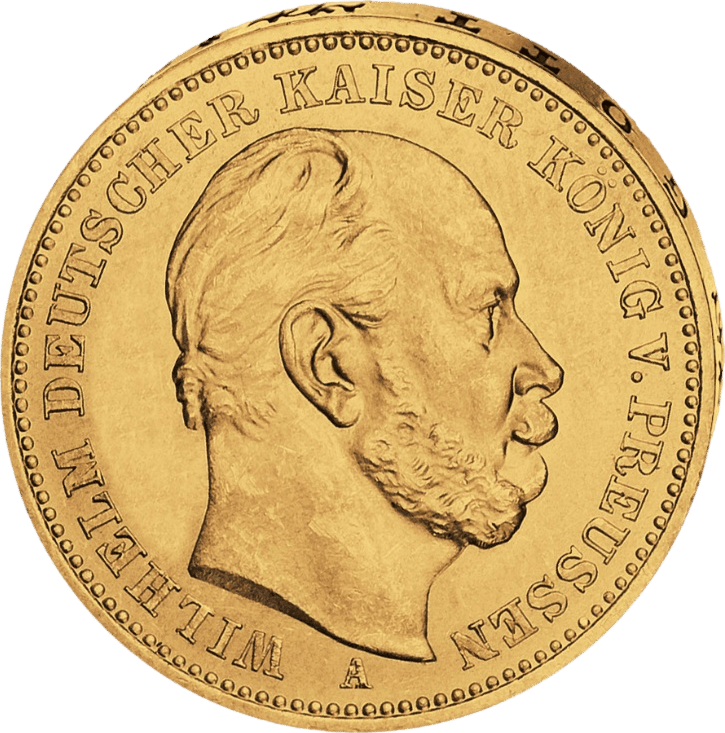
LegendThe legend above the portrait
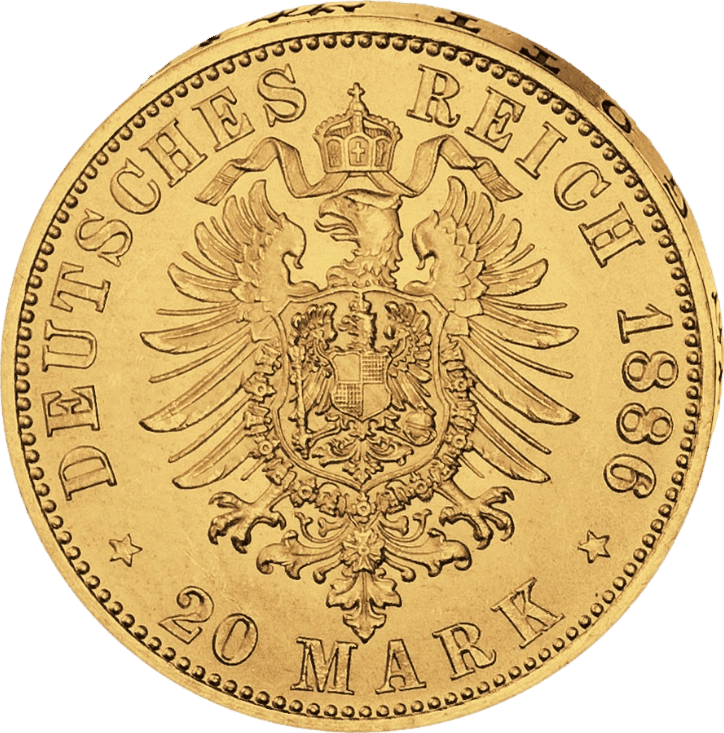
ReichThe word REICH above the eagle
ValueThe value below the eagle
The mint mark
A letter for the mint
On the coins of the Reich a letter names the mint, A for example Berlin, J Hamburg, F Stuttgart. The photo of this piece shows a A.

The gold of the mark
How heavy the gold had to be
The law of 1871 counted in pounds of fine gold, the pound at 500 grams:
“Imperial gold coins of 20 marks, of which 69¾ pieces are struck from one pound of fine gold.”
In other words: one pound of fine gold yields 69¾ pieces of 20 marks.
Fineness 900/1,000 means: of a thousand parts, nine hundred are pure gold.
Officially the ten-mark piece was called the crown and the twenty-mark piece the double crown, as a decree for the imperial authorities laid down in 1875. It never caught on, the Münzkabinett Berlin notes.
The mark in silver
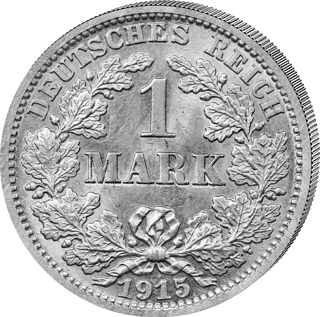
The silver mark in the hand
A mark holds 5 grams of fine silver, 900/1,000, and measures 24 millimetres. No one had to accept silver coins for amounts over 20 marks.
Rentenmark and Reichsmark
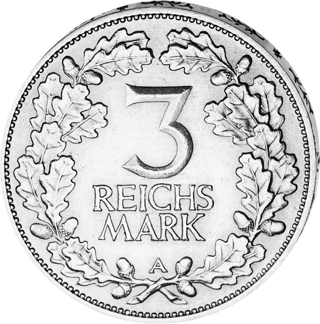
The Reichsmark from 1924
The coinage act of 30 August 1924 introduced the Reichsmark; in October 1924 it came into circulation alongside the Rentenmark, one to one.
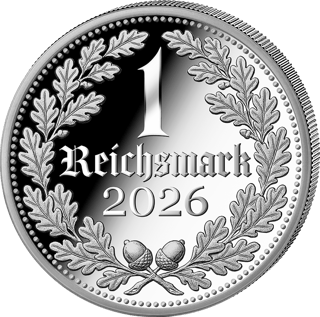
Our strikes
What our strikes take up
Our strikes bear the lettering 1 Reichsmark or 1 Mark in an oak wreath. They are newly struck, no Reichsmark of the past and no legal tender of the Reich.
At a glance
- Type
- Set of originals
- Era
- German Empire
- Ruler
- Wilhelm I
- Metal
- Gold
- Fineness
- 900/1,000
- Gross weight
- 111.44 g
- Fine weight
- 100.38 g
- Diameter
- 22.5 mm
- Number of pieces
- 14 pieces
- Contents
- 14 twenty-mark pieces with Wilhelm I
- Packaging
- Case
Gross weight: the weight of the whole coin. Fine weight: the pure metal in it. Fineness: its share in thousandths.
Details from our product data, the coinage acts and the photo. The year and mint mark of your piece may differ from the photo.

Original and new strike
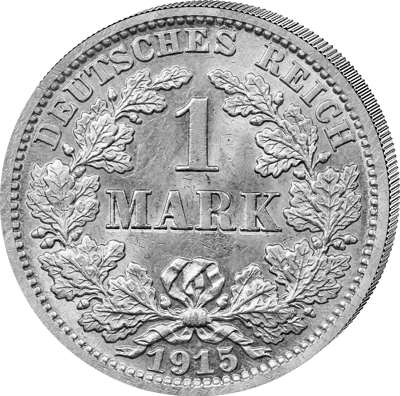
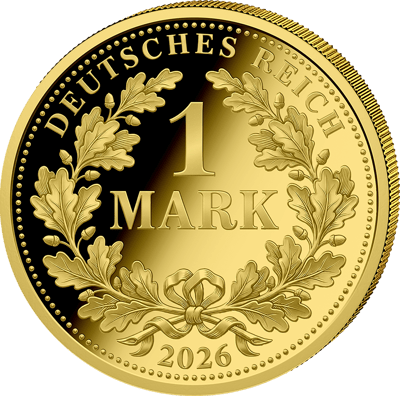
On the left a mark from the German Empire, on the right our strike of 1/200 ounce of fine gold, which takes up DEUTSCHES REICH and 1 MARK in an oak wreath.
One was money throughout the Reich, the other is newly struck: two pieces, one image.
Complete Set 14 x 20 Mark Gold Wilhelm I (1874-1888): fourteen gold pieces from the time of the first German Emperor
- Contents: 14 gold coins of 20 marks each with a total weight of 111.44 g.
- Motif: the profile of Wilhelm I, the first German Emperor; the other side bears the imperial eagle with DEUTSCHES REICH (German Empire) and the value 20 MARK.
- Material / fineness: Gold with a fineness of 900/1,000, a total of 100.38 g of fine gold or around 7.17 g per coin.
- Manufacturer: German mints of the imperial era that struck the gold coinage of the new imperial currency.
- Preserving value: a tangible asset that does not depend on banks or payment systems.
- Condition: bank quality; the coins are used and not new.
Crises rarely announce themselves, and anyone who is prepared stays calm. For such moments, the Complete Set 14 x 20 Mark Gold Wilhelm I (1874-1888) offers solid crisis protection: 100.38 g of fine gold, divided into fourteen individual coins. Each of them comes from the German Empire and bears the portrait of its first emperor.
Fourteen individual values for an emergency
The greatest advantage of the set lies in how it is divided. Instead of a single large piece, you hold fourteen coins with around 7.17 g of fine gold each, in other words small denominations that you can use individually. Gold is recognised worldwide as a means of exchange and offers protection against various crises, from currency devaluation to disruptions in payment systems. For emergencies at home or far abroad, this is valuable support, because individual coins are easy to take along in your wallet when travelling.
Many investors deliberately spread their provision across several building blocks and combine gold with small units of silver. This creates a reserve that gives you security because it is not tied to a bank or a particular currency.
Wilhelm I, King of Prussia and first German Emperor
Wilhelm I was born in Berlin in 1797 and ascended the Prussian throne in 1861. A year later he appointed Otto von Bismarck as Minister President, and together they led Prussia through the wars of 1866 and 1870/71. On 18 January 1871 he was proclaimed German Emperor in the Hall of Mirrors at Versailles. He reigned until his death in 1888, a year that went down in history as the Year of the Three Emperors: he was succeeded first by his son Frederick III and, in the same year, by his grandson Wilhelm II.
The mark as the Empire's new gold currency
After the founding of the Empire, Germany received a common currency. The mark replaced the thaler, the gulden and other regional currencies, and the 20-mark piece was its largest gold coin, officially also called the “double crown”. The new currency rested on gold: one kilogram of fine gold was struck into coins worth 2,790 marks. That is why every coin in the set is precisely measured, at 22.50 mm and around 7.17 g of fine gold.
Preserving value through every change of currency
These coins show impressively what preserving value means. The mark of the German Empire has long been history, replaced by several new currencies, yet the gold in the coins has kept its value. This is also the basis of the inflation hedge that gold offers your assets: paper money can be multiplied, gold cannot.
The coins are in bank quality condition and may show traces of their long circulation. As investment gold, the set is VAT-free. If private investors in Germany hold the set for more than one year, any gain on its sale is tax-free.
Reasons for this complete set
- Divided for crises: fourteen partial values that can be used independently of one another.
- Substantial holding: a total of 100.38 g of fine gold with a fineness of 900/1,000.
- Proven format: 22.50 mm and around 7.17 g of fine gold per coin, easy to store and transport.
- German history: the portrait of the emperor under whom the German Empire came into being.
Fourteen coins, fourteen opportunities to remain able to act at the right moment.
Get the Complete Set 14 x 20 Mark Gold Wilhelm I (1874-1888) from Kettner Edelmetalle and build your crisis provision on fourteen golden pillars.
Product depiction may differ from the final product.
