





Bronze Large Follis Emperor Maximian (286-305 AD | Age of the Tetrarchy)
- Genuinely antique: around 1,700 years old
- Emperor's portrait: with laurel wreath
- A one-of-a-kind: with its own history
- Genuinely antiqueGenuine currency of the Roman Empire, not a restrike
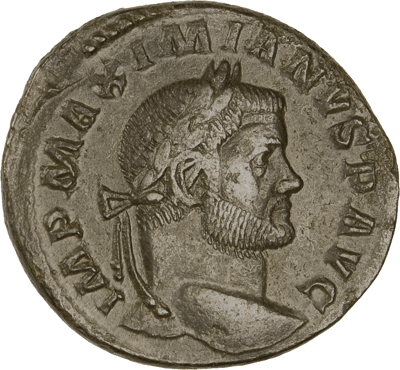
- Emperor's portraitStern soldier's face and genius of the Roman people
- A one-of-a-kindMint marks reveal where your coin was struck











- Genuinely antique: around 1,700 years old
- Emperor's portrait: with laurel wreath
- A one-of-a-kind: with its own history
 Price alert
  Share
ShareLarge Follis of Emperor Maximianus – Bronze from the Age of the Tetrarchy
A piece of world history that fits in the palm of your hand: this large follis was struck around 1,700 years ago in the Roman Empire and bears the name of a man who rose from humble origins to become co-emperor – Maximianus, in full Marcus Aurelius Valerius Maximianus, known as Herculius. Roughly 27 mm in diameter, approximately 9 g gross weight, dark bronze with a naturally grown patina. Whoever holds this coin in their hand holds genuine ancient currency. No modern commemorative piece, no restrike.
Maximianus Herculius: Soldier, Augustus, Hercules-Emperor
Born around 240 AD in Pannonia, Maximianus worked his way up through the army from a common soldier and there became friends with his older compatriot Diocletian. When the latter recognized that a single ruler could no longer govern the Imperium Romanum, he elevated Maximianus to Caesar in 285 and to Augustus in 286. The west of the empire became his responsibility: the Rhine frontier, Gaul, North Africa. Diocletian adopted the epithet Iovius after Jupiter, while Maximianus took the epithet Herculius after Hercules – rulership was thus divinely legitimized.
In 293, Diocletian systematized the multi-emperor rule into the Tetrarchy, the four-emperor system consisting of two Augusti and two Caesares. On 1 May 305, both Augusti voluntarily abdicated – an event unique in the history of the Roman imperial era. The years that followed belonged to Maxentius, Galerius, and finally Constantine the Great. This coin thus dates from the exact hinge point between the Principate and Late Antiquity.
The Follis – Leading Denomination of the Diocletianic Currency Reform
The Crisis of the Third Century had ruined Roman currency. Diocletian put an end to the debasement of coinage by his predecessors, issued a price edict against inflation, and from 294 onward created a newly ordered monetary system: the golden aureus, the silver argenteus, and, as a heavy large-format coin made of copper bronze, the follis, also known as the nummus. Fresh from the mint, the follis carried a thin silver wash that gave it a bright, silvery appearance. Through circulation this coating wore off – on ancient specimens today, usually only traces remain, or it has vanished entirely.
Coins were struck empire-wide under strict standardization, including at Trier, Ticinum, Aquileia, Rome, Siscia, Heraclea, Nicomedia, Cyzicus, and Antioch. Mint marks in the exergue and control marks in the field reveal to the connoisseur where and in which officina a given specimen was produced – these types are catalogued in the standard reference work RIC VI on Diocletian's reform. For collectors, this is precisely what makes it so appealing: each piece can be attributed and tells its own story of origin.
The Design: Imperial Portrait and the Genius of the Roman People
The obverse shows the laureate head of the emperor facing right, surrounded by the legend in Latin capitals, typically IMP C MAXIMIANVS P F AVG. Not an idealized youthful image, but the hard, short-bearded soldier's face of the Tetrarchic period – a display of power without flattery.
The reverse bears the classic reverse type of this era: GENIO POPVLI ROMANI, "to the Genius of the Roman People." It depicts the Genius standing facing left, nude except for a chlamys over the shoulder, holding a sacrificial dish (patera) in his right hand and a cornucopia in his left arm. The message to millions of inhabitants of the empire was clear: prosperity, abundance, and divine protection for Rome. Depending on the mint, other reverse types of the period also occur, such as Moneta with scales and cornucopia.
Technical Data at a Glance
- Face value: Follis (large follis)
- Material: Bronze, fineness varies
- Gross weight: approx. 9 g
- Diameter: approx. 27 mm
- Ruler: Maximianus, 286–305 AD
- Country of origin: Roman Empire
- Year of issue, mint and manufacturer: varies
- Condition: circulated (used), grade of preservation varies
- Packaging: case
- Series: History · Investment purpose: collector's product
Condition: Circulated Money with a Genuine Biography
These pieces are circulated currency and carry corresponding traces: darker patina, individual centring, nicks, wear, and in some cases weaker areas of the legend. This is exactly what makes them appealing. Since the year of issue, mint, and reverse variant may vary, the specimen delivered will differ from the illustration – you receive an original, not a mass-produced item. Please understand that the illustration in the shop serves as an example and may differ individually from the delivered item in terms of appearance and condition due to historical circumstances.
A tip from experience: the naturally grown patina is part of the coin's value and authenticity. Collectors do not remove it but protect it – it is best to store the coin in a dry place and handle it only by the edges.
For Collectors – and for All Who Trust in Tangible Assets
Ancient bronze coins are the classic entry point into Roman numismatics: tangible, richly illustrated, and historically precisely datable. Compared to the smaller antoninianus or radiate coin of the same years – usually only around 20 to 22 mm – the follis, at roughly 27 mm, appears considerably more monumental, with a larger and more sculptural portrait. The argenteus was the more precious but far rarer denomination. The follis, by contrast, was the money of the street, of soldiers' pay, and of the marketplace. Its disadvantage compared to precious metal coins: it derives its appeal from history and numismatics, not from material value. Its advantage: no one can take that history away from it.
Diocletian fought currency devaluation with edicts. What remains is not the edict – what remains is the coin.
Herein lies precisely the lesson that this bronze piece still conveys today: decrees come and go, tangible assets endure. Gold is humanity's oldest currency and has outlasted every other; for generations, investors have regarded physical precious metals as an inflation hedge and as solid crisis protection. This follis, however, is first and foremost a collector's product with historical weight – a witness to its time that unites the preservation of value and history in a single case.
- Genuine ancient original from the Roman Empire
- Iconic Tetrarchic type with imperial portrait and Genius reverse
- Large module of approx. 27 mm – impressive in the hand
- Each specimen unique in patina, centring, and strike
- Delivered in a case – ideal as a gift or as the start of a collection
Whether as a first ancient coin, an addition to an existing Tetrarchy collection, or a gift for history enthusiasts: this large follis of Emperor Maximianus combines Late Antiquity, numismatics, and the quiet authority of genuine tangible assets in a single, tangible piece of bronze.
Product depiction may differ from the final product.
