





Bronze Grand Follis Emperor Galerius (293-305 AD | Age of the Tetrarchy)
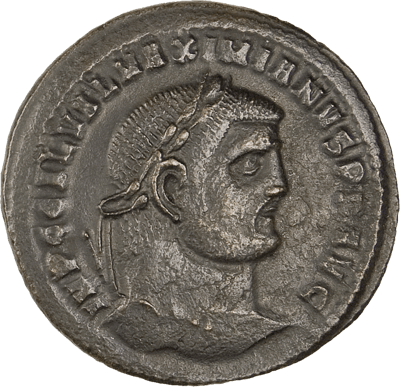
- Genuine Roman Coin: over 1,700 years old
- Emperor's Portrait: with laurel wreath
- Minting Sites: from Trier to Alexandria
- Genuine Roman CoinOnce a means of payment at marketplaces of late antiquity
- Emperor's PortraitBold relief, reverse shows the Genius of the Roman people
- Minting SitesEach piece an original, not a mass product











- Genuine Roman Coin: over 1,700 years old
- Emperor's Portrait: with laurel wreath
- Minting Sites: from Trier to Alexandria
 Price alert
  Share
Share
Ancient original · The tetrarchy
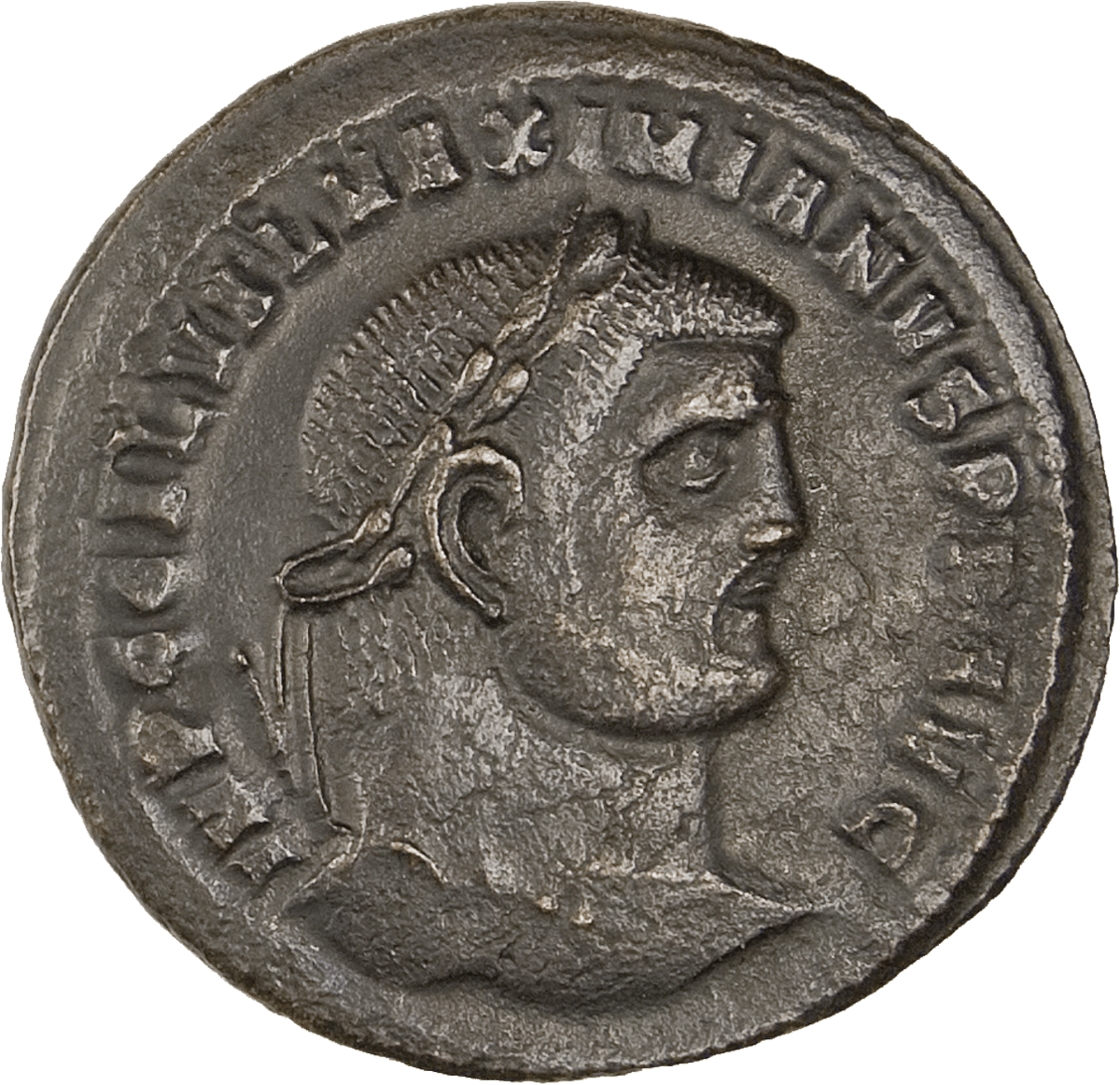
Large follis of GaleriusAbout 1,700 years old.
Around 294 Diocletian introduced a large bronze coin. At first it weighed about 10 grams and carried a thin layer of silver.
- Ruler
- GaleriusAD 293 to 311
- Diameter
- c. 27 mm
- Weight
- c. 10 g
Around 294 Diocletian introduced a large bronze coin. At first it weighed about 10 grams and carried a thin layer of silver.
- Ruler
- GaleriusAD 293 to 311
- Diameter
- c. 27 mm
- Weight
- c. 10 g

The tetrarchy · AD 284 to 313
Four rulers, one new coin.
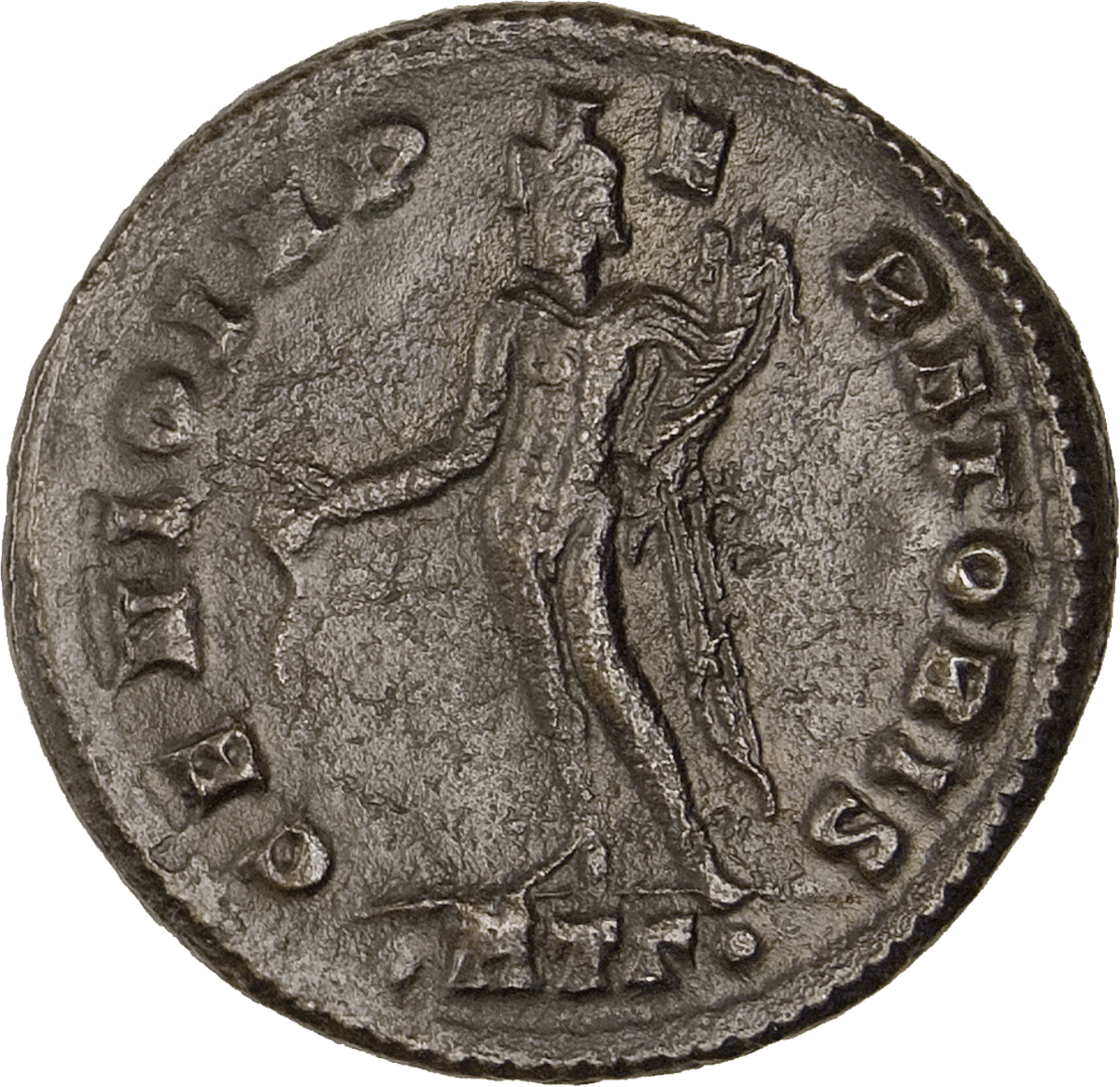
Diocletian ended the crisis with a radical rebuild: four rulers, two Augusti and two Caesares, each for one part of the empire. With it came a new, heavy bronze coin, today called the follis. The portraits of these years look very much alike: what is shown is the office, not the person.
The picture shows an example. The piece you receive may differ in detail.
At the same scale
Denarius, antoninianus, follis and solidus at the same scale
Three sizes are called follis here: about 27 mm in the tetrarchy, 20 mm under Constantine and his sons, 28 mm under Justinian.
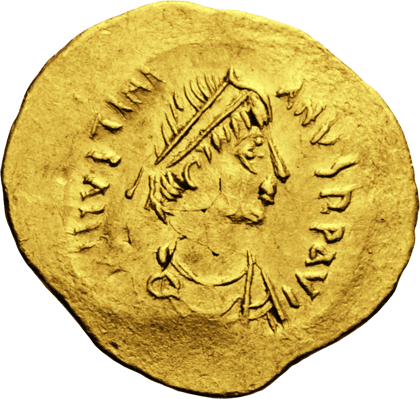 TremissisJustinian I
16 mm
TremissisJustinian I
16 mm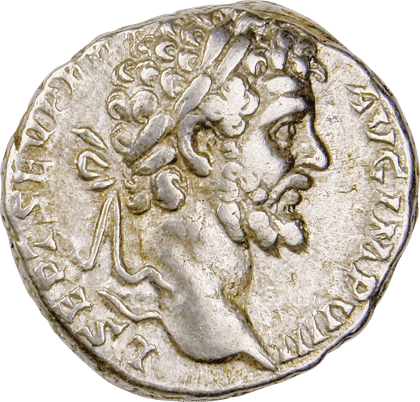 DenariusSeptimius Severus
c. 18 mm
DenariusSeptimius Severus
c. 18 mm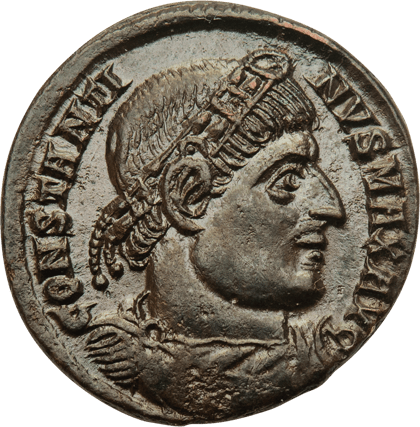 FollisConstantine I
20 mm
FollisConstantine I
20 mm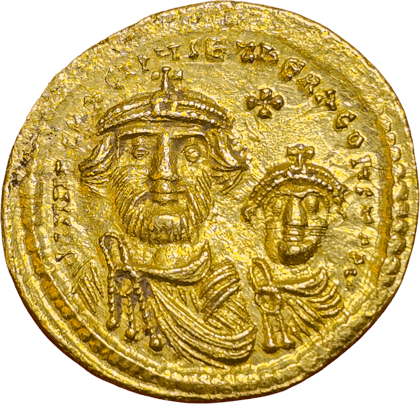 SolidusHeraclius
20 mm
SolidusHeraclius
20 mm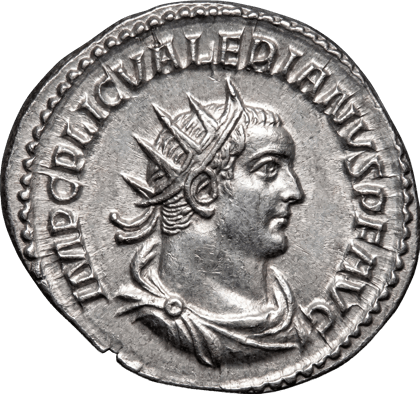 AntoninianusValerian I
21 to 23 mm
AntoninianusValerian I
21 to 23 mm 1 eurofor comparison
23.25 mm
1 eurofor comparison
23.25 mm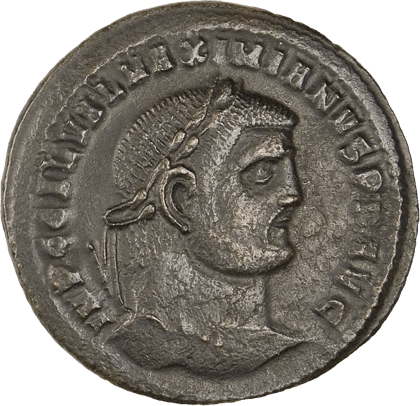 FollisGalerius
c. 27 mmthis page
FollisGalerius
c. 27 mmthis page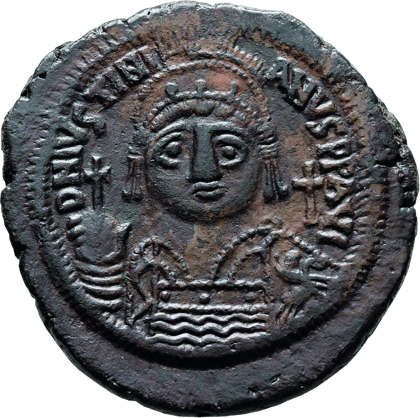 FollisJustinian I
28 mm
FollisJustinian I
28 mmWhere it belongs
31 originals from about 1,100 years
Each piece stands at the years of its ruler or of its type. The era of this piece is highlighted; choose another one to see its originals.
The tetrarchy AD 284 to 313 · 2 originals
 Large follis of DiocletianAD 284 to 305
 Large follis of GaleriusAD 293 to 311this page

Keeping it
First things first: do not clean it.
The dark layer on bronze and the matte grey on silver are called patina. It has grown over centuries and protects the surface. Polishing it away takes that protection from the piece.
- Hold it by the edgeSkin oil can etch itself permanently into the surface. Take the piece by the rim between thumb and forefinger, over a soft surface.
- Store each piece on its own, and dryKeep each piece on its own in a dry place, in a capsule or an acid-free case. PVC sleeves do not belong there, they attack the surface.
- No agents, no polishing clothNo vinegar, no silver cloth, no ultrasound. According to the Bank of Canada Museum, almost any attempt at cleaning without a conservator leaves damage, mostly from abrasion.

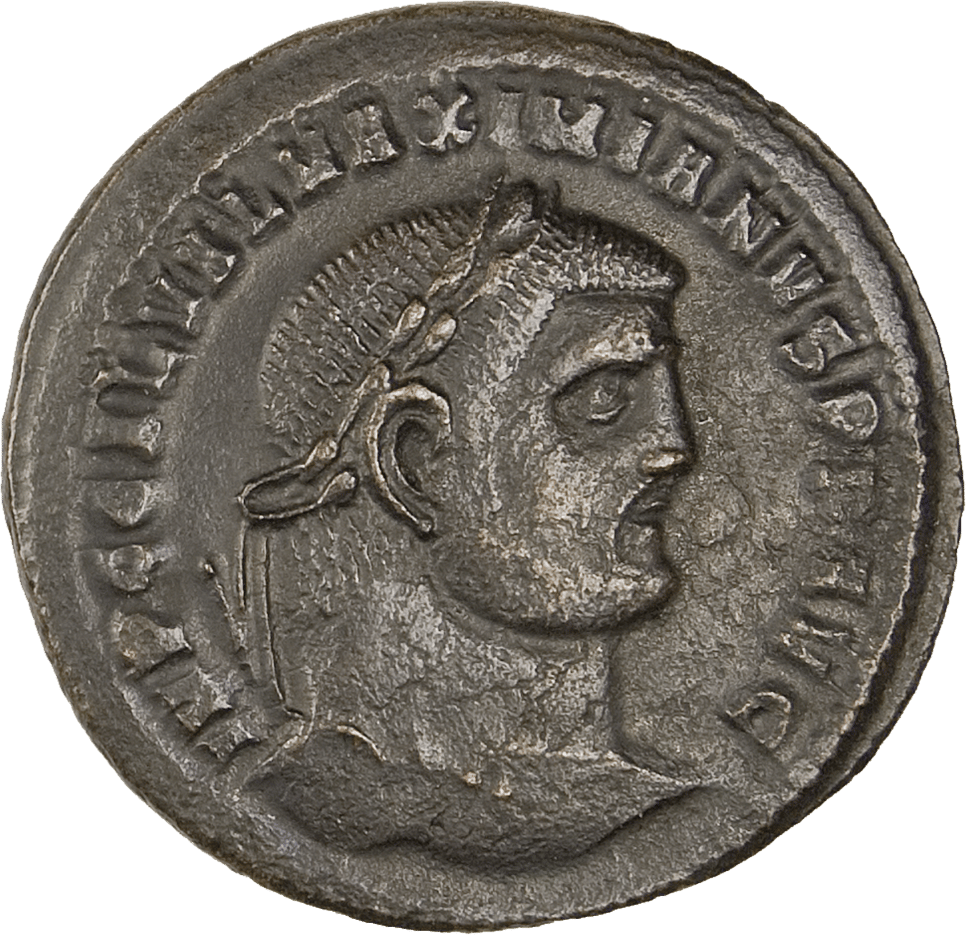
Struck about 1,700 years ago.
Galerius and his world are long gone. The piece has remained, with the traces of its circulation.
Bronze Great Follis of Emperor Galerius – Original Coin from the Age of the Tetrarchy
A piece of world history that fits in the palm of your hand. The Great Follis of Emperor Galerius comes from that extraordinary era when the Roman Empire was ruled simultaneously by four rulers. Struck in the context of Diocletian's great coinage reform, this bronze coin was genuine currency – no modern off-the-shelf collector's product, but money that circulated through the marketplaces, barracks yards and trade routes of Late Antiquity. Around 27 millimeters in diameter, a raw weight of about 10 grams, plus a naturally grown, dark patina: antiquity you can touch.
Galerius – from Shepherd's Son to Emperor of the East
Gaius Galerius Valerius Maximianus was one of the defining figures of Late Antiquity. On 1 March 293, Diocletian elevated him to Caesar; in 305 he rose to Augustus of the East and ruled until his death in May 311. His origins were humble – the epithet "Armentarius," meaning shepherd, accompanied him throughout his life. His court was in Thessaloniki, where the Arch of Galerius still tells of his triumphs today. Militarily, he made a name for himself above all against the Sassanids: in 298 he defeated the Persian king Narseh at Satala. At the end of his life, with the Edict of Toleration of Nicomedia, he brought an end to the persecution of Christians in the eastern part of the Empire.
What Was the Tetrarchy?
Diocletian distributed the burden of the vast empire across four shoulders: two higher-ranking Augusti and two subordinate Caesares. Diocletian and Galerius in the East, Maximian and Constantius Chlorus in the West. Each ruler had his own army, his own administration, and his own mints – yet the empire formally remained a single unit. Coins such as this follis were thus both at once: economic asset and state propaganda.
The Follis – Rome's Answer to Currency Debasement
Around 294, Diocletian introduced the follis (plural: folles) to counter coin debasement and the galloping inflation of the imperial crisis. It became the empire's most important new copper coin. Numismatists assume that the denomination was originally simply called nummus; the term follis – Latin for "money bag" – only became established much later. The coin was struck at 1/32 of a Roman pound, i.e. around 10 grams, made of bronze with a wafer-thin coating of silver. At its introduction, its value was 12.5 accounting denarii; with the currency reform of 1 September 301, it was revalued to 25. A textbook example of how quickly state money can lose purchasing power.
Design: The Genius of the Roman People
The obverse shows the powerful imperial portrait with laurel wreath in profile facing right, surrounded by the Latin titulature – depending on the minting phase, either as Caesar or as Augustus. The reverse bears the classic tetrarchic legend GENIO POPVLI ROMANI, "to the Genius of the Roman People." The Genius is depicted as a standing male figure facing left, with a modius on his head, a sacrificial dish (patera) in his right hand and a cornucopia in his left arm. The mint mark sits in the exergue. Trier, Rome, Siscia, Heraclea, Nicomedia, Antioch, Thessaloniki or Alexandria – the range of possible mints is large, and this is precisely where much of the appeal lies for many collectors.
Key Facts at a Glance
- Face value: Follis
- Material: Bronze (ancient alloy, originally with silver wash)
- Diameter: approx. 27 mm
- Raw weight: 10 g
- Year of issue, mint and reverse variant: varies
- Country of origin: Roman Empire
- Condition: circulated coin (used), grade of preservation varies
- Series: History
- Investment type: Coin | Investment purpose: Collector's item
Condition: Signs of Use as a Character Trait
These pieces are circulated currency and bear corresponding traces: darker patina, individual centring, nicks, wear, and in places weaker legend sections. This is precisely what makes them appealing. Since the year of issue, mint and reverse variant may vary, the piece delivered will differ from the image shown – you receive an original, not a mass-produced item. Please understand that the image in the shop serves as an example and may differ individually from the delivered item in terms of appearance and condition due to historical circumstances.
Every nick, every worn spot tells of hands that used it to pay for bread, wine or soldiers' rations more than 1,700 years ago.
For Collectors and Investors
Ancient coins are a world of their own – and this follis is an excellent entry point. Those who have so far collected modern issues can here step into the numismatics of Late Antiquity at a denomination that is far more accessible compared to the golden aureus or the silver argenteus. Advanced collectors are drawn to the wide variety of types: every mint, every officina, every legend form is its own chapter. And for those who wish, placing the four tetrarchs side by side turns individual coins into a small narrative about power, order and decline.
Precious metals have accompanied humanity for millennia. Gold is the oldest currency in the world and has outlasted every paper currency – a thought that becomes especially tangible when looking at this follis: the Roman Empire has fallen, but its coins have remained. Anyone building physical assets as inflation hedge and as crisis protection holds, with a piece like this, a historical monument against currency debasement in their hand at the same time.
Comparison: Follis, Antoninianus and Denarius
- Follis (from 294): large module, bold relief, clear tetrarchic imagery – visually the most impressive bronze denomination of Late Antiquity. Drawback: the silver wash is usually only preserved in remnants on circulated pieces.
- Antoninianus (3rd century): smaller and lighter, often with a radiate crown. Affordable entry point, but less imposing in effect.
- Denarius: the classic silver denomination of the early and high imperial period, considerably smaller in diameter, but with a higher precious metal content.
The Great Follis scores above all with its size and portrait impact. A historical original that can be beautifully presented in a capsule, collector's frame or display case – and is guaranteed to spark conversation on your next visit.
Product depiction may differ from the final product.
