
 280,000
  30 years
  Secure


1 Ruble Silver Tsar Nicholas II (1895-1915 | Last Tsar | Cousin of Kaiser Wilhelm II)













 Most Popular Product: Number 1 in category Asia
- Collector coin: Especially interesting for collectors
- Secure shipping: 100% insured & anonymous delivery
 Price alert set
 share
share
Personal consultation
Get free advice from one of our precious metals experts - we look forward to your call!
1 Ruble Silver Tsar Nicholas II – a Tangible Piece of the Tsarist Empire
Twenty grams of coinage metal, 900 out of 1,000 parts silver, around 34 millimetres in diameter. That's the sober side of things. The other side is an empire that stretched from the Baltic Sea to the Pacific and perished in the First World War. This ruble was real money in Tsarist Russia: in the hands of peasants, carters, merchants and officers. Not a commemorative piece, not a mass-produced collector's item – an original from the Russian Empire.
The Key Facts at a Glance
- Face value: 1 ruble
- Minting period: 1895 to 1915 – various years of issue
- Fineness: 900/1,000 silver
- Gross weight: 20.00 g
- Fine weight: 18.00 g fine silver
- Diameter: 34 mm
- Country of origin: Russia, various mints
- Condition: Circulated coin, various grades of preservation
The Last Tsar – and the Cousin of the German Kaiser
Nicholas II ascended to the throne in 1894 after the death of his father Alexander III, and remained ruler of the largest land empire on Earth until his abdication in 1917. He was connected to Kaiser Wilhelm II by more than just politics: both were related through Tsar Paul I – usually referred to simply as cousins in the literature – and Nicholas's wife, Alexandra Feodorovna, was a first cousin of the German Kaiser. The famous "Willy-Nicky" telegrams of the July Crisis of 1914 were exchanged between precisely these two men. In vain. Whoever holds this coin in their hand is holding an object from an era in which Europe's monarchies were still related to one another – and yet wrote themselves into the abyss.
Design, Double-Headed Eagle and the Edge Inscription
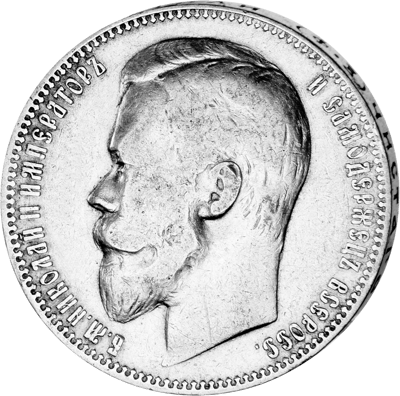
The obverse shows the bearded profile of the Tsar with the inscription "Б.М.НИКОЛАЙ II ИМПЕРАТОРЪ И САМОДЕРЖЕЦЪ ВСЕРОСС." – Nicholas II, Emperor and Autocrat of All the Russias. The reverse bears the crowned double-headed eagle with breast shield, orb and sceptre, along with the face value and year. The edge is particularly appealing: it carries the fineness declaration in old Russian units of weight, four zolotniks and 21 dolyas of pure silver – converted, exactly the roughly 18 grams of fine silver still contained in the coin today.
St. Petersburg, Paris, Brussels
Following the currency reform by Finance Minister Sergei Witte, which pegged the ruble to gold, demand for coinage was enormous. The St. Petersburg mint struck millions of pieces; Paris in France and Brussels in Belgium provided assistance in the late 1890s. Later years of issue from 1902 onward were noticeably smaller – a detail collectors still track closely today.
Condition: Not a Flaw, but a Biography
These pieces are circulated coins – and they look the part. Darker patina, individual centring, small nicks, signs of wear, and in places a weaker strike on parts of the legend: these are not defects, but biography. Every trace stems from hands that, centuries ago, used it to settle goods, freight or debts. Since the year of minting, mint mark and reverse variant can vary, the piece you receive will differ from the image shown.
Please understand the photo in the shop explicitly as a sample image: appearance, exact weight and condition vary from piece to piece for historical reasons. You are purchasing an original.
Why Historical Silver Coins Are Convincing
Silver has been a monetary and coinage metal for millennia, a symbol of wealth and prestige, and it retains its physical properties across generations. This ruble proves exactly that: more than a hundred years after it was minted, the metal remains unchanged. A few good reasons why silver coins like this one are found in hardly any well-established holding:
- Intrinsic value: 18 g fine silver, traded worldwide as a commodity and easily liquidated at any time.
- Dual appeal: material value plus numismatic collector's value – depending on year of issue, mint and condition.
- Industrial demand: electronics, solar technology and medical technology consume silver continuously, while supply remains limited.
- Tax advantages: profits from the sale of physical silver are generally tax-free, provided the minimum holding period of one year is observed.
- Divisibility: small units are suitable as a medium of exchange for manageable transactions and in times of currency instability.
Precious metal in physical form serves many investors as an inflation hedge and as crisis protection – unlike fiat money, its value does not depend on trust in a government. The silver ruble demonstrates this impressively: the empire that issued it has not existed since 1917, and the paper ruble of that era is worthless. The metal in your hand has remained.
Compared to Other Historical Silver Pieces
Compared to the Maria Theresa thaler, which is still produced today as an unchanged restrike, the Tsarist ruble has a clear advantage: every piece is contemporary and at least 111 years old. Compared to the 5-mark coins of the German Empire, it contains somewhat less fine silver, but scores with a stronger historical narrative – the end of the Romanov dynasty is world history. Anyone looking purely for maximum fine weight per euro will find a more efficient solution in modern 999 bullion coins; historical circulated coinage is purchased for the substance and the history.
Who This Piece Is Intended For
For collectors who love Russian numismatics, portraits of the tsars and the double-headed eagle. For investors who want to diversify their tangible assets while holding tangible history in their portfolio. And for everyone who has understood that precious metals outlast currencies, empires and systems. This ruble is also a gift with substance – 20 grams of the Tsarist Empire that carries every story.
Product depiction may differ from the final product.
