





Gold Tremissis Emperor Justinian I (527-565 AD | Reconqueror of Rome)
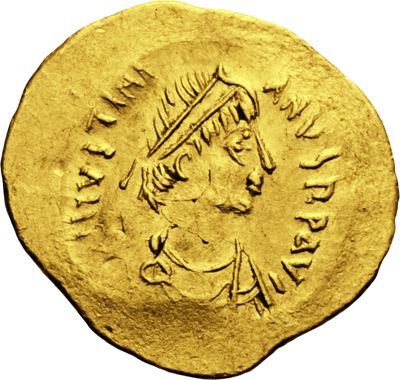











- Witness to Byzantium: 1,500 years old
- Hand-hammered: every piece unique
- Verified authenticity: with certificate
- Witness to ByzantiumFrom the era of the builder of Hagia Sophia
- Hand-hammeredRipples and wear marks make each coin one of a kind
- Verified authenticityAn enclosed certificate confirms the original
 Price alert
  Share
ShareAncient original
The eastern Roman empireTremissis of Justinian I
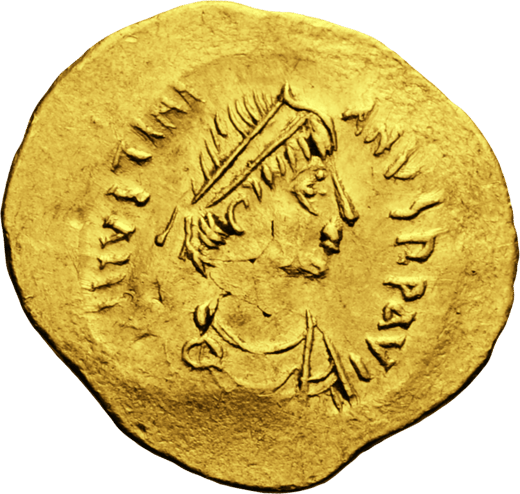
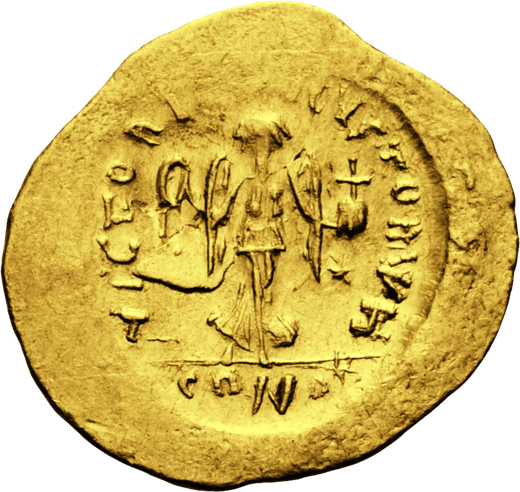
You are looking at the front.
Between the day someone struck this piece with a single hammer blow and the day you hold it, there are roughly
1,500years
- Struck by hand
- Original, not a restrike
- 16mm across
- 30 days return policy
Where it belongs
Eleven epochs, a thousand years, one shelf.
In the west the emperorship ended in 476, in the east it ran for another thousand years. The coins become flatter and more frontal, and the reverse often carries nothing but a large value mark. Justinian built the Hagia Sophia and took back North Africa and Italy; under Heraclius much of it was lost again.
7th to 5th century BC
Archaic Greece
5th to 4th century BC
Classical Greece
6th century to 330 BC
Achaemenid Persia
5th to 2nd century BC
Carthage
336 to 30 BC
The hellenistic age
3rd to 1st century BC
Celtic tribes
27 BC to AD 235
The Roman empire
AD 235 to 284
Crisis of the third century
AD 284 to 313
The tetrarchy
AD 306 to 363
The Constantinian dynasty
AD 395 to 1453
The eastern Roman empire
Your piece
Keeping it
First things first: do not clean it.
The dark layer on bronze and the matte grey on silver are called patina. It has grown over centuries and collectors treat it as a mark of authenticity. Polishing it away does not give you a nicer piece, it gives you a damaged one: auction houses regularly value a brightly cleaned coin below the same coin with its patina intact.
Hold it by the edge
Fingerprints contain acid and salt. Take the piece between thumb and forefinger by the rim, over a soft surface.
Store it dry and dark
Moisture is the only real enemy. A pouch or a capsule in a dry place is enough; PVC sleeves are not, they attack the surface.
No agents, no brush
No vinegar, no silver cloth, no ultrasound. If you want a crust removed, let a conservator do it, not the kitchen sink.
Tremissis of Emperor Justinian I – 1,500 Years of World History in 1.5 Grams
Design: The obverse shows the draped and cuirassed bust of Justinian wearing a pearl diadem, facing right, surrounded by the legend D N IVSTINIANVS P P AVG ("Our Lord Justinian, Perpetual Augustus"). On the reverse, the winged goddess of victory Victoria strides forward holding a wreath and a cross-globe, accompanied by a star in the field, the inscription VICTORIA AVGVSTORVM, and the mint mark CONOB – a design that unites imperial symbolism of power with early Christian imagery in a single coin.
Material / Fineness: Gold. In Late Antiquity, the Tremissis was struck from nearly pure gold – the letters OB in CONOB stood for obryzum, meaning refined fine gold. As this is an ancient, hand-struck circulation coin, the fineness varies from piece to piece.
Mint: Various ancient mints of the Eastern Roman Empire; the classic type of this period originates from Constantinople.
Fine weight / Gross weight: 1.5 g
Diameter: 16 mm
Face value: Tremissis – one third of a Solidus
Year of issue: various, from the reign of 527–565 AD
Origin: Eastern Roman Empire (Byzantium)
Condition: circulated coin, bank-standard condition
Extras: with certificate of authenticity, "History" series, shipped as insured shipping
Some coins are beautiful. This one is a witness to history. Whoever holds Justinian's Tremissis in their hand holds a means of payment that passed through the hands of merchants, soldiers, and officials of a world empire at a time when Rome had already fallen and Constantinople had become the shining metropolis of the known world. Among ancient gold coins, the Tremissis ranks among the pieces with the greatest historical significance – small in size, immense in meaning.
Justinian I – the Emperor Who Reclaimed the West
Flavius Petrus Sabbatius Iustinianus, born around 482 into modest circumstances, reigned from 527 to 565 and is considered one of the most significant rulers of Late Antiquity. His generals Belisarius and Narses reconquered North Africa from the Vandals and Italy from the Ostrogoths; parts of Spain were also added. The Eastern Roman Empire thus reached its greatest extent since the fall of the Western Roman Empire. At the same time, Justinian had Roman law codified – the later so-called Corpus Iuris Civilis continues to shape European legal tradition to this day. And with the Hagia Sophia, consecrated in 537, a building was created that left contemporaries speechless. His reign marks the transition from antiquity to the Middle Ages like almost no other.
Solidus, Semissis, Tremissis – the Golden Monetary System of Byzantium
Constantine the Great had created with the Solidus a gold currency that remained remarkably stable for centuries and was accepted throughout the Mediterranean region. The Tremissis complemented this system at the lower end:
Solidus: the benchmark coin of around 4.5 g of gold – the backbone of state finances and long-distance trade.
Semissis: the half-piece, considerably rarer in circulation.
Tremissis: the third-piece of around 1.5 grams, ideal for larger everyday payments, wage payments, and gifts. Tremisses were later also imitated by Germanic successor kingdoms – evidence of the enormous trust placed in this coin.
Whoever acquires a gold coin from Byzantium is not merely buying precious metal, but a piece of state confidence that has endured for 1,500 years.
Character Instead of Perfection: the Aesthetics of Ancient Coinage
Every Tremissis is a unique piece. The blanks were hammered by hand, which is why roundness, centering, and strike sharpness vary; slight waviness of the blank, minor edge irregularities, and traces of circulation are inherent to the nature of these pieces. This is exactly where the appeal lies: a flawless, high-gloss strike could not tell this story. The enclosed certificate of authenticity provides you with additional assurance – a weighty argument, especially in the case of ancient coins. This is precisely what makes it so appealing. Since the year of issue, mint, and reverse variant may vary, the delivered specimen will differ from the illustration – you receive an original, not a mass-produced item. We therefore ask for your understanding that the image in the shop serves as an example and may individually differ from the delivered item in terms of appearance and condition due to historical circumstances.
For Collectors and Investors – Precious Metal with History
Gold is humanity's oldest currency and has outlasted every paper currency that has ever competed against it. The Tremissis illustrates this vividly: the empire that issued it ceased to exist in 1453 – the metal in your hand has retained its value. As a collector's item, this coin combines numismatic appeal with the physical character of precious metal, making it suitable both as an entry point into ancient numismatics and as an individual addition to a holding oriented toward inflation hedge and crisis protection.
Those wishing to diversify their precious metals holdings often like to combine historical gold coinage with silver. Silver, too, looks back on a millennia-old career as a coinage and monetary metal, has always been regarded as a store of value, and in small units serves as a practical medium of exchange in times of currency instability. In addition, there is strong industrial demand from electronics, solar, and medical technology, while the extractable supply remains limited. For physical precious metals held as private assets in Germany, the following also applies: after a holding period of at least one year, capital gains are generally tax-free (§ 23 EStG) – for a binding assessment of your personal situation, please consult your tax advisor.
Whether as the centerpiece of a collection on Late Antiquity, as a tangible history lesson for the next generation, or as a tangible asset passed down from generation to generation: this golden witness to history from the reign of Justinian I is among those pieces one simply does not want to put down again.
Product depiction may differ from the final product.
