





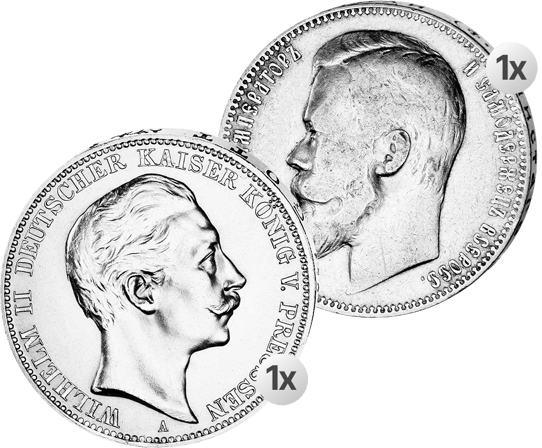


Silver "Willy" & "Nicky" Set (1868-1918 | Cousins in War and Peace)
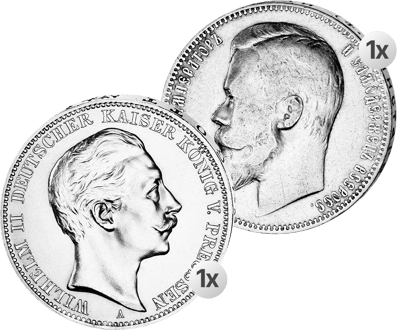













- Kaiser and Tsar: two ruler portraits
- Genuine originals: no restrikes
- Gift idea: for history buffs
- Kaiser and TsarWilhelm II and Nicholas II in profile with crowned eagles
- Genuine originalsBoth coins once circulated as real legal tender
- Gift ideaTells the story of the famous July Crisis telegrams of 1914
 Price alert
  Share
Share
Originals · Wilhelm II and Nicholas II
What a mark had to bear

Value, year, imperial eagle and a letter for the mint: all of this was laid down by law. The set holds a three-mark piece with Wilhelm II and a rouble with Nicholas II.
What the law prescribes
Value, year, eagle and a letter
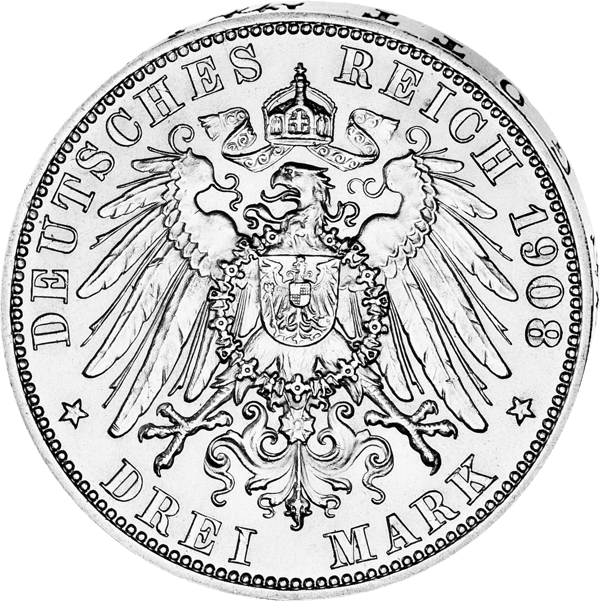
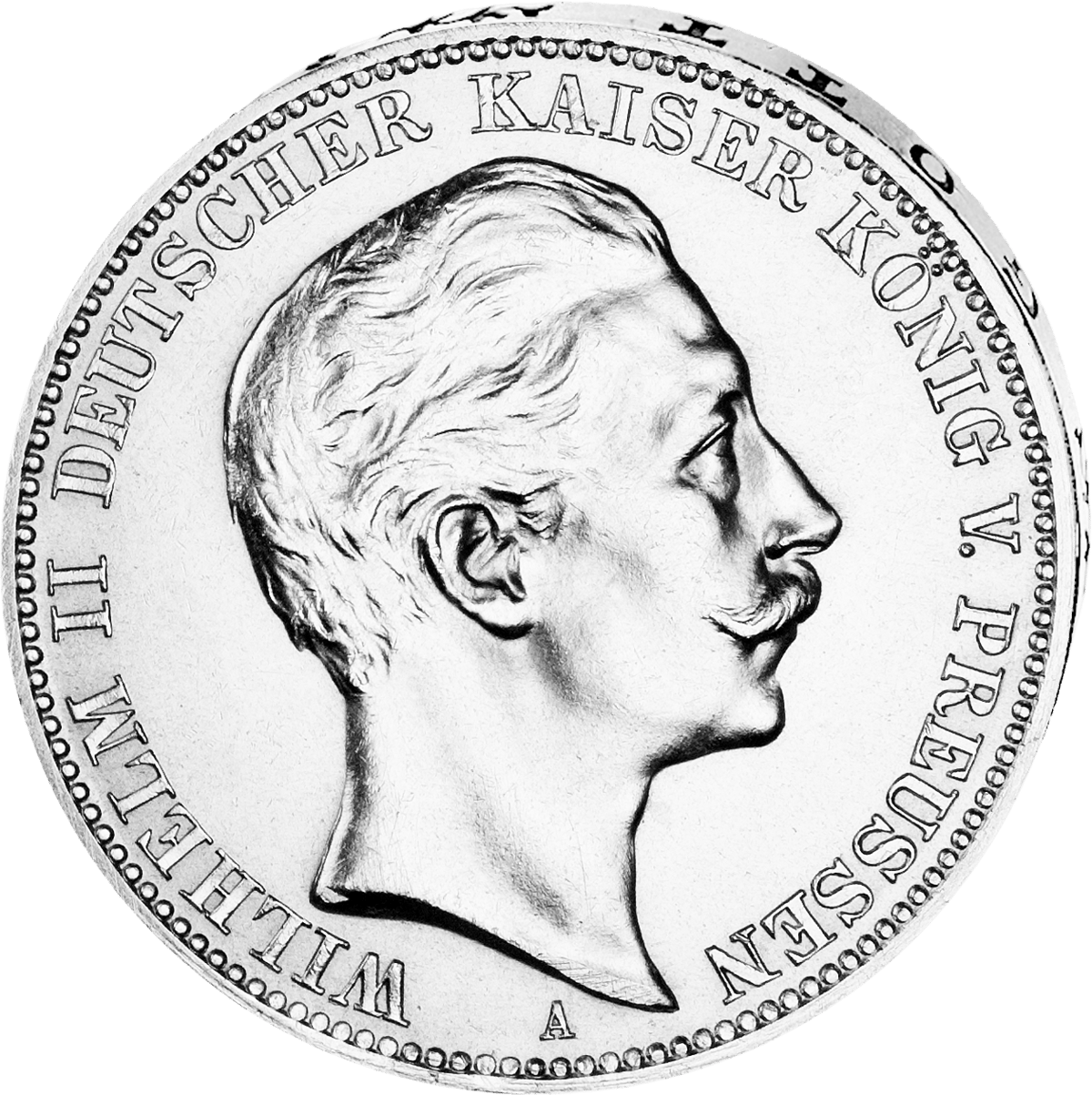
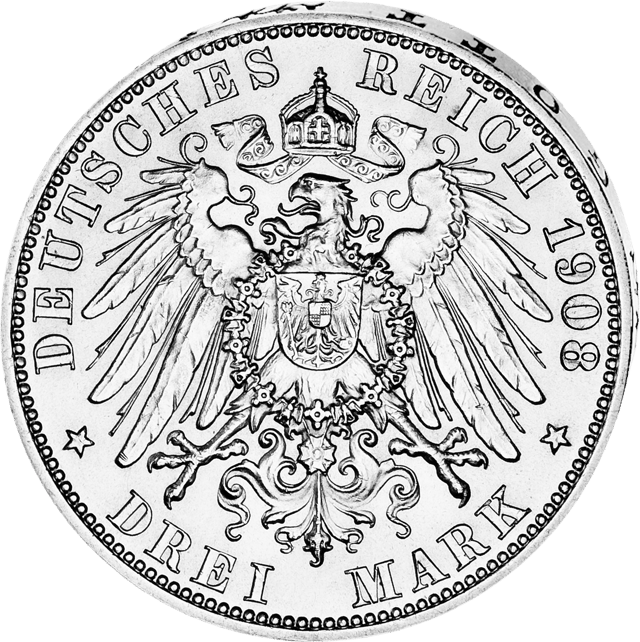
The three-mark piece in the set bears Wilhelm II on one side with the legend WILHELM II DEUTSCHER KAISER KÖNIG V. PREUSSEN, and DEUTSCHES REICH, the year and DREI MARK on the other.
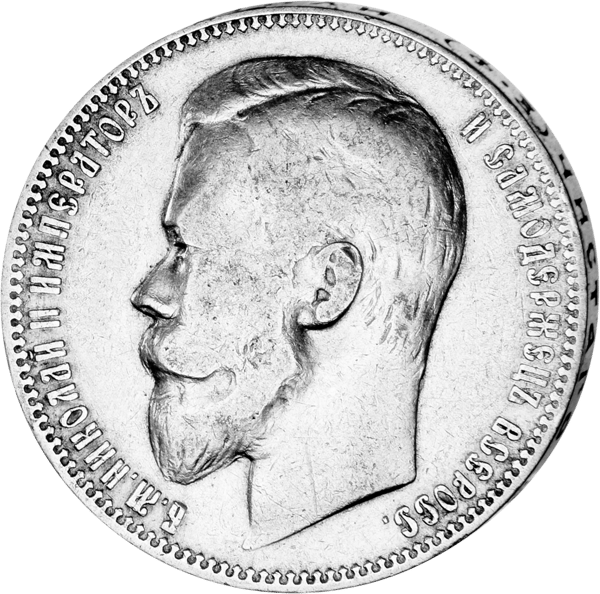
The rouble bears the portrait of Nicholas II with a Cyrillic legend, and on the reverse the double eagle and РУБЛЬ, rouble.
Before the mark
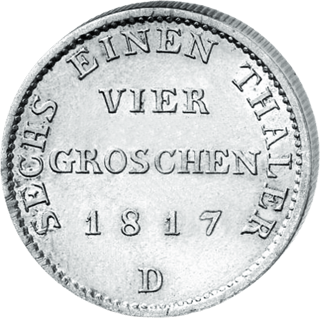
By law: a sixth of a thaler, half a mark
The coinage act of 1873 had silver coins of German stamp worth a sixth of a thaler accepted as half a mark, and those worth a third of a thaler as one mark.
The mint mark
A letter tells where it was struck
The mark and the smaller coins also bear a mint mark: a letter that names the mint. A stands for Berlin, J for Hamburg, F for Stuttgart.
“Below, the mint mark J for Hamburg.”
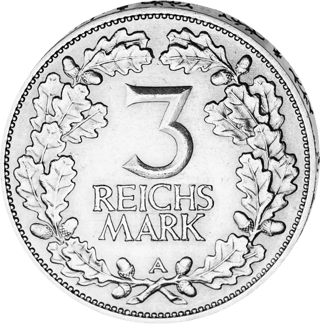
The photo of the three-mark piece in the set shows a A. As the sets come from different years, your three-mark piece may bear another letter.
The gold of the mark
The gold of the German Empire
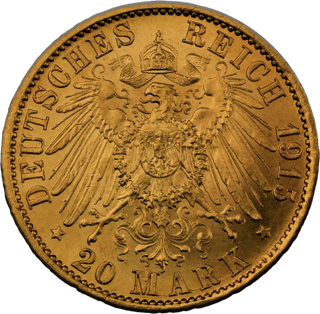
Twenty and ten marks in gold, 900/1,000: a twenty-mark piece weighs 7.96 grams, of which 7.17 grams is fine gold.

The mark in silver
The silver mark in the hand
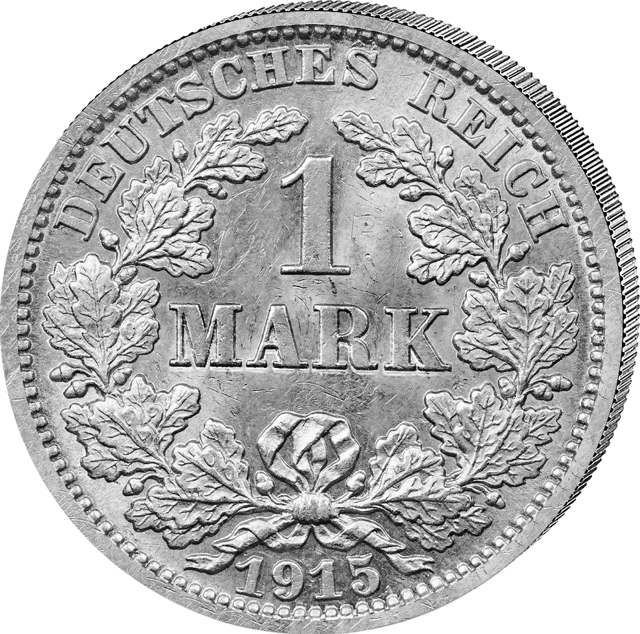
For silver coins, the coinage act of 1873 prescribed pieces of five, two and one mark, and of fifty and twenty pfennig. One pound of fine silver was to yield 100 one-mark pieces, so a mark holds 5 grams of fine silver.
“No one is obliged to accept imperial silver coins in amounts of more than twenty marks …”
Meaning: no one had to accept silver coins for amounts over 20 marks.
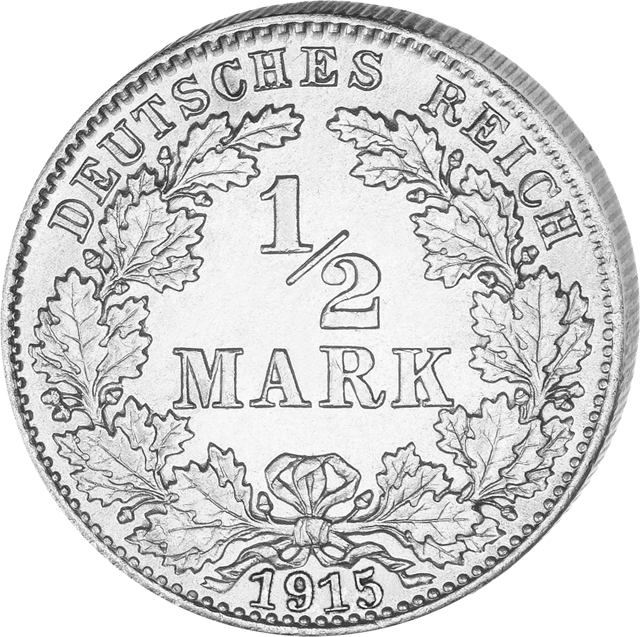
In the law the half mark is called the fifty-pfennig piece: 400 pieces from one kilogram of fine silver, so 2.5 grams of silver per piece.
The three-mark piece exists since a law of 1908. It took the place of the Vereinsthaler, prohibited since 1907, and holds 15 grams of fine silver.
Rentenmark and Reichsmark
The Reichsmark from 1924
The coinage act of 30 August 1924 introduced the Reichsmark; in October 1924 it came into circulation alongside the Rentenmark, one to one.
Our strikes
What our strikes take up
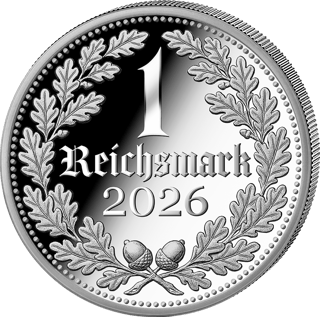
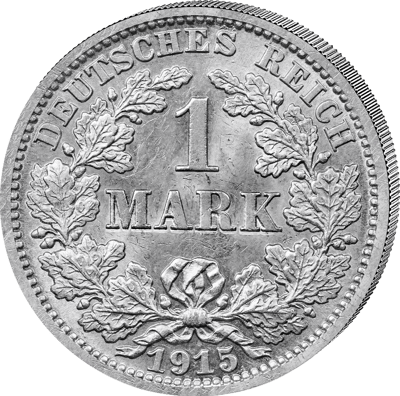
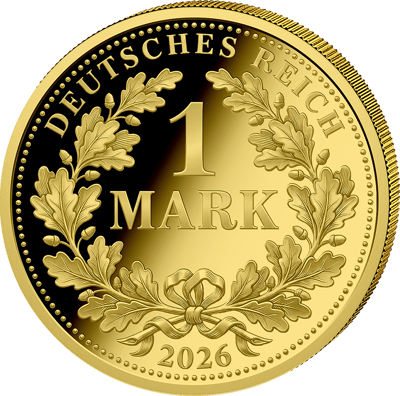
Our strikes bear the lettering 1 Reichsmark or 1 Mark in an oak wreath. They are newly struck, no Reichsmark of the past and no legal tender of the Reich.
At a glance
- Type
- Set of originals
- Era
- German Empire
- Ruler
- Wilhelm II, Nicholas II
- Metal
- Silver
- Number of pieces
- 2 pieces
- Contents
- 3 marks Prussia and 1 rouble
Details from our product data, the coinage acts and the photo. The year and mint mark of your piece may differ from the photo.

Original and new strike
On the left a mark from the German Empire, on the right our strike of 1/200 ounce of fine gold, which takes up DEUTSCHES REICH and 1 MARK in an oak wreath.
One was money throughout the Reich, the other is newly struck: two pieces, one image.
Two rulers, two silver coins – a world shattered
He called him "Nicky", and the other in turn wrote to "Willy": Kaiser Wilhelm II and Tsar Nicholas II addressed each other informally in their dispatches like close relatives. And that is exactly what they were – yet from August 1914 their empires faced each other as enemies. This set brings both men together in a way that history itself only ever permitted on paper: as an original from the German Empire and as a silver ruble of the last Tsar.
The set at a glance
You receive two historic silver coins that were once genuine legal tender – not modern restrikes, but circulated witnesses to their time made of 900 coin silver, weighing around 36.7 g together.
- 1 x 1 ruble silver, Tsar Nicholas II – minted between 1895 and 1915, fineness 900/1000, gross weight 20.00 g, fine weight 18.00 g, diameter approx. 33.65 mm, edge with inscription.
- 1 x 3 mark silver coin, Prussia, Wilhelm II – German Empire, various years of issue, fineness 900/1000, gross weight 16.667 g, fine weight 15.00 g, diameter 33 mm, edge lettering "GOTT MIT UNS".
Grade of preservation, year of minting, mint mark and reverse variant differ from piece to piece for both coins. This means you are securing not one but two classics that belong in almost every collection on the theme of the First World War.
The silver ruble of the last Tsar
The obverse shows Nicholas II in profile facing left, surrounded by the Cyrillic legend identifying him as Emperor and Autocrat of all the Russias. On the reverse, the crowned double-headed eagle of the Romanovs spreads its wings, with the face value and year of minting below. The edge states the silver content in the old Russian unit of weight, the zolotnik. Nicholas II ascended the throne in 1894; his rubles are among the very last circulating coins of the Tsarist Empire.
The 3 mark from the Kingdom of Prussia
Its counterpart bears the portrait of Wilhelm II facing right with the legend "WILHELM II DEUTSCHER KAISER KÖNIG V. PREUSSEN". The reverse shows the large crowned imperial eagle with a coat of arms on its breast, along with "DEUTSCHES REICH" and the face value "DREI MARK". The three-mark denomination replaced the old Vereinstaler in 1908 – these coins are today among the best-known silver coins of the German Empire. The majority were struck at the Berlin mint, identifiable by the mint mark A.
"Willy" and "Nicky" – relatives on the brink
Both monarchs were closely connected through Europe's royal houses. Wilhelm II was a grandson of the British Queen Victoria, as was Nicholas's wife Alexandra – making the German Kaiser related to the Tsar almost like a cousin by marriage, in addition to older dynastic ties between the Hohenzollerns and the Romanovs. They had known each other since youth: mutual honorary ranks, uniforms, yacht visits, confidences.
During the July Crisis of 1914, telegrams went back and forth between them that would become famous as the "Willy–Nicky correspondence". Two relatives who still tried to prevent the war – in vain. Both their reigns ended in 1918: Nicholas II was murdered along with his family in July, while Wilhelm II abdicated in November and went into exile in the Netherlands. Two thrones, two dynasties, an entire era – extinguished within a matter of months.
Two coins that passed through pockets in the very same years – and whose rulers shared the very same downfall.
Traces of circulation: why your coin is a one-of-a-kind piece
These pieces were circulated legal tender and bear corresponding traces: darker patina, individual centring, nicks, wear, and in places weaker areas of the legend. This is precisely what gives them their charm. Since the year of minting, mint mark and reverse variant can vary, the piece you receive will differ from the illustration – you are getting an original, not a mass-produced item. We therefore ask for your understanding that the image shown in the shop serves as an example and may differ individually from the item delivered in terms of appearance and condition due to historical circumstances.
Silver: a tangible asset with history
Silver has been a coinage metal, medium of trade and symbol of wealth and prestige for thousands of years. Unlike fiat money, whose purchasing power depends on trust in governments, silver possesses an intrinsic value rooted in its physical properties. It is durable, tradeable worldwide as a commodity, and highly liquid.
- Tax advantage: Profits from the sale of silver are generally tax-free provided the holding period is at least one year.
- Industrial demand: Electronics, solar and medical technology continuously consume silver; new technologies can further support demand.
- Limited supply: Availability is finite – an argument in favour of long-term value stability.
- Protection against crises and inflation: As a tangible asset, silver serves as a hedge against political and economic upheaval.
- Divisibility: Small denominations are well suited as a means of exchange for manageable transactions.
Historic circulation coins combine this tangible-asset appeal with numismatic fascination. Anyone wishing to pass on wealth across generations will find here a tangible building block for retirement provision – with a silver content that no printing press can dilute.
For collectors and lovers of tangible assets
Compared with modern bullion coins, this set is not a pure weight product. The ruble weighs noticeably more than the 3-mark piece, yet both share a fineness of 900/1000 and a similarly large format of around 33 mm. Anyone who collects strictly by troy ounce will more likely reach for modern issues – anyone who wants to hold history in their hand receives here two originals that no modern die can replace. As a gift for history enthusiasts, as an introduction to the numismatics of the German and Tsarist Empires, or as a small tangible-asset building block: this set tells a story that could hardly be more dramatic.
Product depiction may differ from the final product.
