





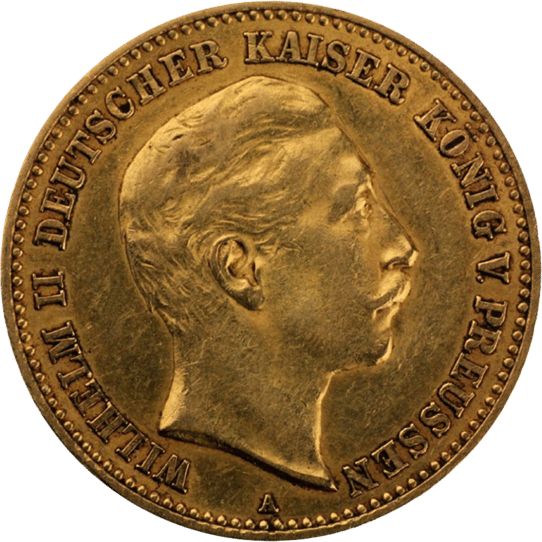


10 Mark Prussia Wilhelm II Gold Coin
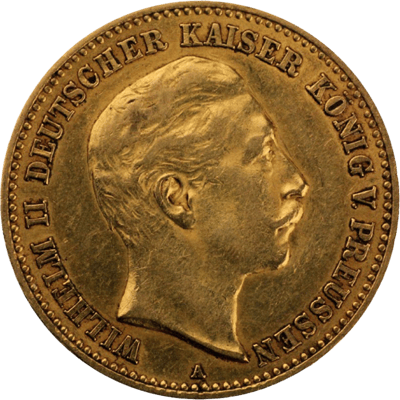













- Last Emperor: House of Hohenzollern
- Fine weight: 3.58 g pure gold
- Historic witness: popular among collectors
- Last EmperorPortrait of the last German emperor of the empire
- Fine weightFineness 900/1,000 and proven protection in times of crisis
- Historic witnessEvery coin carries a piece of German history within it
 Price alert
  Share
Share
Original from the German Empire · Wilhelm II
What a mark had to bear
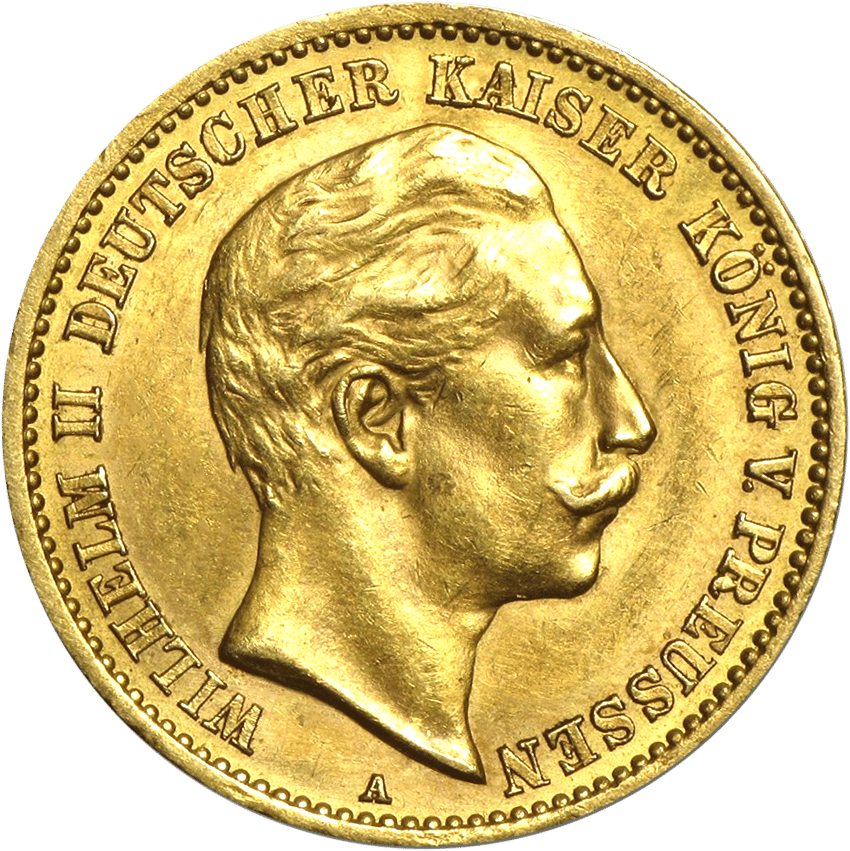

10 marks Prussia, Wilhelm II, obverse with the portrait
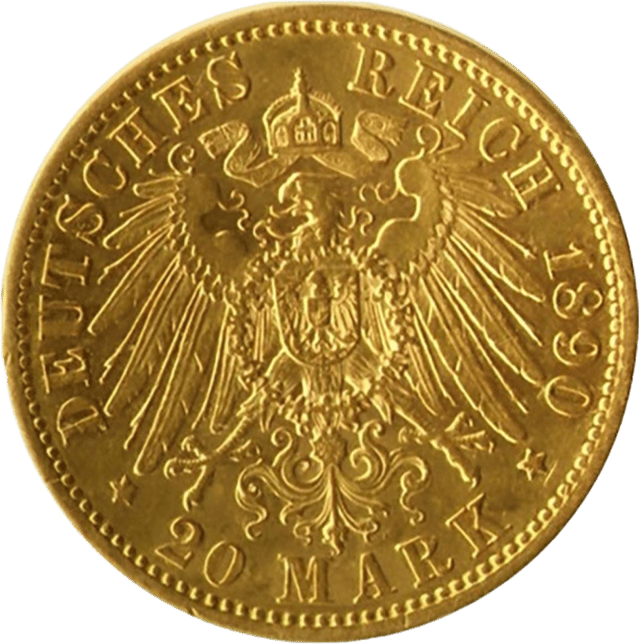
Value, year, imperial eagle and a letter for the mint: all of this was laid down by law. A piece of 10 marks weighs 3.98 g, of which 3.58 g is fine gold.
What the law prescribes
Eagle, value, year and a portrait
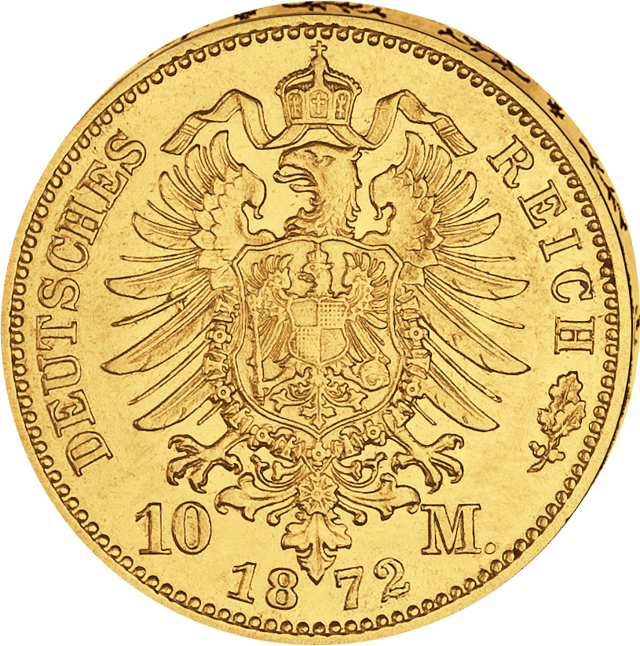
For every gold coin of the Reich, the law of 1871 laid down what it bears:
“The imperial gold coins bear on one side the imperial eagle with the inscription ‘Deutsches Reich’ and the statement of the value in marks, as well as the year of striking, on the other side the portrait of the sovereign, or the emblem of the free cities, with a corresponding legend and the mint mark.”
The Münzkabinett Berlin calls the side with the sovereign the obverse and the side with the eagle the reverse. The mint mark is the letter of the mint.

LegendThe legend above the portrait

ReichThe word REICH above the eagle
ValueThe value below the eagle
The mint mark
A letter tells where it was struck
The law prescribes a mint mark for every gold coin: a letter that names the mint. A stands for Berlin, J for Hamburg, F for Stuttgart.
“Below, the mint mark J for Hamburg.”
The photo of this piece shows a A. As it comes from different years, your piece may bear another letter.

The gold of the mark
How heavy the gold had to be
The law of 1871 counted in pounds of fine gold, the pound at 500 grams:
“Imperial gold coins of 20 marks, of which 69¾ pieces are struck from one pound of fine gold.”
In other words: one pound of fine gold yields 69¾ pieces of 20 marks.
Fineness 900/1,000 means: of a thousand parts, nine hundred are pure gold.
Officially the ten-mark piece was called the crown and the twenty-mark piece the double crown, as a decree for the imperial authorities laid down in 1875. It never caught on, the Münzkabinett Berlin notes.
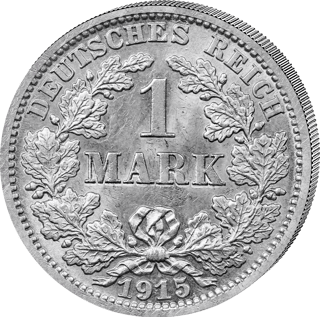
The mark in silver
The silver mark in the hand
A mark holds 5 grams of fine silver, 900/1,000, and measures 24 millimetres. No one had to accept silver coins for amounts over 20 marks.
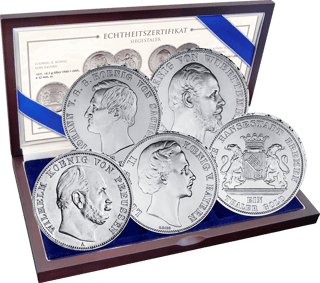
Commemorative coins
Thalers that commemorate
The Victory Thaler of 1871 from Prussia is a commemorative coin in silver. The law of 1871 allowed large silver coins for the time being only as commemorative coins, until the end of 1873.
Rentenmark and Reichsmark
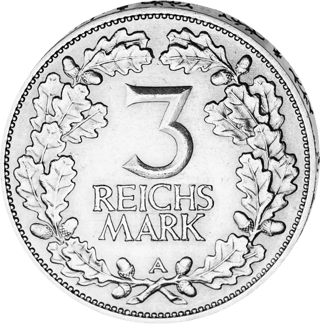
The Reichsmark from 1924
The coinage act of 30 August 1924 introduced the Reichsmark; in October 1924 it came into circulation alongside the Rentenmark, one to one.
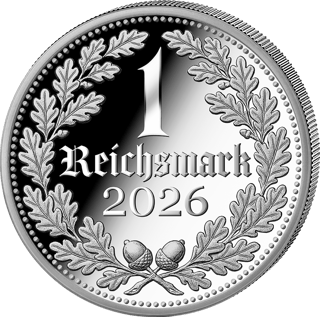
Our strikes
What our strikes take up
Our strikes bear the lettering 1 Reichsmark or 1 Mark in an oak wreath. They are newly struck, no Reichsmark of the past and no legal tender of the Reich.
At a glance
- Type
- Original
- Era
- German Empire
- Ruler
- Wilhelm II
- Face value
- 10 marks
- Metal
- Gold
- Fineness
- 900/1,000
- Gross weight
- 3.98 g
- Fine weight
- 3.58 g
- Diameter
- 19.5 mm
- Packaging
- Coin capsule
Gross weight: the weight of the whole coin. Fine weight: the pure metal in it. Fineness: its share in thousandths.
Details from our product data, the coinage acts and the photo. The year and mint mark of your piece may differ from the photo.

Original and new strike
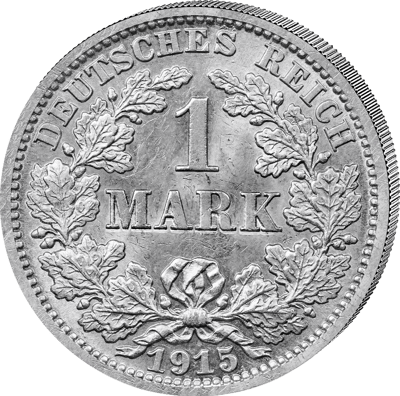
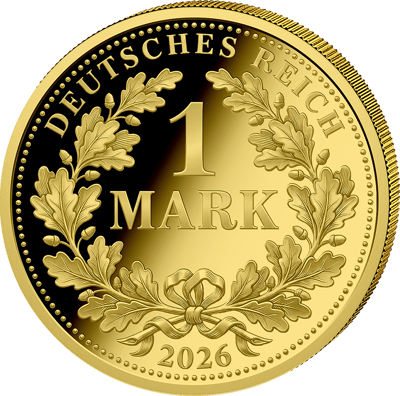
On the left a mark from the German Empire, on the right our strike of 1/200 ounce of fine gold, which takes up DEUTSCHES REICH and 1 MARK in an oak wreath.
One was money throughout the Reich, the other is newly struck: two pieces, one image.
10 Mark Preußen Wilhelm II Goldmünze
Eine Münze, die nicht nur für Numismatiker interessant sein dürfte, sondern auch ein hervorragender Krisenschutz ist. Wie bei kaiserlichen Münzen üblich, ist dieser das Hauptmotiv der Münze. Umrandet wird das Portrait von dem Schriftzug “ Wilhelm II Deutscher Kaiser König von Preußen“.
Wilhelm II war der letzte deutsche Kaiser, seine Regierungszeit war von 1888 bis 1918. Als Enkel von Wilhelm I stammt auch er aus dem Adelsgeschlecht der Hohenzollern. Als 29-jähriger folgte er seinem Vater Friedrich III. im Dreikaiserjahr auf den Thron. In den 30 Jahren seiner Regierungszeit zeigte er wenig Verständnis für die Form der konstitutionellen Monarchie, sondern vertrat die Auffassung einer traditionellen Monarchie. Am Anfang seiner Regentschaft setzte sich Wilhelm II stark für die Sozialpolitik und den Arbeiterschutz ein. Zeitgleich forcierte er aber auch einen starken Ausbau der kaiserlichen Marine, welches eng mit der von Ihm geführten Weltpolitik ein her ging.
Mit der Niederlage des Ersten Weltkrieges war auch die Regierungszeit für Wilhelm II vorbei. Nach der Novemberrevolution verkündete Reichskanzler Max von Baden am 9 November 1918 die Abdankung des Kaisers. Seit Ende Oktober 1918 lebet Wilhelm II im belgischen Spa, von dort ging er in die Niederlande ins Exil, wo er auch 1941 starb.
Dennoch sind die Goldmünzen aus dem Kaiserreich sehr beliebt bei Anlegern und auch bei Sammlern, denn aufgrund des Alters der Münzen verbindet sich mit jeder Münze ein Teil der Geschichte.
Abschließender Hinweis:
Aufgrund des Alters dieser Münzen sind die Erhaltungszustände von einander abweichend und bei numismatischen Münzen kein Reklamationsgrund.
Product depiction may differ from the final product.
