





The Gold Crowns of the Glücksburgs — 3 Danish Kings in Gold (Christian IX · Frederik VIII · Christian X)











 Collector coin: Especially interesting for collectors
- Shipping costs: Free shipping within Germany available
- Secure shipping: 100% insured & anonymous delivery
 Price alert
  Share
ShareThree Kings, One House: The Gold Crowns of the Glücksburgs
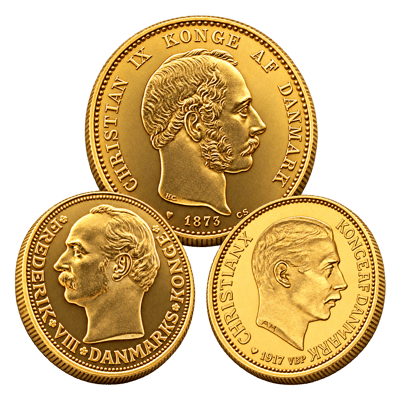
Grandfather, son, grandson. With this set you hold three generations of Danish royal history in your hand, each as a 20 Kroner gold coin from Denmark. Christian IX, Frederik VIII and Christian X represent roughly seven decades during which the House of Schleswig-Holstein-Sonderburg-Glücksburg steered the fate of the country. Their descendants still sit on the Danish throne today.
All three gold coins come from the mint in Copenhagen, recognizable by the small heart as a mint mark. They were issued as perfectly ordinary legal tender. This means it is genuine circulation gold from the era of the classical gold standard, and whoever owns these coins today owns a piece of that period.
What's included in the set
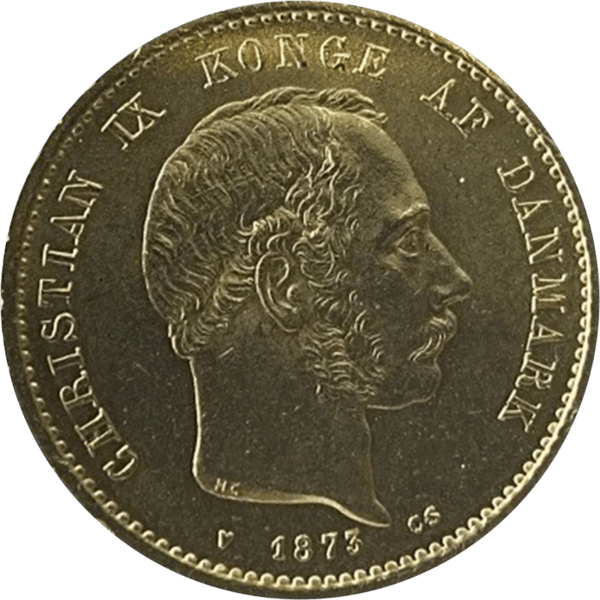
- 1x 20 Kroner Christian IX Denmark, minted 1873–1900
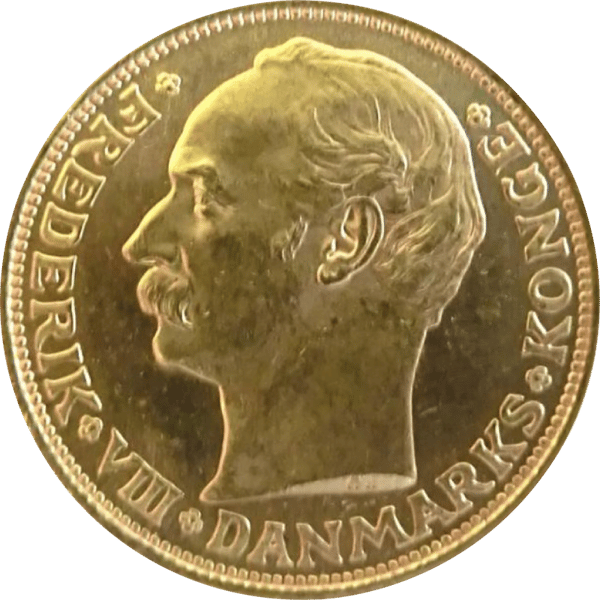
- 1x 20 Kroner Frederik VIII Denmark, minted 1908–1912
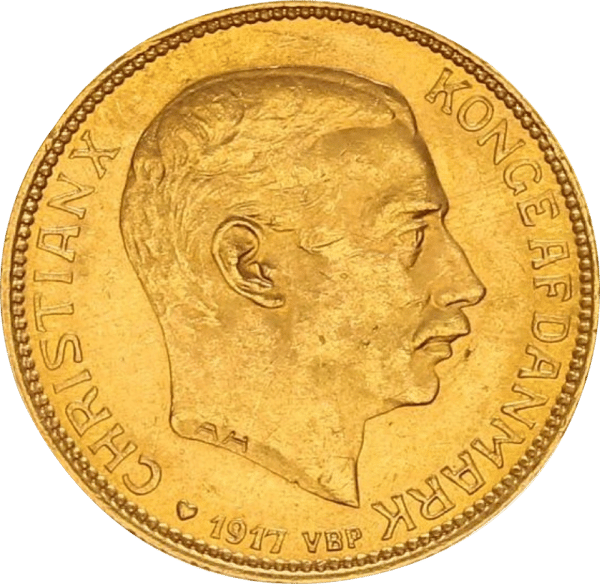
- 1x 20 Kroner Christian X Denmark, minted 1913–1931
Each individual coin contains 8.06 g of fine gold. Together the set adds up to a fine weight of 24.18 g, with a gross weight of 26.87 g. Because the crowns were minted over several years, the years of issue may vary within the periods stated.
The kings in portrait
Christian IX, the "Father-in-Law of Europe"
With Christian IX, the first Glücksburg ascended the Danish throne in 1863. His children married into the great houses of Europe. Daughter Alexandra became Queen of Great Britain, Dagmar became Tsarina of Russia, and son Wilhelm ascended the Greek throne as George I. This is where his nickname "Father-in-Law of Europe" comes from. The obverse shows his bearded profile with the legend CHRISTIAN IX KONGE AF DANMARK, designed by Harald Conradsen (signature HC). On the reverse sits a female figure with a scepter next to the coat of arms bearing the Danish lions. At her feet lies a dolphin as a symbol of Denmark as a seafaring nation.
Frederik VIII, the king with the short minting window
Frederik VIII did not become king until the age of 62. He reigned from 1906 to 1912 and was regarded as a liberal monarch who was sympathetic to the parliamentary system. His son Carl became King Haakon VII of Norway. Accordingly, the minting period of his gold crown is short: only 1908 to 1912. The leftward-facing portrait with the legend FREDERIK VIII DANMARKS KONGE was created by Gunnar Jensen. The reverse shows the crowned great coat of arms of Denmark, framed by a mantle of arms.
Christian X, the king of the crisis years
Christian X reigned from 1912 to 1947 and led his country through two world wars. His gold coins were minted between 1913 and 1931. They mark the conclusion of Danish gold crowns intended for circulation. The slender profile was created by Andreas Hansen (AH), surrounded by the inscription CHRISTIAN X KONGE AF DANMARK. Here too, the reverse shows the crowned coat of arms, below which is the denomination 20 KRONER.
Technical data at a glance
- Quantity: 3 gold coins
- Face value per coin: 20 Kroner (Danish: Kroner)
- Fineness: 900/1000 gold (21.6 carat)
- Fine weight per coin: 8.06 g
- Total fine weight: 24.18 g (just under 0.78 ounces)
- Total gross weight: 26.87 g
- Diameter per coin: 23 mm
- Mint: Copenhagen (heart as mint mark)
Gold for three countries: the Scandinavian Monetary Union
In 1873, Denmark and Sweden agreed on a joint gold currency. Norway joined in 1875. The krone, divided into 100 øre, replaced the old rigsdaler, and the size, weight and alloy of the gold coins were standardized. As a result, Danish, Swedish and Norwegian 20 kroner coins were considered legal tender in all three countries. The gold crowns are thus witnesses to an early European monetary union. Their value was tied to the metal, and that has outlasted many paper currencies.
Gold is humanity's oldest currency. These three crowns have survived kings, wars and currency reforms, and their gold content has remained the same.
Why a trio instead of three single coins?
- A complete lineage: Grandfather, son and grandson together tell a continuous dynastic story.
- Three different visual worlds: an allegory with a dolphin for Christian IX, state coats of arms for Frederik VIII and Christian X, plus three portraits by three different artists.
- Small units: Each coin can be sold individually if needed, without having to part with all the gold at once.
For investors and collectors
The Danish crowns are among the best-known historical gold coins in Europe. With 8.06 g of fine gold, each 20 Kroner coin contains more gold than a British Sovereign (7.32 g) or a Swiss Vreneli (5.81 g). They are typically traded close to the gold price. This appeals to investors who value manageable, easily tradable denominations, for example to hedge against inflation or prepare for times of crisis.
Anyone focused purely on gold content can obtain it at a somewhat lower premium with modern bullion coins or small gold bars. In return, this set offers something a bar cannot: a complete royal lineage that fits together numismatically. It makes an ideal gift, the start of a Scandinavian collection, or a stylish way to hold wealth in gold.
Would you like to buy these gold coins? At Kettner Edelmetalle, you can get the gold crowns of the Glücksburgs as a carefully assembled trio: three kings from one house, in genuine gold.
Product depiction may differ from the final product.
