





Bronze Follis Emperor Maximinus II (305-313 AD | Last Official Pharaoh)
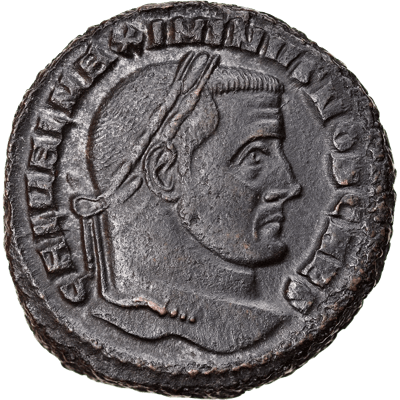
- Genuine Original: over 1,700 years old
- Emperor's Portrait: clearly visible without a magnifier
- Silver Wash: bright sheen on patina
- Genuine OriginalNo restrike, but real money from everyday Roman life
- Emperor's PortraitLaurel wreath, hair and beard are finely detailed
- Silver WashBright highlights shimmer over dark, natural patina











- Genuine Original: over 1,700 years old
- Emperor's Portrait: clearly visible without a magnifier
- Silver Wash: bright sheen on patina
 Price alert
  Share
ShareThe Last Pharaoh Wore a Laurel Wreath
Over 1,700 years old. Struck by hand, passed on by hundreds of hands, at some point lost, buried, forgotten – and today back in circulation. The Follis of Emperor Maximinus II is not a restrike or a commemorative piece, but a genuine Roman coin from the era of the Tetrarchy. Whoever holds it in their hand is holding money that was actually spent within the Roman Empire: at markets, in barracks, in port cities between Asia Minor and Egypt.
Maximinus II Daia – Tetrarch, Augustus and the Last Pharaoh Attested in Hieroglyphs
Gaius Galerius Valerius Maximinus, known in numismatics mostly as Maximinus II or Maximinus Daia, did not come from a great family. He rose through the ranks of the Roman army, was adopted by his uncle Galerius, and was raised to the rank of Caesar in May 305. From 311 onward he ruled the eastern part of the Empire as Augustus. In August 313 he died in Tarsus, following his defeat against his rival Licinius.
What is truly fascinating, however, is found not in Roman history but in Egyptian history: Maximinus Daia is the last Roman emperor to be titled and recorded as pharaoh in the Egyptian king lists – the last ruler of Egypt attested in hieroglyphs. With him ends a line that reaches back to predynastic times. Three millennia of pharaonic rule close with the man whose portrait you see before you here. An emperor who also attempted to establish the cult of Serapis as the state religion – the old world resisting once more, one last time.
The Follis: Rome's Answer to Inflation
Around 294, as part of his currency reform, Emperor Diocletian introduced a new denomination intended to counter debasement and inflation: the Follis. It became the most important copper coin of the Roman Empire. It was struck at 1/32 of a Roman pound – roughly 10 grams – from bronze with a thin silver coating, the so-called silver wash. The diameter initially measured 27 to 30 millimeters. Incidentally, the ancient name of the coin is not definitively established; numismatists assume it was originally simply called Nummus.
It is precisely this silver wash that creates the visual appeal. On many examples, the raised areas still shimmer bright and silvery, while dark patina has gathered in the recesses. The name "Follis" (plural: Folles) means "bag" or "purse" and presumably derives from sealed money bags containing a fixed, pre-counted amount of coins. Over the course of the Tetrarchy, the weight and diameter of the Folles were reduced several times – the pieces offered here date from this phase.
Technical Specifications at a Glance
Denomination: Follis
Gross weight: approx. 7 g
Diameter: 20–24 mm
Material: bronze or billon (copper alloy, historically with silver wash)
Year of issue: various, reign 305–313 AD
Country of origin: Roman Empire
Investment type: coin – collector's item
Condition: circulated coin, condition varies
Series: History
Shipping: as insured value shipment
Obverse and Reverse: What You See on the Coin
The obverse shows the emperor in profile facing right, crowned with a laurel wreath, with short, finely combed hair and a hint of a beard. The laurel wreath is finely worked with individual leaves and is held at the back of the neck by a ribbon with two curved ends. Below is an armored and draped bust, a strong neck, and a distinctive chin. The legend on the pictured example reads GAL VAL MAXIMINVS NOB CAES – Galerius Valerius Maximinus, Nobilissimus Caesar.
On the reverse appears the legend GENIO CAESARIS: the Genius, the guardian spirit, standing to the left, holding a sacrificial dish (patera) and a cornucopia. The exergue bears the mint mark ·HTB· for Heraclea, second officina. Other pieces carry different reverse types and mints – such as GENIO AVGVSTI or Jupiter types of the IOVI CONSERVATORI type. This variety is typical of the Tetrarchy and offers an additional appeal for collectors.
Condition: Signs of Circulation as a Mark of Authenticity
These pieces are genuine circulated currency and bear corresponding traces: darker patina, individual centering, nicks, wear, and in some cases weaker portions of the legend. This is precisely what makes them appealing. Since the year of issue, mint, and reverse variant may vary, the piece you receive will differ from the illustration – you receive an original, not a mass-produced item. Please understand that the image in the shop serves as an example and that, due to historical circumstances, the delivered item may individually differ in appearance and condition. Obverses and reverses may explicitly vary.
An ancient coin is not a smooth industrial product. The slightly irregular flan, the weak strike in the field, the small nick at the edge – these are the fingerprints of a workshop that closed its doors for the last time roughly 1,700 years ago.
Who This Follis Is Suited For
Newcomers to ancient numismatics: a large, well-legible imperial portrait from the Roman Empire
Collectors of the Tetrarchy: a fitting complement to Diocletian, Maximianus, Constantius, Galerius, Licinius and Constantinus
History enthusiasts: a tangible connection to the end of pharaonic rule and to Late Antiquity
Lovers of genuine tangible assets: an original coin that can be held, turned, and passed on – independent of any digital accounting system
Gift-givers: a year in which this piece changes hands will not be forgotten
Comparison: Follis, Denarius and Antoninianus
For centuries, the denarius was Rome's silver backbone – small in diameter, and increasingly debased in silver content over time. The antoninianus followed as a double denarius and likewise quickly lost fineness. The Follis, by contrast, relies on format: bulkier in flan, more sculptural in portraiture, and generally more legible in its legend. Anyone wishing to display an imperial portrait from antiquity without reaching for a magnifying glass will do excellently with a Follis. Silver denominations, on the other hand, score with their precious metal content. Both paths have their appeal – and most well-established collections combine them anyway.
History You Can Hold in Your Hand
Gold is humanity's oldest currency and has outlasted every paper currency. Coins like this Follis tell the other half of that story: they show what happens when rulers tamper with the weight and content of their money. Diocletian's reform was an attempt to restore lost trust. The Follis is the monument to that attempt – and thus far more than a piece of bronze. Secure an original from the reign of the last pharaoh while examples in attractive circulated condition are still available.
Product depiction may differ from the final product.
