
 280,000
  30 years
  Secure


5 Kopecks Tsarina Catherine the Great (1762-1796 | German Princess on the Tsar's Throne)













 Popular Product: Among the top 3 in category Asia
- Secure shipping: 100% insured & anonymous delivery
- Kettner Bullion: Already over 280,000 satisfied customers
 Price alert set
 share
share
Personal consultation
Get free advice from one of our precious metals experts - we look forward to your call!
Heavy Copper from the Tsarist Empire: 5 Kopeck Catherine the Great
Few coins tell so much history on such a small surface. The 5 kopeck coin of Tsarina Catherine II is a hefty piece of copper from the 18th century – circulating currency from the Tsarist Empire of Russia, ruled by a woman who was born a German princess and died as one of the most powerful rulers in Europe. Anyone who holds this original in their hand notices immediately: this is no dainty small change. This is metal with weight, edge, and history.
Catherine was born on 2 May 1729 as Sophie Auguste Friederike of Anhalt-Zerbst in what was then Prussian Stettin. In 1745 she married the Russian heir to the throne, Peter. In 1762, with the support of the military, she overthrew him and had herself proclaimed Tsarina. For 34 years, until her death in November 1796, she shaped the destiny of Russia; she was succeeded on the throne by her son Paul I. Under her rule, Russia grew into the leading power of Eastern Europe – and the copper coins of these years passed by the millions through the hands of peasants, soldiers, and merchants.
Monogram, Double-Headed Eagle, Net Edge: The Design in Detail
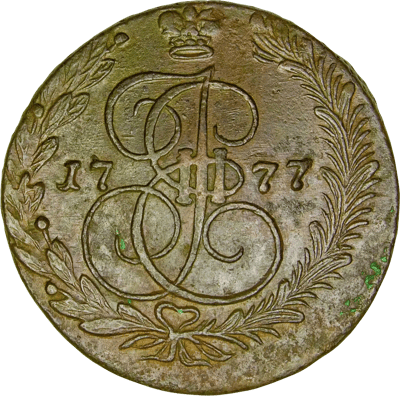
Obverse: the crowned monogram "E II" for Ekaterina II Imperatrix, framed by a laurel and palm branch, with the year split to the left and right of it.
Reverse: the crowned Russian double-headed eagle with sceptre and orb, the coat of arms on its breast, below it the curved lettering "ПЯТЬ КОПѢЕКЪ" – Five Kopecks.
Mint marks: depending on the mint, e.g. ЕМ (Yekaterinburg), ММ (Moscow), СПМ (St. Petersburg), КМ (Suzun), АМ (Anninsk), or ТМ (Tauride Mint).
Edge: characteristically net-shaped (reticulated) – a contemporary safeguard against coin clipping.
The pictured specimen bears the year 1777 and the mint mark ЕМ, meaning it originates from Yekaterinburg in the Urals. Delivery is mixed by year of issue: minting year, fine weight, and condition vary, as each piece is an original over two centuries old with its own history of circulation and its own patina.
Key Facts at a Glance
Face value: 5 kopecks (1 ruble equalled 100 kopecks)
Material: Copper
Gross weight: approx. 46 g
Diameter: approx. 42 to 46 mm, depending on mint and year of issue
Minting period: reign 1762–1796, copper five-kopeck coins of this type from 1763
Origin: Russia, Russian Empire
Series: Personalities – coin investment type, a distinct collector's product
Condition: These pieces are circulated legal tender and bear corresponding traces: dark bronze patina, individual centring, nicks, wear, and in some cases weaker areas of the lettering. This is precisely what makes them appealing. Since the year of minting, mint, and reverse variant vary, the specimen delivered will differ from the image shown – you receive an original, not a mass-produced item. Please understand that the image in the shop serves as an example and may differ individually from the delivered item in terms of appearance and condition.
With 18th-century coinage, dimensions and weight vary considerably from piece to piece. Numismatic catalogues list a standard weight of around 51 grams for this type and document tolerances of roughly 35 to 65 grams. It is precisely this irregularity that gives such originals their charm – no two specimens are entirely alike.
Why Collectors Seek Out This Coin
Mintage figures were enormous. In 1777 alone, over 37 million five-kopeck coins left the Yekaterinburg mint, and in other years there were even more than 50 million pieces. And yet fine specimens are by no means a given today: due to their high copper weight, a large portion of the stock was melted down over the centuries, and further pieces were literally worn down through hard everyday circulation. What remains is sought-after material for any collection on the Tsarist Empire of Russia.
Added to this is the appeal of the unusual. A copper coin with a diameter of a good four centimetres appears almost archaic next to modern issues. Anyone who already owns a silver ruble of the Tsars will find here the fitting counterpart from everyday life: the silver coin represented wealth, the heavy copper represented the market, the tavern, the carter's wage. Alongside small denominations such as the Denga or 1 kopeck, the five-kopeck coin is the tactile heavyweight of any album.
Copper: A Friendly Entry Point into Collecting
Copper coins and copper bars are, for many people, the first encounter with metal in collector and bar form. The material is accessible, and the variety of designs is enormous. In the USA, numerous copper rounds – that is, copper medallions – are struck with the most varied designs, from animal depictions and historical portraits to new interpretations of classic coin designs. Those who buy copper are generally classic collectors who enjoy building up their own collection piece by piece. Feel, sound, sharpness of strike, patina: with copper, one learns everything that later also helps in assessing gold and silver coinage.
Gold is humanity's oldest currency and has outlived every paper money experiment. Copper tells the other half of this story – that of everyday circulating money, with which people have lived, traded, and saved for centuries.
Who This Piece Is Suited For
Collectors value the 5 kopecks as a key piece of an entire era. Beginners get a robust, uncomplicated original that can be examined without any glove ceremony and yet still commands respect. As a tangible asset, the coin remains graspable: a real piece of metal with historical substance, independent of digital systems, unable to be deleted and not arbitrarily reproducible. For many buyers, this is precisely where the idea of wealth protection and crisis protection lies – precious metal in hand rather than mere figures on paper.
Whether as a gift for history enthusiasts, as a building block of a collection on the Russian Empire, or as one's very first historical large-format piece: the 5 kopecks of Catherine the Great unite German and Russian history in a single, heavy piece of copper. Shipping is, of course, carried out as insured value shipping.
Product depiction may differ from the final product.
