 280,000
  30 years
  Secure














 Special offer: Product is currently on sale
- Shipping costs: Free shipping within Germany available
- Secure shipping: 100% insured & anonymous delivery
 Price alert set
 share
share
Ancient Silver Tetradrachm of Longinus – A Minted Testament to the Ides of March
Some coins are pure investment. This one is world history you can hold in your hand. The ancient tetradrachm made of silver comes from Antioch, the glittering metropolis on the Orontes, and it bears the mark of the man who became the strategic mastermind behind one of the world's most famous conspiracies: Gaius Cassius Longinus, born before 85 BC, fallen in 42 BC at Philippi. Around 15.5 grams of high-quality coin silver, over two thousand years old – and each specimen a unique piece.
The Man Behind the Coin: Gaius Cassius Longinus
His military rise began in 53 BC. In the war against the Parthians, he marched into battle alongside Marcus Licinius Crassus. After the devastating defeat at Carrhae, Longinus saved the remnants of the Roman army, led them back to Antioch, and successfully defended the province of Syria – a daring feat that no one in Rome ever forgot. After being appointed praetor and later senator, he always acted prudently and with great political skill.
When the Republic Was at Stake
After Gaius Julius Caesar was elevated to "Dictator perpetuus", dictator for life, Longinus saw it as his duty to save the Republic, escape tyranny, and restore the old republican order. He convinced skeptics. He acted out of pragmatic, political calculation. Yet one piece of his advice was overruled: the conspirators spared Marcus Antonius, Caesar's close confidant. This turned the expected joy among the people into mourning – and forced Longinus and Brutus to flee to the east of Rome, where they raised a large army. In 42 BC, the decisive Battle of Philippi took place in Macedonia against the Caesarians Marcus Antonius and Octavian. When Longinus lost the wing battle against Antonius and mistakenly believed Brutus had fallen, he took his own life.
Design and Minting: Zeus Nikephoros over the Orontes
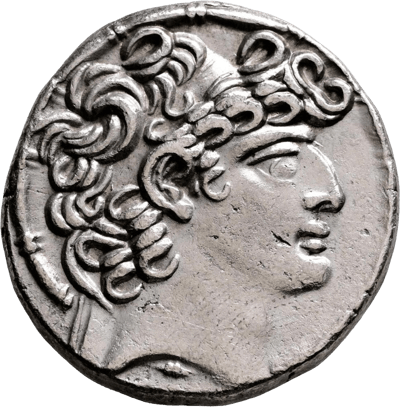
The obverse shows the head of the Seleucid king Philip I Philadelphus with diadem and elaborately curled hair. The reverse presents the enthroned Zeus Nikephoros holding Nike and a long scepter, framed by a wreath and the Greek legend ΒΑΣΙΛΕΩΣ ΦΙΛΙΠΠΟΥ ΕΠΙΦΑΝΟΥΣ ΦΙΛΑΔΕΛΦΟΥ. The Romans simply continued minting this coin type, familiar throughout the entire eastern part of the ancient world, in Antioch – the responsible officials merely added their monogram. This is precisely why specimens of this series bear the signature of Longinus, while dies, mint marks, and years of issue vary. No two pieces are alike.
Technical Data at a Glance
- Precious metal: Silver, fineness 950–980/1,000
- Gross and fine weight: approx. 15.5 g
- Face value: 4 drachmas (one tetradrachm)
- Diameter: 30–35 mm
- Country of origin: Antioch
- Year of issue and manufacturer: various ancient dies
- Condition: circulated coin, bank-standard grade
- Packaging: in a velvet pouch, shipped as insured value shipment
Why Ancient Coin Silver Delights Collectors and Investors
- Double appeal: This piece combines the material value of the precious metal with numismatic collector's history.
- Tax advantage: Profits from the sale of silver are generally tax-free, provided the holding period is at least one year.
- Substance instead of promises: Unlike fiat money, which relies on trust in governments, silver possesses an intrinsic value derived from its physical properties – and enjoys high demand in electronics, solar, and medical technology.
- Scarcity: Availability is limited, the supply finite.
- Longevity: This coin has endured for 2,000 years. Silver retains its properties across generations – ideal for passing on wealth.
Historically, silver has always been money: a medium of exchange in small transactions, a symbol of wealth and prestige, the backbone of entire trading regions. This role makes classic silver coins just as interesting today – as a building block for inflation hedging, for crisis protection, and for broad diversification of one's own holdings. Gold is humanity's oldest currency and has outlived all others; silver has accompanied it since the days of Athens as the money of everyday life.
In Comparison: Longinus, the Athenian Owl, and Alexander the Great
The famous tetradrachm from Attica with the head of Athena and the owl is the classic among the great Greek silver coins, but is usually traded at a high price. Tetradrachms with Herakles and the enthroned Zeus, minted in the name of Alexander the Great, are likewise highly sought after. The Antioch minting with the monogram of Longinus, by contrast, scores with a tangible, precisely datable historical moment – the fall of the Roman Republic. Anyone building a collection on the Roman civil war period will find a key piece here; anyone starting a collection of ancient silver coins gains great historical significance for manageable capital.
Whoever holds this coin in their hand holds silver that has outlasted the Ides of March – and that draws its value not from a promise, but from its substance.
A note on condition: as a circulated coin, each specimen shows traces of 2,000 years of monetary history. It is precisely this patina, the slight variations in minting, and the individual mint marks that define the character of this collector's coin. Design, die, and preservation may therefore differ from the piece shown.
Product depiction may differ from the final product.
