
 280,000
  30 years
  Secure


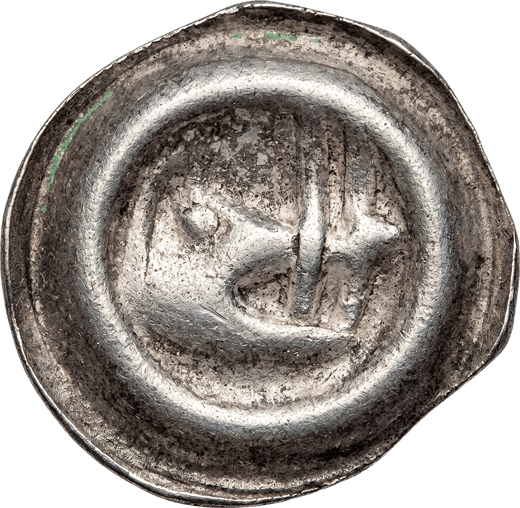


Silver Hollow Penny Boar with Tusks (14th-15th Century | Silesian Trade Coin of the Middle Ages)












 Popular Product: Among the top 3 in category Germany
- Collector coin: Especially interesting for collectors
- Secure shipping: 100% insured & anonymous delivery
 Price alert set
 share
share
Personal consultation
Get free advice from one of our precious metals experts - we look forward to your call!
Silver Bracteate "Boar with Tusks" – Trade Money from Medieval Silesia
A wafer-thin flake of silver, just 13.5 mm in diameter and weighing around 0.2 grams. Nothing more was needed. This unassuming little disc was genuine money in the 14th and 15th centuries – everyday currency used in Silesian markets to pay for cloth, grain, beer, and cartage fees. The bracteate featuring a boldly stylized boar with its distinctive tusks is among the most characteristic small coins of the Holy Roman Empire of the German Nation. Whoever holds it between their fingers holds a piece of European economic history.
The Boar: Heraldic Animal of a Wealthy Trading City
The coin's design is archaic and unmistakable: a boar in profile, its tusks prominently protruding, framed by a sturdy beaded border. Numismatically, this type is attributed to the Lower Silesian region around Schweidnitz (present-day Świdnica). And that makes sense. Schweidnitz was, after Breslau, the second most important trading center in Silesia; the citizens' most important homegrown product was beer, which was exported as far as Poland, Hungary, and Russia. The city belonged to the Duchy of Schweidnitz-Jauer, which remained independent for a long time under Duke Bolko II and only finally fell to the Bohemian crown in 1392 – to the House of Luxembourg, from which Emperor Charles IV himself descended. In 1425, King Ladislaus Posthumus granted the city a coat of arms featuring a griffin, a boar, and the Bohemian crown. The boar thus accompanied this trading city across the centuries.
What Is a Bracteate? The Technique of the Hollow Penny
The term derives from the Latin bractea – thin metal sheet. Bracteates were struck on one side from thin silver sheet placed on a soft base: the blank was laid on a recessed mold and struck with a leather-covered die. The result is striking: the obverse shows the design in high relief, while the reverse remains hollow, displaying the same image as a mirrored negative. Hence the German name Hohlpfennig, or hollow coin.
From the mid-12th century into the 14th century, bracteates were the dominant coin type across almost the entire German-speaking region. The large early pieces measured 22 to 45 mm. By the late Middle Ages, they had shrunk considerably – our specimen, at 13.5 mm, belongs precisely to this later, small-format phase, quite similar to the hollow pennies from Hamburg or Magdeburg. The economic background is fascinating: in many regions, bracteates were regularly recalled, that is, declared invalid and exchanged for new coinage. In Magdeburg, this happened twice a year during the 12th century, often at a ratio of three new coins for four old ones. The retained fourth coin was the minting fee – frequently the sole tax revenue of the minting lord. Only the "Eternal Penny" (Ewiger Pfennig), introduced from 1413 onward, ended this practice and, with it, the era of the bracteate.
Key Facts at a Glance
- Precious metal: Silver (fineness historically variable)
- Denomination: Bracteate / Hohlpfennig
- Diameter: 13.5 mm
- Gross weight: approx. 0.2 g
- Minting period: 14th to 15th century
- Design: Boar with tusks
- Country of origin: Holy Roman Empire of the German Nation
- Investment type: Coin, collector's item from the "History" series
- Condition: Circulated (used), varying grades of preservation
On Condition: Not Flaws, but Biography
These pieces are circulated coinage – and they look the part. Darker patina, individual centering, small nicks, wear, and occasionally weaker sections of the legend: these are not flaws, but biography. Every trace stems from hands that, centuries ago, used them to settle payments for goods, freight, or debts.
Since the minting year, mint, and reverse variant may differ, the specimen delivered will differ from the illustration. Please understand the shop photo explicitly as a representative image: appearance, exact weight, and condition vary from piece to piece for historical reasons. You are acquiring an original.
Silver: The Monetary Metal of the Centuries
What makes this bracteate so compelling is not its size – it is its proof. As a coinage metal, silver has outlasted dynasties, duchies, and entire currency systems. The Duchy of Schweidnitz-Jauer has long since ceased to exist, and so has the medieval penny. But the metal itself has remained, unchanged in its physical properties, durable, and tradeable worldwide as a commodity. Gold is humanity's oldest currency and has outlived all others – silver, as its "little sister," has always walked this path alongside it.
A coin that has survived over 500 years of circulation, wars, and currency reforms needs no state guarantee. It carries its value within the material itself.
Add to this the modern perspective on the metal: silver is industrially indispensable – in electronics, solar technology, and medical devices. Supply is limited, while demand from new technologies tends to grow. Physical silver possesses intrinsic value, whereas fiat money rests solely on trust in governments. This is precisely why investors value silver coins as a building block for inflation hedge and crisis protection – small denominations are also practical as a means of exchange in times of currency instability.
Who This Bracteate Is Suited For
- For history enthusiasts: a tangible original from the late Middle Ages, not a restrike and not a medal.
- For newcomers to numismatics: medieval originals are rarely as compactly accessible as with this type.
- For collectors of medieval coins: a meaningful addition alongside hollow pennies from Hamburg, Braunschweig, or Thuringia.
- For gift-givers: a present with a story to tell, carrying over 500 years of history.
- For preservers: a tangible asset that can be passed down through generations.
Tax Note
In Germany, profits from the sale of silver are generally tax-free provided a minimum holding period of one year is observed. For historical collector's coins, the margin scheme typically applies. Tax advice tailored to your personal situation is always recommended.
An Original That Breathes History
Compared to modern bullion coins such as a Maple Leaf or a silver Britannia, this bracteate is not a weight-based holding – 0.2 grams does not move any significant material value. Its appeal lies elsewhere: in its authenticity. While bullion coins are struck by the millions in fine silver, each of these hollow pennies is a unique piece with its own striking weaknesses, its own patina, its own history. The drawback: no standardized fineness, no certificate of minting year. The advantage: you are literally holding in your hands the money with which Silesian merchants conducted their business while Charles IV ruled in Prague. Secure your own specimen – each piece is historically unique.
Product depiction may differ from the final product.
