 280,000
  30 years
  Secure


1 Rupee Silver Queen Victoria Empress of India (1862-1876)













 Popular Product: Among the top 5 in category Asia
- Collector coin: Especially interesting for collectors
- Secure shipping: 100% insured & anonymous delivery
 Price alert set
 share
share
1 Rupee Silver Victoria – a piece of world history in your hand
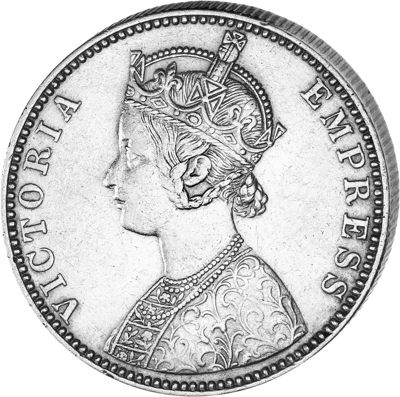
Hardly any circulation coin tells as much about the 19th century as the silver India rupee from the Victoria era. The crowned Queen looks to the left, her robe finely ornamented, above it the proud inscription. On the reverse, a lush wreath of flowers frames the simple denomination ONE RUPEE INDIA along with the year. This piece was real money: it traveled through bazaars, through harbor offices, from hand to hand, over decades. Today it is a sought-after collector's item – with real, globally traded silver value.
The technical data at a glance
- Face value: 1 Rupee, British Crown Colony of India
- Material: Silver, fineness 917/1000 – the old Indian standard of 11/12 silver
- Gross weight: 11.61 g · Fine weight: 10.637 g silver
- Diameter: catalog-typical around 30.8 mm, reeded edge
- Year of issue: various · Mints Calcutta (C), Bombay (B) and Madras (M)
- Condition: circulated coin, various grades of preservation
- Series: British Cult · Investment type coin · Collector's item
From "QUEEN" to "EMPRESS": a title change on the coin design
After the end of the East India Company's rule, India fell directly under the British Crown in 1858. From 1862, the new rupees appeared with the portrait of Victoria and the inscription VICTORIA QUEEN; the image goes back to the famous die engraver William Wyon. In 1876, the Parliament in London passed the Royal Titles Act, and on January 1, 1877, Victoria was ceremonially proclaimed Empress of India at the Delhi Durbar. From then on, EMPRESS appeared on the obverse – a small word by which collectors can instantly distinguish the two major types. Only after Victoria's death in 1901 did her son Edward VII take over the coin design as King and Emperor.
The rupee was far more than a colonial coin: as solid silver money, it circulated at times beyond India as well – in the Gulf, in East Africa, and until 1867 in the Straits Settlements. Whoever holds it in their hand holds genuine trade money of the British Empire.
Circulated coin: patina, nicks, character
Important to know: you receive a circulated means of payment, not a polished mass-produced product. These rupees bear the traces of their decades – darker patina, individual centering, small nicks, wear at the highest points of the relief, and sometimes weaker legend areas. This is exactly what makes them appealing.
- Year of issue, mint and reverse variant may vary
- The image in the shop is a sample image
- Each specimen is a historical original with its own biography
Please understand that the piece delivered may individually differ in appearance and condition. Historical circumstances cannot be standardized – nor should they be.
Why silver – and why this particular coin?
Silver has been a coinage metal, means of payment and status symbol for millennia. This rupee is proof of that. Silver is convincing not only historically: industrial demand from electronics, solar technology and medical technology is high, while the extractable supply is limited. Add to that the intrinsic value of the metal, which – unlike fiat money – does not depend on trust in governments. As a medium of exchange in small units, as an inflation hedge and as a building block for crisis protection, physical silver has held its role across generations. It is durable, always liquid, and can be passed on as a wealth component.
Gold is humanity's oldest currency and has outlived every paper currency. Silver was always its companion – the metal of everyday life, of trade, of the small purse.
In comparison: rupee, crown, dollar
Those who collect historical silver coins know the usual classics: Morgan Dollar, Austrian crowns, the mark of the German Empire. The Victoria rupee scores over many European pieces with its higher fineness of 917/1000 and its unmistakable duo of design elements – the ruler's portrait and the wreath of flowers. Compared to modern bullion coins such as Maple Leaf or Britannia, it lacks the neat troy ounce denomination – but it delivers something no new minting can offer: lived history, backed by around 10.6 grams of fine silver.
For collectors and investors
This coin is a classic entry point into the numismatics of the British Empire – significantly more affordable than gold, easily tradable, and pleasant to hold thanks to its format. Collectors appreciate the variety of years of issue, bust and reverse types as well as mints; investors appreciate the tangible material value that exists independently of paper promises. And a tax point that interests many: profits from the sale of silver are generally tax-free in Germany, provided the minimum holding period of one year is observed.
Whether in an album, in a coin frame, or as a small heirloom for the next generation: a Victoria rupee combines numismatic appeal with the sober tangible asset value of a precious metal that humanity has accepted as money for thousands of years.
Product depiction may differ from the final product.
