





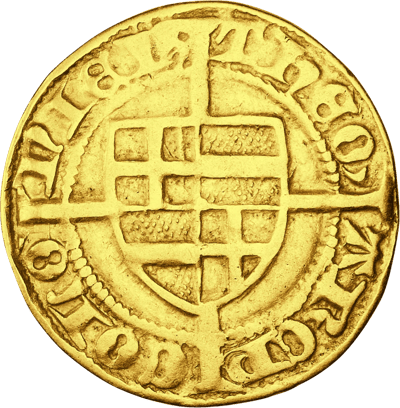
Gold Gulden Cologne City Coat of Arms (1371-1463 | Holy Roman Empire)
- Special offer: Product is currently on sale
- Secure shipping: 100% insured & anonymous delivery
- Special offerProduct is currently on sale
- Secure shipping100% insured & anonymous delivery







- Special offer: Product is currently on sale
- Secure shipping: 100% insured & anonymous delivery
 Price alert
 Share
Gold Gulden Cologne City Coat of Arms – Coin History from Medieval Cologne
- Minting quality: Deliberately not a modern Proof, but genuine, hand-struck circulation coinage with more than 560 years of history
- Design: Coat of arms shield with the Cologne cross, on the reverse the coats of arms of the Rhenish electors – varying depending on the issuing ruler and mint
- Material / Fineness: Gold with a fineness of 900/1,000, gross weight 3.9 g at 23 mm diameter
- Manufacturer: German minting facilities – the mints of the Archbishopric of Cologne, such as Bonn, Riehl or Deutz
- Era: Reign of the Archbishops Friedrich III of Saarwerden (1371–1414) and Dietrich II of Moers (1414–1463)
- Delivery: In a case, accompanied by a certificate of authenticity
Some gold coins are bought for their gold content. This one is bought because it is history you can hold in your hand. The gold gulden from Cologne was minted in the 14th and 15th centuries, at a time when the city on the Rhine was among the largest and wealthiest trading centers in the Holy Roman Empire of the German Nation. Merchants, princes and churchmen paid with coins exactly like this one. Today, a piece of this era lies in your hand.
Cologne, the Electors and the Rhenish Gulden
The fact that an archbishop was even allowed to mint gold coins was by no means a given. This right originally belonged to the German king and emperor. Cologne received its gold minting privilege on 26 November 1346, and the Golden Bull of 1356 ultimately secured the full minting right for all electors. On 8 June 1386, the four Rhenish electors – Friedrich III of Saarwerden for Cologne, as well as the lords of Trier, Mainz and the Palatinate – founded the Rhenish Mint Union.
Its joint gold coin, the Rhenish gulden ("florenus Rheni"), developed into the leading trade coin in the western part of the empire. Its model was the Florentine florin. Anyone moving larger sums at the time calculated in gulden. The Imperial Grand Chamberlain Konrad von Weinsberg summed it up in a 1426 memorandum:
"Item zu mercken, der do wandelt und zert, der muß allwegen golt haben."
Whoever travels and spends money always needs gold. A statement that, after 600 years, has lost none of its truth.
The Design: Coats of Arms, Cross and Electoral Union
The design of the Cologne gold gulden changed with the issuing ruler, mint and contractual status of the mint union. The example shown depicts a typical variant from the time of Dietrich II of Moers: a quartered Cologne/Moers coat of arms shield bearing the Cologne cross rests on a long cross, the arms of which break through the inscription. The reverse combines the coats of arms of the partners Mainz, Trier and Palatinate-Bavaria, arranged in a triangle around a crescent moon – a symbol of the mint union on the Rhine.
Other issues show the coat of arms shield within a trefoil, surrounded by the small coats of arms of the members, or on the obverse the cathedral patron Saint Peter with the key. It is precisely this diversity that makes collecting so appealing. Since each coin was individually struck by hammer, no two pieces are ever completely alike.
Circulated, Marked, Unmistakable
This gold coin was a form of currency actually in circulation. It passed through trading houses, customs stations and purses – and it shows. Typical features include:
- a darker patina that has developed over centuries
- an individual centering of the hand-guided strike
- nicks, wear and small traces of use
- in some cases, weaker-struck sections of the inscription
This is exactly what makes it so appealing. Since the year of minting, mint and reverse variant can vary, the item delivered may differ from the illustration. You receive an original, not a mass-produced product. Please understand that the image shown in the shop is an example and that, due to historical circumstances, the delivered item may individually differ in appearance and condition. Anyone expecting flawless mirror surfaces in Proof quality is looking in the wrong era – anyone looking for genuine history is in exactly the right place.
Gold Gulden, Florin or Modern Bullion Coin?
The comparison is worthwhile. Modern bullion coins such as the Krugerrand or the Vienna Philharmonic offer a lot of gold for the money invested and a price closely tied to the gold price. They are ideal when the metal alone is what matters. A medieval gold gulden, on the other hand, combines the gold value with numismatic added value: age, provenance and limited survival. As a result, its price lies noticeably above the pure material value, and condition plays an important role in its valuation.
Compared with the gulden from Mainz or Trier, the Cologne piece scores points with the brilliance of its city: Cologne was a Hanseatic city, seat of a powerful archbishopric, and one of the largest cities in the empire. While the florin and ducat originate from Italy, the Rhenish gulden is the typically German gold coin of the late Middle Ages.
Why Gold Has Enjoyed Trust for Millennia
Gold is the oldest currency in the world. Even in ancient Egypt it served as a measure in trade, and for over 6,000 years it has proven itself as a stable store of value. A value of zero? Gold has never had that, because it possesses an inherent, intrinsic value. Paper money can be multiplied at will, gold cannot. This scarcity makes it the classic inflation hedge and a reliable crisis protection in politically and economically turbulent times. It is not without reason that many call it God's money.
- Globally recognized, liquid and tradable at any time
- Protection against loss of purchasing power when confidence in fiat money wavers
- Central banks themselves rank among the largest gold holders in the world
- In Germany, profits from the sale are generally tax-free after a holding period of at least one year
- Ideal for passing on wealth and history to the next generation
Silver may be the little brother – gold has shone for millennia and will never lose that shine. The Cologne gold gulden is the best proof of this: it has outlasted emperors, electors and countless currencies. For collectors, it is a key piece of German coin history; for lovers of lasting value, it is a piece of gold with soul.
Product image may differ from the actual product.
